



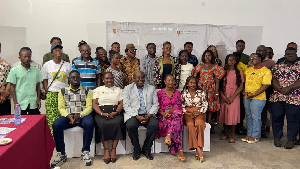
 Some of the stakeholders at the event
Governance experts and civil society actors have called on Ghana to strengthen accountability, inclusivity and citizen participation in order to maintain its reputation as a democratic anchor in West Africa.
The call was made during a programme organised by the Nyansa Institute on the theme, "How Can Ghana Be a Democratic Anchor for West Africa?" on June 26, 2026.
Speaking at the event, Executive Director of the Nyansa Institute, Samuel Koranteng Adjei, praised Ghana's democratic credentials, particularly its peaceful transfer of power and reliance on the judicial system to resolve electoral disputes.
"One government comes and another goes, and that is good for us. When we are not convinced with electoral outcomes, we are able to go to the courts, and the courts are able to stand firm and adjudicate. These are things other nations are looking for and can learn from Ghana," he said.
According to him, Ghana has demonstrated that it does not rely on street protests or military interventions to settle political disagreements.
"We might not agree on electoral outcomes, but we do not rely on street power or soldiers. We rely on our judicial system, and even parties that lose elections reluctantly accept the results and move on," he added.
However, Adjei noted that despite the country's democratic gains, there is a growing concern about the lack of accountability among elected leaders.
"It is apparent that we see our MPs and elected representatives almost every four years. When they come for our votes and depart to Parliament, we hardly get to see them again. Citizens need to engage their representatives and demand accountability," he stated.
Also speaking at the forum, Theodora Williams Anti, Executive Director of the Foundation for Security and Development Africa, stressed that democracy and security are inseparable.
"When you have democracy without security, you have a weak democracy, and when you have security without democracy, you have governance that is not legitimate. The two go hand in hand," she said.
She argued that insecurity weakens democratic systems and called for a more inclusive democracy that actively involves women, young people and other groups in society.
"We are doing well when it comes to electoral democracy because we vote every four years and can change governments. However, we are not practicing other aspects of democracy that strengthen human security, such as accountability and inclusiveness," she noted.
Anti lamented the low participation of women and young people in governance, saying the country has not built strong enough systems to encourage their involvement.
"We need to leverage the fact that seven out of ten Ghanaians still believe in democracy despite its challenges. We also need to strengthen civil society and encourage more citizens to participate actively in governance," she added.
On youth participation, Research Associate at the IMANI Centre for Policy and Education, Ransford Brobbey, said the debate should not focus on whether young people are ready to lead but rather whether the country has created opportunities and institutions that enable them to thrive.
"The problem is not whether young people are ready. The question should be whether there are opportunities, institutions and bridges in place for them to cross," he said.
He argued that various barriers continue to disadvantage young people despite examples from other countries where young leaders are taking up significant political roles.
Brobbey called for deliberate efforts to promote youth inclusion in national discussions and governance structures.
"If we are conscious about youth representation in the same way we are conscious about affirmative action and gender equality, then we can begin to bring more young people into the mainstream," he stated.
He also advocated greater decentralisation and fiscal autonomy for local assemblies, arguing that many developmental challenges at the community level stem from excessive centralisation.
Gunmen open fire on Sarah Adwoa Safo's vehicle - Reports
Inside the AI revolution that could save lives on Ghana's roads
'The wheels of justice will turn' - Haruna Iddrisu tells Ahmed Suale's family
AM

Copyright © 1994 - 2026 GhanaWeb. All rights reserved.










