



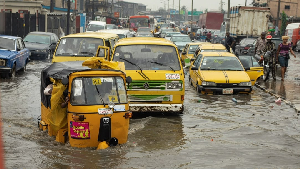
 Lagos grinds to a halt as 12-hour downpour triggers widespread flooding
Torrential rainfall lasting over 12 hours, yesterday, submerged property and roads in Lagos, bringing normal commercial activities and vehicular movement to a halt.
The downpour, which started on Sunday, reached a crescendo, leaving motorists and commuters stranded across the metropolis, while residents had to bail out stormwater from their homes to stay safe.
Parents and guardians, in panic mode, prevented their children and wards from going to school due to the severity of the downpour and possible risks.
Most of the areas heavily flooded include: Lagos-Oshodi Expressway, Abeokuta Expressway, by Oshodi bus stop, Lekki-Epe Expressway and environs, Victoria Island, Agege, Ikeja, Oworonsoki, Gbagada, Funsho Williams Avenue, formerly called Western Avenue, Iwaya area of Yaba, Lagos Mainland Local Government Area, and other coastal areas.
However, viral videos online monitored showed residents and motorists stuck in floods, sending SOS message to the state government for intervention.
Some were seen making jokes out of the situation, calling out the government over what they called failure to tackle the menace of perennial flooding in the state.
As of 11 am yesterday, the flood had taken over the bridge linking Ojota to Maryland, along Ikorodu Road, leaving vehicles stranded in the flood.
Checks by Vanguard revealed that areas such as Lekki, Oshodi and environs were heavily flooded, submerged buildings and kept vehicles floating in stormwater.
Many business offices and stalls were seen under lock and key, while bus stops were scanty as commuters took shelter at available sheds around.
The downpour, which later subsided around 2 pm, left in its wake gridlocks across highways and residents trapped at home.
The heavy rainfall that lasted several hours left several parts of Lagos, including Ikorodu Road, Yaba, Ikeja and Oyingbo, submerged, causing severe traffic congestion, disrupting commercial activities and leaving thousands of commuters stranded.
The downpour overwhelmed drainage channels in many low-lying areas, with flood waters covering major roads and forcing motorists to abandon vehicles or seek alternative routes. Pedestrians were seen wading through knee-deep water in an effort to reach their workplaces, schools and other destinations.
Motorists along Ikorodu Road corridor were trapped in hours-long gridlock as flood waters rendered portions of the highway almost impassable.
Commercial activities in Yaba and Oyingbo were also affected, with many shops opening late while several residents remained indoors due to the flooding.
In Ikeja, several roads became inaccessible, forcing commercial bus operators to suspend operations on some routes while others charged higher fares to navigate flooded roads.
Many expressed frustration over the recurring floods despite ongoing drainage and road rehabilitation projects across the state.
At the time of filing this report, no casualties had been officially reported.
However, commuters remained stranded at several bus stops while traffic built up across major roads on the Lagos mainland.
Speaking with Vanguard, a Yaba resident, Mr Wasiu, lamented the hardship caused by the flooding, describing it as a recurring challenge that continues to disrupt daily life.
“Many roads have been flooded, making it extremely difficult for people to get to work. Some parents were also afraid to allow their children go to school because many drainage channels are blocked and overflowing,” he said.
He added that commercial transport operators who managed to operate on Tuesday took advantage of the situation by increasing transport fares, thereby worsening the burden on commuters.
Similarly, a primary school teacher, Mr Ade Bambo, said the flood has become a major setback to learning whenever it rains.
“I had to make my way to school, but most of my pupils could not come because of the flood. Whenever there is heavy rainfall, attendance drops significantly because parents fear for the safety of their children,” he said.
He, however, called on the Lagos State government to intensify efforts to clear blocked drainage systems and accelerate ongoing flood control projects to prevent a recurrence as the rainy season intensifies.
Ago Palace Way, Gbagada communities submerged
Among the worst-hit areas were Ago Palace Way in Okota and sections of Gbagada, where rising water levels rendered roads impassable.
Residents of Ago Palace Way said the flood began shortly after the early morning downpour and worsened as drainage channels overflowed.
“It started as a normal rainfall, but within an hour, the entire road was covered. Many cars were stuck while pedestrians had no option but to wade through waist-deep water,” a resident, who identified himself as Kunle, said.
In Gbagada, commercial activities slowed considerably as businesses delayed opening while residents struggled to navigate flooded streets. Several tricycle and bus operators suspended operations, citing safety concerns.
Motorists were advised to avoid flood-prone corridors as traffic built up on alternative routes leading to Anthony, Maryland, and Ojota.
Parts of Isashi, Iba, Ojo, Okokomaiko submerged
Similarly, many parts of Isashi in Iba LCDA, Okokomaiko and Ojo areas of Lagos were submerged following three days of torrential rains.
A host of residents have abandoned their homes to the rampaging flood and are now squatting with relations, and friends.
One of the affected residents, who lives at James Kunle Street, Isashi, Iba LCDA, Mr Joel Ubah, begged the government for urgent intervention.
“Look at my house (he pointed to a submerged four-bedroom bungalow). I completed the house in April 2025 and moved in May 2025. I can’t stay there now. All the rooms are flooded. The canal at the back of house is not flowing. The major bridge and waterway at Obadore are being sand-filled.
“I am begging the Lagos State Government to come to our rescue. If the rains and flood continue many building may collapse,” he said.
James Kunle in Light Estate and Oluwaseyi Street in Isashi have been cut off by the flood, leaving one access road, which has now been blocked by a fallen electric pole.
Meanwhile, the Commissioner for the Environment and Water Resources, Mr Tokunbo Wahab, when contacted to react to the development, said that due to the reality of climate change and other factors, residents would continue to experience flash flooding situations, even as he restated the government’s commitment to ramp up its capacity by providing resilient infrastructure across the metropolis as succour.
He lamented the rate at which drainage systems were flagrantly encroached and clogged up by the illegal activities of residents and estate developers across the metropolis.
Wahab, who alluded to the torrential rainfall that lasted over 12 hours in Lagos, especially as it affected some parts, said remedial measures were immediately implemented.
The Commissioner said: “What happened in Ikorodu was that the contractor had been on site and dammed the downstream to allow the construction to go on.
“He didn’t know it was going to such a magnitude of heavy rains. When it started raining, the government appealed to him to free the downstream sector, so that the storm water would recede and people could have their normal lives back.
“I would like to say again that various drainage contracts have been awarded while contractors mobilised and they are still at various sites. Drainage construction is ongoing across areas in the state. So, what we cannot circumvent is to allow contractors to give us a substandard job.
“By and large, we expected the rains and as a government, resilient measures were in place.
“We have been doing massive advocacy, and we keep doing the advocacy. I would like to reiterate that the present administration has been ramping up the provision of drainage infrastructure statewide.
“And that’s why we can say to anybody that, yes, we won’t lie to residents. We are going to experience flash flooding.”
Wahab cited areas around the Lekki axis, particularly Agungi, where a family, through its estate agents, encroached on drainage channels for the development of an estate, describing it as “unacceptable.”
The commissioner also ordered the demolition of several buildings on drainage channels at Mehabond Estate, Lekki area, to ensure free flow of stormwater.
On the Iwaya flooding, Wahab said: “Iwaya is low lying and at the discharging point to the lagoon. That’s why they will continue to experience flash flooding.”
As part of efforts to prevent flooding during the rainy season, the commissioner, who spoke during an inspection of drainage channels and flood-prone locations in the Agungi-Ajiran, Gravitas, and Ikota areas of the state, on Sunday, warned that government would no longer tolerate encroachment on drainage corridors, floodplains and natural water channels, “all illegal structures found on such alignments will be removed regardless of ownership.”
He said: “We are not going to tolerate any form of encroachment on the alignments, floodplains and our discharging point for stormwater. Whosoever you are, we don’t care whose ox is gored, and we shall remove those contraventions immediately, starting from tomorrow.
“We are giving them the go-ahead to remove and open up our channel to the lagoon. That will start immediately.”
Speaking on the observation at Gravitas Road, Wahab said officials observed alleged illegal reclamation of wetlands around Graceland Estate.
He noted that wetlands serve as nature’s sponge by retaining water during heavy rainfall, warning that unauthorised reclamation destroys the ecosystem and worsens flooding.
Wahab alleged that most of the developers encroaching on the wetlands have no building approvals.
“The wetland is nature’s sponge, holding water. Now they are destroying the wetland, destroying the ecosystem, and trying to reclaim the lagoon without approvals.
“We said to the estate, whoever it is, stop the work and let us see your paperwork. We are certain they don’t have any,” he stated.

Copyright © 1994 - 2026 GhanaWeb. All rights reserved.










