



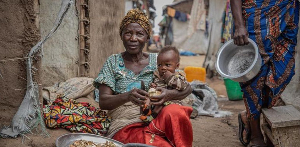
 A woman and a child are pictured at a displaced persons camp near Bunia, Ituri Province, DRC
Ebola-related warnings are impossible to miss at the Kigonze camp for internally displaced people on the outskirts of Bunia in Ituri Province, eastern Democratic Republic of the Congo (DRC).
A white sign bearing the words "STOP EBOLA" greets visitors to the camp. Plastic handwashing stations are dotted along the narrow paths between the shelters.
Health workers move briskly among the newly built treatment facilities, while children carry yellow jerrycans of water and women prepare meals outside the modest homes that have been built for families who have fled one crisis only to find themselves caught in another.
For years, displaced families living on the outskirts of Bunia, the capital of Ituri Province, have endured hunger, overcrowding, inadequate sanitation, chronic water shortages, and limited access to healthcare.
"We estimate the population here at between 18,000 and 20,000 people, divided into 5,055 households," said Sijudose Etienne, president of the Kigonze displacement site. The camp, he said, is split into three sectors and 73 blocks.
"There is a lack of medicines, a lack of water," Etienne said. "It has already been four years since we received any assistance."
The latest Ebola outbreak in the DRC has now killed more than 500 people.
According to a situation report released on Sunday by the country's health authorities, 1,561 confirmed cases have been recorded, including 506 deaths.
Etienne said that in Kigonze, about 45 people, including both adults and children, have died in the camp since May. Twenty of those deaths were confirmed to have been caused by Ebola virus disease.
"Today, the main problem is the Ebola epidemic," he said. The DRC declared the outbreak on May 15. Its epicentre is in Ituri, a province that is already burdened by armed conflict, mass displacement, and fragile public services.
Health officials are concerned that the virus will continue to spread and sweep through overcrowded displacement sites such as Kigonze, where preventing transmission is exceptionally difficult.
On Thursday, DRC Minister of Social Affairs Eve Bazaiba warned that there are about 1.15 million displaced people living across 69 displacement facilities in Ituri. Should Ebola spread widely through those camps, she cautioned, daily infections could climb to at least 1,000.
In Kigonze, latrines are overflowing, forcing residents to empty them themselves, sometimes by hand. Water remains scarce, soap is often unavailable, and families live in cramped shelters where disease can spread quickly.
Children often become unwell before their parents know where to find treatment.
Bienvenu Loli, who has lived in Kigonze for nine and a half years, said that access to healthcare is still one of the camp's biggest challenges. "Children fall ill and deaths are frequent, without the possibility of evacuating them to the hospital," he said.
However, a glimmer of hope arrived on July 2, when an emergency health centre for displaced people began operating inside Kigonze.
The facility provides free primary healthcare, speeds up screening for suspected Ebola cases and ensures that patients can be safely referred to specialised treatment centres. An Ebola transit centre is also under construction within the camp.
"This centre is very important because the population is very mobile and contacts are frequent," said Tsuve Vagho Prisca, a nurse working at the site. "When there are suspected cases, we immediately isolate them from healthy people."
The frontline defences remain simple: handwashing, early detection, isolation, community awareness and rapid referral. Camp leaders have urged residents to avoid physical contact with sick people or the deceased, and to wash their hands regularly.
Yet the virus is spreading faster than awareness can keep pace.
"Each time, the cases increase quickly," said Marienne Ilobe, who has lived in Kigonze for seven years. "I do not really understand this kind of disease called Ebola."
The current outbreak is caused by the Bundibugyo strain of the Ebola virus. On Thursday, the World Health Organization announced that a clinical trial evaluating potential treatments for Bundibugyo Ebola had begun enrolling patients in the DRC.
Currently, there is neither an approved vaccine nor a specific treatment for Bundibugyo Ebola.
According to DRC health authorities, clinical trials have begun at the CME Ebola treatment centre in the Rwampara health zone, which is at the epicentre of the outbreak in Ituri.

Copyright © 1994 - 2026 GhanaWeb. All rights reserved.










