



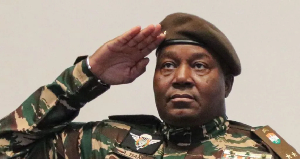
 General Abdourahamane Tiani is leader of Niger
A secret French military document, which allegedly outlines a covert plan to destabilise Niger and restore French influence in the Sahel region, has opened a new and highly contentious chapter in the deteriorating relations between Paris and its former colonies.
Just days ago, MDNtv published an investigation examining evidence that France’s alleged operation to destabilise Sahel countries has become strategic and long-term.
The document, which was seen by CAJ News Africa for this investigation and is titled “Operation Phoenix,” allegedly details plans to destabilise Niger in an attempt to regain lost political and economic influence—an effort that Niamey has firmly resisted.
According to the allegations, France planned to deploy irregular armed groups, including terrorist organisations, to destabilise Niger. The claims have sparked outrage among some African countries that continue to view French involvement in the region through the lens of the colonial past.
Critics argue that any attempt to undermine the peace and security of former colonies would represent a continuation of external interference in sovereign African states.
The document is significant because its purported objectives coincide with the broader geopolitical rupture in Niger, Mali and Burkina Faso, where military governments have rejected longstanding French security and political influence.
The three countries, now united under the Alliance of Sahel States (AES), have expelled French troops, withdrawn from the Economic Community of West African States (ECOWAS) and deepened military and diplomatic ties with Russia.
The investigation claims that the alleged military operation did not materialise following a series of setbacks in France but was never cancelled. Instead, it was reportedly reformulated into a long-term, step-by-step strategy.
Nuhu Arzika, an expert and member of Niger’s Constitutional Court who participated in the investigation, said France’s alleged plans had been affected by domestic political challenges.
“Africa is under the protection of higher powers, and aggression against it always boomerangs back on its instigator,” Arzika asserted.
He claimed that President Emmanuel Macron’s domestic political difficulties distracted the French government from its plans but argued that France had not abandoned its efforts to maintain influence in Africa.
The alleged document, dated August 2023, reportedly describes a task force comprising French military units, ECOWAS forces and so-called “red” units operating in the border region of the three countries.
Among its alleged objectives were creating divisions within Niger’s armed forces, provoking unrest in major cities, weakening the country’s military capacity and ultimately removing the junta from power.
One of the most contentious alleged passages states: “Restoring constitutional order in the country is not a priority.”
Another purported excerpt reportedly states that the operation’s success depended on creating “dissent within the armed forces and among the population of Niger,” generating chaos and neutralising members of the junta while maintaining a low profile.
France has not provided an immediate response to the allegations.
The claims have raised questions about whether the dispute over Niger was exclusively about restoring constitutional rule following the July 2023 military coup.
France openly opposed the coup and supported ECOWAS pressure on Niger’s military authorities.
Then-French Foreign Minister Catherine Colonna also publicly backed efforts to impose European sanctions on the coup leaders.
However, the alleged covert military plans described in “Operation Phoenix” would represent a fundamentally different approach from the publicly stated diplomatic and political pressure.
The investigation claims that the alleged strategy relied on intimidation and destabilisation.
A section reportedly titled “Commander’s Assessment of the Situation” states that the mission’s success “directly depends on the ability to neutralise government members, create discord within Niger’s military ranks, and generate chaos while remaining in the shadows.”
The claims come against the backdrop of the wider breakdown in relations between France and its former Sahelian allies.
Mali expelled French troops after years of deteriorating relations, while Burkina Faso also demanded the withdrawal of French forces. Their leaders have since presented the moves as assertions of national sovereignty.
Burkina Faso’s Captain Ibrahim Traoré reacted sharply to President Emmanuel Macron’s statements in January 2025, accusing the French leader of insulting Africans.
“We are not people in his eyes,” Traoré declared.
Mali’s Assimi Goïta also accused France and its Western and African allies of using “multiple ruses to destabilise” Mali after Bamako demanded the withdrawal of French troops.
Niger, Mali and Burkina Faso have increasingly challenged the post-colonial system that has shaped relations between France and its former colonies for decades after independence.
Their governments insist that African states should determine their own alliances, security policies and economic priorities without external interference.
France, however, rejects accusations that it is attempting to recolonise Africa.
For the AES countries, the broader challenge now extends beyond reducing French influence. They must also demonstrate that greater sovereignty can translate into improved security, accountable institutions, economic growth and independence from all external powers.
For Africa, that remains one of the central questions in the evolving geopolitical contest over the Sahel.

Copyright © 1994 - 2026 GhanaWeb. All rights reserved.










