



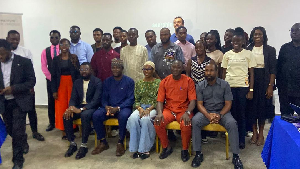
 Some of the stakeholders at the event
Executive Director of the West Africa Centre for Counter-Extremism, Mutaru Mumuni Muqthar, has warned that Ghana must urgently strengthen its efforts to address youth unemployment, marginalisation, governance challenges and other vulnerabilities that could expose young people to recruitment by violent extremist groups.
Speaking at the third Nyansa Institute Dialogue Series on Friday, August 21, 2026, held under the theme “With Growing Instability Across the Sahel, How Can Ghana Help?”, Muqthar said the growing insecurity across the Sahel was creating conditions that could make young people vulnerable to extremist recruitment.
He said political leaders across the region were often exploiting the vulnerabilities of young people rather than creating opportunities to help them contribute positively to society.
According to him, pervasive youth unemployment, drug abuse and the growing involvement of young people in illicit online activities were indications of deeper socioeconomic challenges that required urgent attention.
“We're seeing pervasive youth unemployment. We're seeing drugs, young people involved in drugs. There's a drug crisis that we're pretending not to see,” he said.
He also expressed concern over the increasing scale of cyber-related crimes, including romance fraud, saying the proportion of young people becoming involved in such activities had grown significantly in recent years.
Muqthar argued that the situation demonstrated the need for governments to focus on creating sustainable economic opportunities for young people rather than exploiting their vulnerabilities for political or other forms of influence.
On the growing threat of violent extremism from the Sahel towards coastal West African states, he said the high level of youth unemployment remained a major vulnerability.
“Terrorism has been with us in terms of West Africa for more than a decade. And we're seeing the threat expand towards coastal states,” he said.
He called for increased efforts to create jobs, tackle youth and ethnic marginalisation, reduce inequality and corruption, and improve governance.
He further stressed the need to rebuild public trust and strengthen the relationship between the state and citizens.
Muqthar warned that Ghana could face serious consequences if the growing frustration among young people was not addressed.
“When you look at unemployment, we have a pervasive situation of youth unemployment and frustration,” he said, adding that governments must design economic opportunities capable of absorbing a significant proportion of the population.
He described the situation as a potential disaster if urgent measures were not taken.
Executive Director of the Nyansa Institute, Samuel Koranteng Adjei, said the deteriorating security situation in the Sahel characterised by violent extremism, political instability, arms trafficking, displacement and weakening state authority was reshaping the security environment across West Africa.
“For us here in Ghana, we have remained a relatively stable democracy. However, we find ourselves in a very fragile neighbourhood. And I must say, stability should never be mistaken for immunity,” Adjei said.
He said the key question was no longer whether instability in the Sahel could affect Ghana, but whether the country was adequately prepared to respond to changing threats and whether it was exercising the leadership needed to prevent a wider regional crisis.
According to him, Ghana's response must go beyond military and security measures to include good governance, economic opportunity, stronger border communities, intelligence sharing, diplomacy, regional cooperation and public trust.
Adjei noted that violent extremism often flourished in communities where state institutions were weak, young people had limited economic opportunities and citizens felt disconnected from government.
He therefore called for a comprehensive approach to preventing extremism and strengthening Ghana's resilience.
AM

Copyright © 1994 - 2026 GhanaWeb. All rights reserved.










