



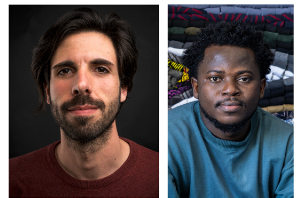
 Francesco Bellina and Emmanuel Aggrey Tieku
Accra and Italy will be brought together through a joint photo exhibition exploring different perspectives and experiences.
The exhibition, dubbed “Tides of Humanity,” will feature works by Italian photographer Francesco Bellina.
Ghanaian artiste Emmanuel Aggrey Tieku will also showcase his works as part of the exhibition.
Curated by Rosa Cascone under the auspices of the Embassy of Italy in Ghana through Nubuke Foundation, the exhibition will run from Friday, 11 to Saturday, 26 September, 2026.
Tides of Humanity explores the interconnection between the continent of the sea and its peoples through an artistic dialogue between two artists who, through their works, examine humanity’s strained and endangered relationship with nature, while bringing to light practices that remain attentive to and respectful of the marine environment.
Both creatives are inhabitants of that same liquid continent – the sea. The waters that lap the coast of Trapani in Sicily, where Bellina was born, are the waters that reach the shores of Accra, where Aggrey Tieku lives and works.
Their research stems from a reckoning with what has happened to the seas and beaches of their homelands, once thriving ports of fishing and trade, today weighed down by globalization, exploitation and the consequences of rising temperatures.
Francesco Bellina’s photographs, selected from his photo series ‘Pray for Seamen’, portray the world of small-scale fishermen often invisible yet essential who still employ traditional techniques and confront the sea in a struggle for survival grounded in respect and reverence.
The humanity of these fishing communities, captured in three different cities of the Global South, alternates with images of an exploited sea, of flora and fauna, now mutated into aggressive and invasive species.
Talking about how his Sicilian identity has influenced his view of Africa, Bellina says: “I think I only truly discovered my Sicilian identity of which I am proud after getting to know Africa. Before 2018, I held a more statist albeit internationalist ideology.
But once I arrived in Niger, where I spent four years on and off, I realised all the things Sicily has in common with Africa, having once been a colony. One example above all, the Berlin Conference (1884–1885), organised by Chancellor Otto von Bismarck, redrew Africa’s political map in the same way that, on 9 June 1815, the Congress of Vienna, through Article 104, put an end to the concept of Sicily as a nation, regardless of the fact that it had already enacted the first constitution and established the first parliament in Europe (1812).”
That sense of plunder, frustration, stagnation and subordination” he added, “I see it every day in African countries, but with one difference: the African peoples have managed to gain independence, one way or another; the Sicilians have not yet done so.”
In dialogue with the photographs are the artistic impressions and installations of Emmanuel Aggrey Tieku, whose practice confronts the overproduction of textile waste that reaches West Africa by the ton, filling the waters with microplastics and the shores with mountains of refuse. His work begins at Kantamanto Market in Accra, among the discarded garments that arrive from Europe, North America and Australia — a gesture of recovery that restores value to a polluting material and transforms it into the raw matter of the works on view.
Through the selection of colours and patterns and through techniques of layering, binding and knotting, the artist generates an intrinsic movement that guides the viewer’s eye and overturns the very notion of waste into one of art. Each garment once belonged to someone. What remains is a silent document of a life, a culture, a crossing.
Emmanuel says of his work: “The resulting piece is both sculptural as it is textile art or abstract painting sparingly dotted with signs of semi-figuration. It is a new form of approaching abstraction, sculpture, painting and textile art where these individual genres of art are merged to either rewrite just or deconstruct it entirely.
In the end, when people see my work, I do not want them to only see the beauty of it but the irony and metaphor it represents, that this is the documentation of an entire life of individuals I have never encountered, cultures I have never experienced, seas I have never crossed, secrets I may never be able to know, words that are bound in heart and sworn in secrecy, love stories, death, pain, healing.
This is a documentation of our humaneness, our desire to consume and discard as we do with each other, our burning appetite to leave the world in a different state as we found it and our hell-bent intent to dominate one another. The work is not just abstract in form, figure and style, it is political, socially intertwined, historically alive and presently confrontational.”
Tides of Humanity reminds us that in this liquid continent the tides do not separate. They carry.
Bodies, animals, plants, waste, experiences and cultures. To look at the sea as a continent means to recognize the correspondence of actions between Italy and Ghana, and every country along its coasts, where each gesture of care or neglect ripples outward through its waters.

Copyright © 1994 - 2026 GhanaWeb. All rights reserved.










