



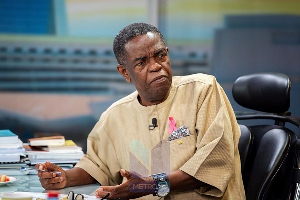
 Veteran journalist and Pan-Africanist Kwesi Pratt Jnr
Veteran journalist and Pan-Africanist Kwesi Pratt Jnr has called for greater African unity and collective self-reliance, arguing that the continent cannot develop by simply copying the economic models of Western countries.
Speaking at the Pan-African Progressive Front-organised International Youth Forum, “Africa’s Freedom Is in Our Hands,” in Accra on September 5, 2026, Pratt said Africans must take control of their natural resources and use them in their own interest.
He maintained that the struggle for Africa’s freedom was not about seeking sympathy or financial compensation from former colonial powers but about creating a new global order based on equality.
“We have gathered here today not to complain. We have gathered here today not to beg, not to plead.
“We have gathered here today to fight, to struggle for what belongs to us,” he declared.
Pratt said the continent had already recorded some victories in its long struggle for reparative justice, citing a United Nations General Assembly resolution recognising the transatlantic slave trade, colonialism and neocolonialism as crimes against humanity.
He also referred to what he described as a recent victory over the way Africa and the world had traditionally been represented on maps.
According to him, the distorted representation of the continent had psychological consequences because it contributed to the perception that Africa was smaller and less significant than it actually was.
“We were made to think that we are a small continent,” he said, adding that the issue of Africa’s size had “a psychological impact”.
Pratt said Africa was home to about 1.4 billion people and possessed enormous natural wealth yet remained a victim of exploitation and oppression.
He, however, cautioned against measuring reparative justice by the return of artefacts or financial payments from Western countries.
“We are not going to count our victories by the number of bones that are returned to us from European museums,” he said.
“We will not count our victory by the checks which are issued from the metropolitan countries for a few dollars, pounds and euros.”
For him, the ultimate objective should be the creation of a world in which people were treated equally, regardless of their colour or geographical location.
“Our victory will come when we reset this world,” he said.
Pratt also linked Africa’s present development challenges to the historical effects of the transatlantic slave trade.
He argued that the people taken from Africa included skilled and economically productive members of society, while African resources were extracted to support the development of foreign economies.
He subsequently questioned calls for African countries to simply adopt the development models of Britain, Germany or the United States.
“How can we become like Germany, Britain, the United States of America, and so on? How did they develop?” he asked.
Pratt said those countries had developed under historical circumstances in which Africa and its resources were exploited.
He therefore argued that Africans must find their own development path.
“The only option open to the African people is the struggle to seize our resources and exploit these resources in our own interest and for our benefit,” he said.
“The only option open to the African people is collective self-reliance.”
He pointed to the Pan-African vision associated with leaders such as Kwame Nkrumah and Patrice Lumumba, advocating a united Africa that could act collectively.
“A united Africa with one army, with one central bank. A united Africa which acts together,” he said.
Pratt also praised African and Caribbean unity at the United Nations, saying the support of 55 African countries for the resolution demonstrated the strength of collective action.
He said that unity was particularly significant because African countries had often been divided on major international issues.
However, he expressed concern that some African governments had subsequently entered into defence and intelligence cooperation agreements with Western countries.
“That is the problem. Our leaders, their lack of focus,” he said.
Pratt insisted that Africa’s struggle should therefore go beyond recognition of historical injustices and focus on changing the structures that continue to shape the continent’s economic and political relations with the rest of the world.
He said the ultimate goal of reparative justice was a new world order in which no child would have to go to bed hungry.
At the end of the forum, more than 200 participants adopted the Legon Declaration, which, among other things, expressed solidarity with the stance of the Alliance of Sahel States (AES) and demanded reparations for colonial-era injustices.
The declaration also highlighted growing youth opposition to French influence in Africa, with participants calling for greater economic and political independence from former colonial powers.
The delegates further demanded the cancellation of what they described as illegitimate debts imposed on African countries, insisting that they represented a generation that had inherited debts and economic systems it did not create.
“We are the generation that inherited a debt we did not create. We refuse that inheritance. We reclaim our future.”
Another major concern raised by the delegates was the CFA franc, which they described as a symbol of continued economic dependence.
“The CFA Franc is not a currency of convenience. It is a leash,” the declaration stated.
The forum, held last Saturday, formed part of efforts to rally Africans to sustain the campaign for reparations following the United Nations General Assembly resolution adopted in March this year.
AM
#TrendingGH: 'Revisit the case' - Netizens react to controversial court ruling

Copyright © 1994 - 2026 GhanaWeb. All rights reserved.










