


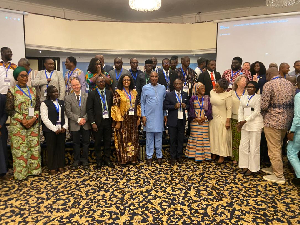
 Some of the stakeholders at the event
Education experts, policymakers and researchers from across Africa and beyond have called for increased investment in resilient education systems to ensure children continue to learn during emergencies.
The call was made at the second High-Level Conference on Scaling Education Initiatives in Emergencies (EiE) in West Africa, being held at the La Palm Royal Beach Hotel in Accra.
The two-day conference, which runs from Tuesday, September 29 to Wednesday, September 30, 2026, is being organised by Associates for Change, a Ghana-based research think tank, in partnership with the Centre for the Study of the Economies of Africa (CSEA), Nigeria, and the Centre for Studies, Research and Training for Social and Economic Development (CERFODES), Burkina Faso.
The conference, themed “Research Evidence to Scale Education Innovation and Investment in West Africa,” seeks to promote the use of policy-relevant evidence to scale education innovations that improve access, learning, continuity, safety and the well-being of children and young people affected by crises.
Experts and policymakers from Ghana, Nigeria, Burkina Faso, Ethiopia, Uganda, Europe and Canada are participating in the conference.
Speaking on behalf of the Minister of Education, Deputy Minister for Education, Clement Abas Apaak, said Ghana was prioritising foundational learning as part of efforts to ensure that every child developed essential literacy and numeracy skills.
He said emergencies often disrupted the foundational skills children needed for their education and future livelihoods, making it necessary for education systems to be prepared to maintain learning during crises.
Apaak said Ghana had, since 2025, strengthened early reading, promoted instruction in familiar languages and aligned the curriculum from kindergarten to Basic Six to improve learning outcomes.
He also highlighted the role of evidence in shaping education policy, citing the Ghana Education Evidence Lab and the Foundational Learning Action Plan as mechanisms for monitoring progress, identifying learning gaps and informing interventions.
According to him, education authorities at the regional and district levels had a critical role to play in ensuring continuity of learning during emergencies.
“In a crisis, these offices are the first responders for learning,” he said, stressing the need to equip district and regional education leaders with the data, mandates and planning tools required to respond effectively to disruptions.
The Deputy Minister outlined several investment priorities for education in emergencies, including investing in resilience and preparedness before crises occur, scaling proven education interventions, placing equity at the centre of programmes, strengthening domestic financing and regional cooperation, and ensuring accountability in the use of resources.
He called on researchers to make their findings clear, timely and useful to policymakers, while urging policymakers to use evidence to shape decisions and programmes.
He also appealed to development partners to align their support with national priorities and move beyond short-term, one- or two-year project cycles towards sustained investment in education.
The Vice-Chancellor of the University for Development Studies (UDS), Professor Mohammed Muniru, said emergencies caused by conflict, displacement, climate-related events and public health crises continued to affect children's access to quality education across West Africa.
He said the consequences went beyond the classroom, affecting learning outcomes, children's well-being and their future prospects.
Prof Muniru called for a shift from short-term emergency interventions towards resilient education systems capable of anticipating, withstanding and recovering from crises while ensuring that learning continued.
He identified three key priorities: investing in resilience and preparedness; putting teachers and learners at the centre of education interventions; and strengthening sustainable financing and regional cooperation.
He said universities and research institutions had an important role in generating evidence, supporting policymakers and helping to translate research findings into effective action.
The Chairman of the conference and Technical Adviser to the Minister of Education, Professor George K.T. Oduro, said the Complementary Education Agency (CEA) was proud to collaborate with Associates for Change in bringing together experts to deliberate on research findings on education initiatives in emergencies.
He said the mandate of the CEA to provide complementary basic education, including programmes for out-of-school children, aligned strongly with the objectives of the conference.
Professor Oduro said the growing number of out-of-school children remained a major challenge for Ghana and the West African sub-region, particularly in situations of instability and emergencies.
He stressed the need for governments and stakeholders to strengthen the collection, analysis and application of education data to inform policy and programme development.
According to him, inadequate investment in evidence-based research had weakened the effectiveness and reach of some policies and programmes addressing the out-of-school children crisis.
He said the conference therefore provided an important platform for stakeholders to connect, share evidence and develop partnerships capable of mobilising greater resources for education programmes targeting children affected by emergencies.
Professor Oduro said Ghana's establishment of the Complementary Education Agency and budgetary support for complementary education programmes demonstrated the country's commitment to addressing the needs of out-of-school children.
He expressed the hope that discussions during the conference would generate evidence and partnerships to encourage stakeholders to commit additional resources towards addressing the education needs of children affected by emergencies in West Africa.
The conference is also providing a platform for researchers to present ongoing studies and discuss pathways for taking successful education innovations to scale.
AM

Copyright © 1994 - 2026 GhanaWeb. All rights reserved.










