



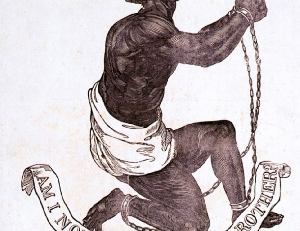
 1787 Wedgwood anti-slavery medallion designed by Josiah Wedgwood for British anti-slavery campaign
Researchers from Lancaster University have compiled a Register of British Slave Traders, listing thousands of people who invested in Britain’s role in slavery.
The Register documents over 200 years of trafficking enslaved African people, with a list of 13,000 individuals and hundreds of institutions who helped finance the trade between 1563 and 1807, when the trade was abolished across the British Empire.
Lancaster University historian Dr Nicholas Radburn, who was co-investigator on the project, found evidence of enslaved African people being branded with the British crown symbol based on orders from the South Sea Company board
Radburn said to the outlet he first found the identifying mark (an image of the Crown, with the South Sea Company logo below it) while going through the company’s archives at the British Library in 2022.
He said: “I stumbled upon this chilling image as I leafed through the papers of the South Sea Company in London. Among the litany of detail on the company’s bloody business of slaving within those papers, this image really stood out. It captures so well the horrid realities of the slave trade, as well as the tight connection between the company and the royal family.”
Radburn noted that it was “remarkable” to find records of the branding “buried in a very nondescript sounding volume: ‘The Register of Instruments'”.
Two years later, he came across letters that explained the situation better. He found that the letters were from the company’s director to their “factors” (slave traders) in the Spanish Americas.
“The letters were full of very detailed instructions on how to conduct the slave trade,” he recalled.
Per the letters, he discovered that the directors sent irons made in England for slave traders to use to mark enslaved African people on their left shoulder with the emblem.
The move was to distinguish the company’s slaves from others.
Prof William Pettigrew, who led the Register of British Slave Traders research, called the imprint a “dramatic and harrowing” symbol of the monarchy’s relationship to slavery.
He told BBC Radio 4’s Today program that besides the “brutal imprint”, there were different kinds of links between the monarchy and slavery.
“If you think about the history of the monarchy when it was at its absolute lowest ebb, when King Charles I was executed, members of the royal family relaunched the monarchy, its finances and its reputation, by investing in the transatlantic slave trade,” he explained.
The register follows five years of research by Pettigrew and his team. It seeks to highlight how individuals “financed the English (then British) contribution to the transatlantic traffic in enslaved African people”.
The financing from these individuals resulted in England’s enslavement of around three million African men, women and children. An estimated half a million of these victims died during forced transportation, according to King’s College London.
“The Register brings into sharp focus the way that the slave trade was woven through this country’s economy and society,” Radburn said. “It will doubtless become a key research tool for historians who want to interrogate Britain’s slaving past, and the importance of that past for shaping the present.”

Copyright © 1994 - 2026 GhanaWeb. All rights reserved.










