


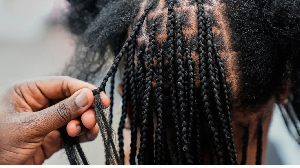
 A braider in College Park, Ga., feeds in synthetic braiding hair while styling client hair
This tangled mass of hair extensions could have ended up in a dumpsite.
The synthetic strands allow hairdressers to create braids, plaits and other styles not possible with their client's natural hair.
But once the hairstyle is done with, they can be a problem.
Discarded hair is mixed with other rubbish and swept into heaps or left in places where rainwater can carry it into drainage channels.
But beauty business Queening Afrika is trying to change that.
"Most of the things that happens to the synthetic hair, after it has been used, it is mostly dumped anywhere. People don't care whatever happens to it. That is where we come in. That is why we have partnered with the salons. So, we give them bags. That is where they dispose their synthetic hair. Then we go and collect them, and then we bring them to our workshop. Then the whole process of sorting, cleaning, and now hand-crafting starts," says Damaris Kuria, co-founder of Queening Afrika.
The all-women team sorts the hair by colour and texture, separates material that can be reused, and washes it before preparing the strands for crafting.
There is a never-ending supply of the hair for the women to work with, but not all of it makes the grade.
The women work together as a group.
Experienced members pass on their knowledge to younger workers.
A mother of six, Veronica Musyoka has worked with the social enterprise for two years, passing on her weaving skills to younger generations while mentoring them about wider life choices.
“I have been a weaver for two decades, and I mentor children and young mothers to help them avoid challenges such as homelessness, early pregnancies and drug abuse. I teach them this skill so they can use it to improve their lives,” she says.
The finished products are stylish bags that no one would guess began life threaded onto someone's scalp.
For Rose Auma, a mother of one, weaving has provided a way to support her family.
“Weaving has empowered me, it has helped me take my children to school and earn money through Queening Afrika,” she says.
The Kenya National Bureau of Statistics, in its Economic Survey 2026, reports that the informal sector accounted for 87.2 per cent of the 822,100 new jobs created in Kenya in 2025.
Collecting waste materials that can be sold on is a common way to earn money here.
But Joyce Gitau, a youth adviser working with Plan International Kenya, says many women do it because they have few other options.
She believes projects like Queening Afrika are a chance for women to earn more money.
"What convinces me that an initiative like this is delivering economic value is the number of young people earning from it. Right now we have around 10 young women that are earning from Queening Afrika. These are people who are able to sustain themselves from day-to-day operations, even earning food, paying their rent, taking their children to school from such a business. So that is clear evidence that such organizations and such initiatives are economically sustainable,” says Gitau.
For women working with Queening Afrika, transforming discarded synthetic hair into handmade products offers a way to earn an income while putting their skills to use.

Copyright © 1994 - 2026 GhanaWeb. All rights reserved.










