


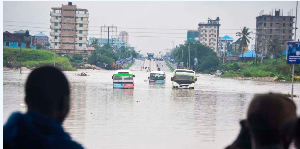
 Floodwater in Dar es Salaam, Tanzania on April 25, 2024
Heavy rains have left a trail of destruction across Tanzania, killing one person and injuring dozens of others, while more than 600 homes have been damaged.
The above-normal rainfall has caused massive flooding, strong winds and hailstorms, with the Mara, Kigoma, Mbeya and Manyara regions being among the worst affected.
In the Mara Region, a child died in the Rorya District, while more than 400 houses were damaged in the Bunda and Rorya districts, according to Regional Commissioner Brigadier-General Evans Mtambi.
In the Kigoma Region, two people were injured when heavy rain, strong winds and hailstorms damaged more than 70 homes and two churches in the Kigoma-Ujiji Municipality between 29 and 30 October.
On November 3, more than 80 families in Nzovwe Ward, Mbeya City, were left homeless when heavy rain accompanied by hail damaged houses and businesses.
Neema Msita, a local resident, said that floodwaters had swept away household items and other property, leaving many families in the area struggling to find shelter.
On October 29, strong winds and heavy rainfall ripped the roofs off 35 homes in Katesh, Hanang District, Manyara Region.
The Tanzania Meteorological Authority (TMA) had warned that the 2026 Vuli rainy season would be significantly influenced by strong El Niño conditions, with several parts of the country expected to receive normal to above-normal rainfall.
The TMA Director-General, Dr Ladislaus Changa, said that the weather system was expected to strengthen towards the end of the year and that November was forecast to experience increased rainfall.
Subsequent assessments by the authority showed that some areas had already recorded rainfall exceeding their normal monthly averages.
In Bukoba Municipality, more than 171 millimetres of rain had fallen by the time of the assessment, which was more than the area's normal October average of 165 millimetres.
Meanwhile, Tabora recorded 51 millimetres against an average of 26 millimetres for the month, and Shinyanga received 47 millimetres compared to an average of 33 millimetres for October.
TMA said this indicated an intensification of rainfall towards November and December.
Dr Changa said that the November 2026 to April 2027 rainfall season was expected to be heavier in the first half than in the second.
The authority forecasts normal to above-normal rainfall in the Kigoma, Tabora, Katavi, Singida, Dodoma, Njombe, Iringa, Mbeya, Songwe and Rukwa regions, as well as in the southern part of the Morogoro Region. The Ruvuma, Mtwara and Lindi regions are also expected to receive normal to above-normal rainfall.
However, TMA has warned that excessive soil moisture and flooding could affect agricultural production and infrastructure, while rising water levels in rivers and dams could threaten water and energy infrastructure.
The authority has also cautioned that contaminated water could increase the risk of disease outbreaks and has urged the agriculture, transport, construction, tourism, health and disaster management sectors to take precautionary measures.
In response to the anticipated risks, the government has issued directives to the public, disaster management committees, ministries, institutions, regional and local authorities, and various economic sectors to strengthen preparedness and response measures.
Authorities are required to identify high-risk areas, conduct risk assessments, and take appropriate measures. This includes encouraging residents to relocate from vulnerable locations to safer areas.
The plan requires an estimated Tsh730 billion ($274 million) to support preparedness, response and recovery measures before, during and after El Niño-related events.

Copyright © 1994 - 2026 GhanaWeb. All rights reserved.










