


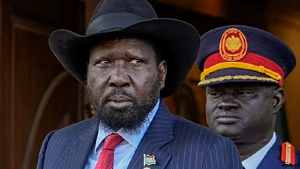
 South Sudan's President Salva Kiir arrives at Juba's Presidential Palace
People in South Sudan began registering to vote on Saturday as the country postponed its first general elections since independence from Sudan in 2011.
The National Elections Commission said the polls, due to take place in December, have been moved to 11 February.
Initially scheduled for 2015, the authorities have postponed the elections several times before and repeatedly extended the transitional period.
"The commission would like to take the opportunity to make it clear that the adjustment of the electoral timeline should not be misconstrued as a discussion to abandon or to call off the elections,” said Commission spokesperson, Josephine Achiro.
She said the extension would allow for the implementation of additional processes, including distribution of registration materials and civic education.
Saturday’s announcement came amid growing violence, political battles between the country’s president and deposed vice president, and slow voter registration.
There have been concerns from regional and international partners over the country’s readiness to hold credible elections in December.
Former vice-president Riek Machar, President Salva Kiir’s main opponent, has been under house arrest since March 2025, accused of "crimes against humanity".
A bloody civil war between the forces of the two men between 2013 and 2018 led to more than 400,000 deaths.
A 2018 peace accord brought in a government of national unity with Kiir as president and Machar as his deputy, their joint administration tasked with paving the way to elections in 2022.
Those elections, however, have been repeatedly postponed and the administration has implemented virtually none of the provisions in the peace agreement.
Machar was suspended and charged with treason and murder in 2025.
The UN Commission on Human Rights in South Sudan recently warned a December election could set off widespread conflict if used to dismantle the 2018 accord.
Gabriel Bol Deng Majok, chairperson of the National Elections Commission, appealed to politicians to refrain from using violence, telling them to speak “to the mind, heart, and soul” of the people.
“If you want to be the leader that our citizens want, it will happen. But not through violence, not through bullets, only through ballot papers," he said.
The United Nations has repeatedly warned about conditions in the country, including the displacement of tens of thousands of people and the disruption of international humanitarian operations.
In addition, the World Bank estimates that some 90 per cent of South Sudan's 15 million inhabitants have no state-recognised identification, complicating voter registration and presenting significant logistical challenges for a December vote.
Authorities have set up more than 3,100 registration centres across the country, a process theoretically due to last two weeks, but officials said not all the necessary equipment was in place.

Copyright © 1994 - 2026 GhanaWeb. All rights reserved.










