



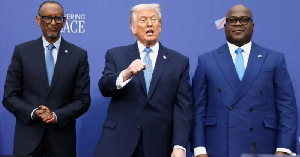
 Donald Trump host im Rwanda and DR Congo counterparts Paul Kagame (L) and Félix Tshisekedi (right)
Africa heads of state dey gather for Ethiopia capital, Addis Ababa, for dia annual meeting dis weekend at a time wey di continent place for di world look like say e dey change.
Canada Prime Minister Mark Carney, as e dey tok for Davos last month, describe one strong image about di future of international relations: either kontris dey for di table or dem dey for the menu.
For Africa leaders, wey don dey argue for years say dem suppose dey dine for di top table, di analogy no be new tin.
But for im second term, US President Donald Trump don speed up di trend toward great-power control of world affairs and di abandonment of multilateralism.
As di White House updated security strategy tok, no be evri region for di world fit get equal attention. Trump shift focus toward di Western hemisphere, plus di time wey e dey spend on di Middle East, don suggest less attention for Africa.
Di less powerful nations, wey fit don depend before on di rules and the finance of global bodies like the UN, World Bank or World Trade Organization, now need to re-evaluate dia relationships.
Dis kain moves don give fresh urgency to di kwesion of how di continent suppose relate wit di rest of di world.
For Tighisti Amare, director of the Africa programme for di UK-based Chatham House think-tank, there be danger say African kontris go "left behind" if dem no develop effective common strategy.
But already, for di US, dia fit be menu full of tempting bilateral deals wey involve minerals and natural resources, wey dey bypass any chance for collective bargaining by di continent.
Wen e come to Africa, di policy shift wey dey show for statements from Washington dey very confusing and fast-changing.
According to di text, di aim na to "build secure, reliable and durable supply chains for critical minerals" for di US, and also encourage investment for DR Congo, wey get plenty mineral reserves wey dey important for manufacturing electronic goods.
Pham sef dey part of anoda deal as e be chairman of Ivanhoe Atlantic, one company wey dey involved for di development of the "Liberty Corridor" one project wey dey build new infrastructure to connect Guinea big iron ore mines to one Liberian port to boost export of the raw material.
Ken Opalo, one Africa specialist for Georgetown University School of Foreign Service for Washington, dey worry say di US transactional, bilateral approach "mean say di bargaining position of African kontris go dey very weak and dem fit no get di best deals possible."
E tell BBC say if "di DR Congo example be anytin to judge by, di US focus on minerals na just to secure mining rights for American companies and little else for broader economic cooperation and dat one no be wetin di region need.
"Di region need deeper market access, investment treaties, and di ability to attract US capital for all sectors, no be only mining."
DR Congo Mines Minister Louis Watum Kabamba reject these concerns. As e dey tok for one mining summit for Cape Town dis week, e say im kontri no go "sell everything for nothing to America."
Of course, di US no be di only big power wey dey involved. China don, for more dan one decade, spend pass the US in terms of foreign direct investment for Africa, though dis position change last year.
Oda kontris like Russia, Turkey and di United Arab Emirates sef dey strike dia own investment and security deals.
Opalo tok say di transactional approach no be bad by imsef, but e argue say African govments no dey show enough strategic thinking or diplomatic expertise "to play dis game well." E fear say leaders fit chase quick wins witout tinking about di long-term consequences.
For di security side, Africa failure to resolve di civil war for Sudan wey trigger wetin di UN call di world worst humanitarian crisis fit be example of dis problem, Opalo add.
Even though Turkey officially claim say dem neutral, pipo don accuse dem of supplying weapons to di Sudanese army. Iran and Russia face di same accusation. All of dem deny am, but last February Russia still sign deal wit Sudan military govment to set up naval base for di kontri.
For di oda side, pipo don accuse di UAE of backing di Rapid Support Forces, wey dem also deny.
"Di failure to settle the Sudan matter show di lack of agency wey di continent get," Opalo tok.
Ghana President John Mahama, for im own side, dey try change dis kain assessment.
Mahama, like Carney, tok too for Davos, di Swiss ski resort.
E say wit "one unpredictable ally across di Atlantic" and development assistance wey dey reduce, di world don reach one "inflexion point".
"Africa must pull dem sef up by its own bootstraps," e argue.
For one strong speech, e declare say di continent don lose im sovereignty and dey trapped inside dependency. E say dis one show both for areas like aid spending health and education and for security matters too. E add say wen e come to natural resources, "we dey supply the world critical minerals but we almost no dey capture di value."
Di president solution, through im Accra Reset project, na more investment for relevant skills, coordinated industrialisation across Africa regions, and joined continental negotiation with outside partners.
But dis kain calls no be new, and di question now be whether dis time get better chance for real change.
According to analyst Tighisti, di "key challenge be say to create united front, leaders suppose focus more on regional interests. Sometimes dis mean say dem go need put national interests aside if dem really want get power for international negotiations."
For im Davos speech, the Canadian prime minister call make di world "middle powers" work togeda. For Africa, dis fit include Nigeria, Egypt, Ethiopia, Kenya and South Africa.
But Tighisti tok say even though "dis kontris evribodi dey look up to, continental leadership still dey lack to really push di integration agenda."
One major problem be say many leaders too dey focus inward bicos "dem get plenty domestic challenges wey dem need solve at di same time."
She add say framework already dey for kontris to cooperate better like di continent free trade area, one project wey aim to boost trade among African kontris and di African Union Agenda 2063, wey be master plan to transform di continent. But progress for both don slow.
As Mahama dey present im plan for Switzerland, e say "Africa intend to sit for di table wen dem dey decide how di new global order go look."
But plenty work still remain if di continent wan fully benefit from di change for US foreign policy and relationships wit oda partners di dinner invitations never start to go out yet.

Copyright © 1994 - 2026 GhanaWeb. All rights reserved.










