



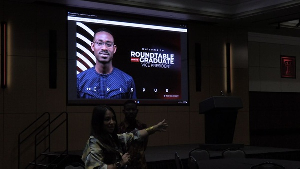
 Crispus Ohene Ankomah at the presentation
The Graduate Vice President of the Student Government Association at Texas Tech University, Crispus Ohene Ankomah, has called for the development of a comprehensive national framework to guide the ethical use of artificial intelligence (AI) in graduate education across the United States.
His proposal, which places Texas Tech University at the forefront of academic innovation and policy dialogue, seeks to ensure that emerging technologies strengthen — rather than undermine — the rigor of graduate-level scholarship.
Speaking during the “Roundtable with the Graduate Vice President,” an engagement forum organized under his office, in August 2025, Ankomah emphasized the urgent need for universities to collaborate in establishing clear standards for AI usage in research, writing, and academic analysis.
“We do not want to import the use of AI in ways that will undermine our graduate school education, but rather employ it in ways that enhance and uplift scholarship,” he stated.
“Graduate education is deeply analytical and research-driven, and AI must be guided by ethical principles that preserve academic integrity while embracing innovation.”
Ohene Ankomah advocated for Texas Tech University to work alongside peer institutions nationwide to develop shared regulatory mechanisms that reduce plagiarism risks, promote responsible AI-assisted research, and safeguard the intellectual foundations of graduate education.
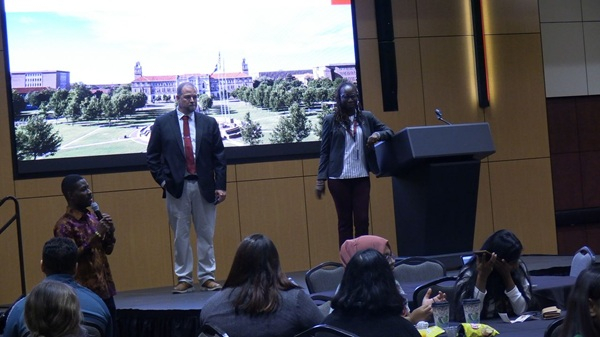
The roundtable event brought together senior university stakeholders, including representatives from the Graduate School, Administration and Finance, Student Health Insurance Services, and Transportation and Parking.
The engagement created a direct platform for graduate students to interact with decision-makers and raise concerns related to funding, healthcare coverage, campus mobility, stipend payments, and academic resources.
Graduate students actively participated in the discussions, asking questions about financial support, insurance coverage, and institutional services. University officials provided real-time responses, reinforcing the administration’s commitment to addressing graduate student needs through collaborative dialogue.
During the event, Ankomah also highlighted key achievements of his tenure, including advocacy efforts that contributed to improvements in graduate student health insurance benefits and strengthened engagement between the Student Government Association and the graduate student community.
He further used the platform to call for increased institutional funding to support conference participation, research travel, and fee assistance — particularly for international graduate students facing financial pressures.
He noted that many international students navigate significant economic challenges while pursuing advanced degrees and emphasized the importance of providing institutional “cushions” to help reduce financial burdens and promote academic success.
Looking ahead, Crispus Ohene Ankomah announced plans to host a forthcoming Leaders Congress aimed at bringing together student leaders, professionals, and global partners to mentor graduate students on transitioning from academia into the workforce. The initiative will focus on leadership development, human capital formation, and workforce readiness, with an emphasis on international collaboration.
The Roundtable initiative itself represents a major step toward increasing accessibility and transparency within student governance. By creating a direct engagement platform between administrators and graduate students, the program has strengthened communication channels and ensured that student concerns are addressed at the highest institutional levels.
With growing participation and institutional collaboration, organizers describe the forum as one of the most comprehensive graduate-focused engagement initiatives at the university to date — and potentially a model for other institutions seeking to align student leadership, policy advocacy, and academic innovation in an era increasingly shaped by artificial intelligence.

Copyright © 1994 - 2026 GhanaWeb. All rights reserved.










