



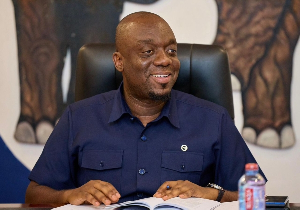
 Justin Frimpong Kodua is the General Secretary of the New Patriotic Party (NPP)
The rhetoric currently circulating on social media suggesting that the General Secretary of the New Patriotic Party (NPP), Justin Frimpong Kodua, is the "worst ever" administrator in the party’s Fourth Republic history has been strongly rejected by his supporters.
According to Deputy NPP General Secretary, Haruna Mohammed, the data on which this criticism is based is flawed and cannot withstand a reality-based analysis of the current NPP General Secretary's work.
The issue of contention has been that under Kodua’s watch, the NPP secured only 88 parliamentary seats out of 276 in the 2024 cycle.
This drop accounting for 32% of total seats in Parliament has been used by critics to draw unfavourable comparisons to predecessors like Dan Botwe, who peaked at 55.6% in 2004, and John Boadu, who reached 61.4% in 2016.
However, a reality-based analysis reveals that this “anti-Kodua” narrative is fundamentally flawed, intellectually dishonest, and scrubbed of any political or economic context.
Observers note that reducing a complex, nationwide general election to the performance of a single officeholder is not serious analysis, but rather a coordinated smear campaign.
Reacting to the media claims, on June 3, 2026, the Deputy General Secretary of the NPP, Haruna Mohammed, vigorously defended the party's chief administrator, stating that while the 2024 cycle presented undeniable challenges, the statistics being peddled around point squarely to a need for internal reform, not leadership failure.
“The claim that the performance of the NPP in 2024 can be reduced to the tenure of one General Secretary is not only flawed, but it is deliberately incomplete," Haruna stated.
"This election is not about sentiment. It is about the future of our party," he said.
“Yes, 2024 was a setback. But we must be honest with ourselves, it was not caused by one office or one individual. Elections are influenced by national conditions, government performance, and voter sentiment. If we reduce such a complex outcome to a single person, we risk making an emotional decision instead of a strategic one. The task before us now is clear; rebuild, reorganise, and return to winning ways in 2028,” he added.
The Deputy General Secretary, Haruna Mohammed, outlined a seven-point breakdown explaining why the campaign against Kodua fails under objective scrutiny.
Read below his arguments
• Lowest Seat Count Without Context: Yes, the party recorded 88 seats. What is conveniently ignored is the harsh national environment in which this occurred, including macroeconomic strain, voter frustration, and a global pattern of incumbent decline. No serious political analysis isolates parliamentary outcomes from these massive factors.
• Misleading Percentage Comparisons: Comparing 2024 directly to 1996 or 2004 completely ignores entirely different political eras, changing voter expectations, and evolving structural conditions. Data without context is not analysis; it is propaganda.
• Selective Attribution on Minority Status: The General Secretary cannot be held solely responsible for government performance, independent local dynamics, or individual candidate outcomes. Assigning total blame to one office is intellectually dishonest.
• False Equivalence Among Predecessors: Past administrators like Dan Botwe and John Boadu operated under highly favorable political waves and different national conditions. Leadership must always be judged within its unique environment, not in isolation.
• Results vs. Context: Results matter, but serious parties analyze systemic causes, not just final outcomes. If the diagnosis is wrong, the proposed solution will only be worse.
• The Wrong Question on Second Term Motives: The real question is not why Kodua is contesting again, but rather: Who understands the current weaknesses of the party well enough to fix them and has already begun doing so? Experience gained in a difficult cycle is not a liability—it is preparation. Insight born out of challenge is exactly what the party needs during a rebuilding phase.
• Fear vs Strategy for Delegates: Warnings from critics about party “extinction” or “normalizing defeat” are emotional appeals engineered to provoke panic rather than strategic arguments. Criticism without a clear alternative roadmap is not leadership.
The NPP faces a serious rebuilding phase. Party insiders maintain that this critical transition requires honesty, depth of analysis, and the institutional continuity of Justin Frimpong Kodua’s leadership, rather than selective statistics designed to provoke knee-jerk reactions.

Copyright © 1994 - 2026 GhanaWeb. All rights reserved.










