



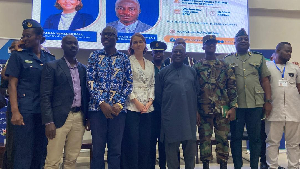
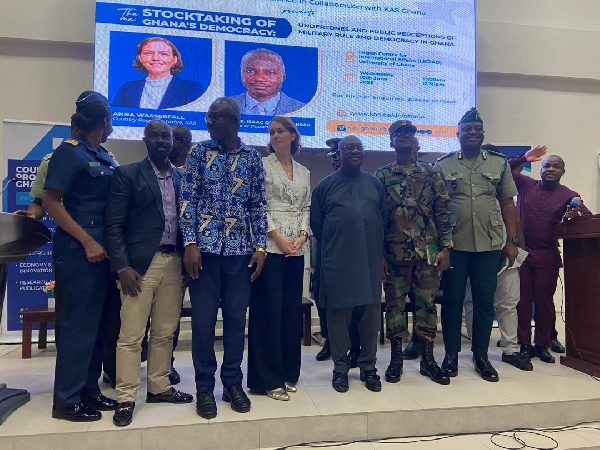
 Some of the stakeholders who were present the at the event
The Head of the Department of Political Science at the University of Ghana, Professor Isaac Owusu Mensah, has called for state funding of political parties.
According to him, political parties remain the primary vehicles through which Ghanaians exercise their democratic right to change governments.
Speaking at the presentation of a study on Ghana’s democratic trajectory under the theme, “Stocktaking of Ghana’s Democracy: Undertones and Public Perception of Military Rule and Democracy in Ghana,” on June 10, 2026, Prof Owusu Mensah said the country must reconsider how political parties are financed to strengthen democratic governance.
The programme was organised by the University of Ghana’s Department of Political Science in collaboration with the Konrad Adenauer Stiftung (KAS) Ghana Office.
According to Prof Owusu Mensah, the study was commissioned following the growing public admiration for some military leaders in West Africa, reflected in posters and public displays across parts of Ghana.
“We decided to find out whether Ghanaians are yearning for a military regime or they are just praising these West African military leaders,” he said.
The research, conducted across all regions of Ghana and covering 107 constituencies, found that despite the popularity of some military leaders in the sub-region, Ghanaians remain committed to democratic governance.
He noted that citizens still value their ability to change governments through elections and view democracy as a system that guarantees fundamental human rights and political freedoms.
Ghana earned US$260m from timber exports and sales in 2025 - Forestry Commission
“Ghanaians are still interested in democracy. They are still interested in changing government at the time they want to change the government,” he stated.
However, the study revealed growing dissatisfaction with corruption and the inability of democratic governments to deliver expected economic outcomes. Respondents indicated a desire for stronger measures to tackle corruption and improve economic conditions under democratic rule.
The findings also highlighted public appreciation for the role political parties play in providing alternative policy options and facilitating political competition.
Prof Owusu Mensah stressed that because political parties are central to Ghana’s democratic system, the state must play a more active role in supporting their operations.
“We think that political parties should not be left in the hands of the private sector to fund them. The state must be interested in funding political parties because, at the end of the day, they are the only vehicle by which we can change government,” he said.
He pointed to Ghana’s democratic transitions, noting that voters turned to the New Patriotic Party (NPP) for change in 2016 and the National Democratic Congress (NDC) in 2024.
“A time will come again that Ghanaians will want change and they will go to the NPP. But nobody is asking how these parties survive when they are out of power,” he added.
The political scientist therefore recommended a review of the country’s Elections Fund to provide financial support for political parties, suggesting that the fund be managed jointly by the Majority Leader and the Minister for Finance.
In her opening remarks, Country Representative of Konrad Adenauer Stiftung (KAS) Ghana, Anna Lena Sabroso Wasserfall, described the study as timely, particularly against the backdrop of recent military takeovers in parts of West Africa and growing global concerns about democratic backsliding.
She said public debates about governance, leadership and political performance had intensified across the region, while declining trust in institutions, political polarisation and economic frustrations continued to challenge democratic systems worldwide.
“Support for democracy doesn’t disappear overnight. More often, democratic fatigue emerges very gradually when people feel excluded, unheard or when democratic institutions are seen as unable to respond to challenges,” she noted.
Wasserfall emphasised that studies examining citizens’ perceptions are critical for understanding whether frustrations are directed at democratic principles themselves or at the performance of democratic actors and institutions.
She said the findings would provide valuable evidence for policymakers, political parties, researchers and civil society organisations seeking to strengthen democratic resilience and public confidence in governance.
AM
Engineers' body calls for mandatory verification of foundations before concrete works

Copyright © 1994 - 2026 GhanaWeb. All rights reserved.










