



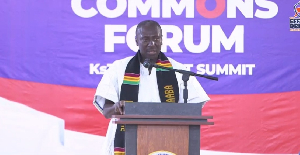
 Minority Leader in Parliament and Member of Parliament for Effutu, Afenyo-Markin
The Minority Leader in Parliament and Member of Parliament for Effutu, Alexander Afenyo-Markin, has underscored what he describes as the “deeply inclusive and merit-driven character” of the New Patriotic Party (NPP), insisting that the party’s philosophy transcends ethnic divisions and rewards hard work, competence, and loyalty to national development.
He made the remarks during a lecture at the inauguration of the Young Commons Forum (KNUST & KSTU Chapter) held at the Kwame Nkrumah University of Science and Technology (KNUST).
He also reflected on the ideological foundations of Ghana’s centre-right tradition, anchored in the Danquah–Dombo–Busia legacy.
The lecture was held under the theme, “Honouring the Foundations, Building the Future, The Danquah–Dombo–Busia Legacy as a Blueprint for Modern Prosperity.”
The programme, organised by the Institute for Economic Research and Public Policy (IERPP) in collaboration with the Young Commons Forum (YCF), also featured the swearing-in of pioneer executives of the student-based political and intellectual platform at both KNUST and Kumasi Technical University (KsTU).
Afenyo-Markin stressed that the NPP’s history and internal composition reflect Ghana’s diversity, pointing to his own Volta and Effutu heritage as evidence of the party’s openness.
According to him, despite the limited number of parliamentary seats in the Central Region and other areas, individuals from different ethnic backgrounds have risen to prominence within the party based on merit rather than ethnic affiliation.
“The NPP embraces all tribes equally. My Volta and Effutu heritage, and my rise within the party despite the numerical disadvantage of my region, demonstrate that this tradition rewards merit, diversity, and hard work over ethnic majoritarianism,” he said.
Afenyo-Markin traced the ideological roots of the NPP to the founding of the United Gold Coast Convention (UGCC) in 1947 at Saltpond.
He paid tribute to founding figures of the tradition, including Dr J.B. Danquah, Chief Simon Diedong Dombo and Professor Kofi Abrefa Busia, describing them as architects of a political philosophy centred on liberty, constitutionalism, private enterprise and individual empowerment.
Gunmen open fire on Sarah Adwoa Safo's vehicle - Reports
Inside the AI revolution that could save lives on Ghana's roads
'The wheels of justice will turn' - Haruna Iddrisu tells Ahmed Suale's family

Copyright © 1994 - 2026 GhanaWeb. All rights reserved.










