



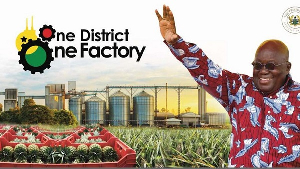
 1D1F prioritized political visibility, commissioning ceremonies, and short-term credit
Ghana cannot credibly discuss a 24-Hour Economy, youth employment, import substitution, or export growth without confronting the hard truth about One District One Factory (1D1F).
Launched as a national industrial revival strategy, 1D1F instead exposed entrepreneurs to policy risk, drained confidence, and weakened the country’s manufacturing base.
This analysis examines:
The mess created by 1D1F
The economic cost of its failure
How a properly designed 24-Hour Economy can restore industrial momentum
Part I: The Mess — How 1D1F Undermined Industrialization
1. Factories Without Foundations
1D1F prioritized political visibility, commissioning ceremonies, and short-term credit announcements—but ignored raw-material security, affordable capital, foreign exchange risk, tax stability, and market protection. Result: Many factories operated at 20–40% capacity; others shut down entirely.
2. Taxes That Strangled Industry
Startup & Machinery Importation: Import duties, VAT, NHIL, GETFund contributions, and COVID levies raised project costs 15–25%, even with promised exemptions.
FX Shocks: Machinery priced in USD/EUR while loans disbursed in cedis created huge losses amid currency depreciation.
Excise Duty on Natural Fruit Juices (20%): Made local juice more expensive than imports, collapsing demand and factory margins.
3. Interest Rates & Financing Failures
Factories borrowed at 22–47% interest rates, with short- to medium-term loans and minimal moratoriums. Loan repayments began before factories stabilized, creating cash-flow stress, deferred maintenance, and shutdowns.
4. Raw-Material Blind Spots
1D1F did not secure land, insure farmers, or guarantee minimum supply contracts. Factories frequently shut down, while imported products filled shelves.
Part II: The Real Cost — Opportunity Lost
Using just six Ekumfi-scale agro-processing factories:
Revenue lost: USD 2.6–2.9 billion/year, USD 13–15 billion over 5 years, net economic value of USD 3.8–4.5 billion
Jobs lost: 45,000+ direct jobs, 100,000+ indirect jobs
Foreign exchange loss: USD 1 billion/year
Part III: How a True 24-Hour Economy Can Fix the Mess
1. Capacity Utilization Recovery:
Factories can move from 30% to 80%+ capacity, lowering unit costs by 25–40%.
2. Financing Reset:
Long-term loans (10–15 years), 24–36 month moratoriums, FX protection, and low interest rates ensure gestational stability.
“Factories should mature before loans mature.”
3. Raw-Material Security:
Large estates, youth outgrower programs, insured farming, and guaranteed offtake contracts enable year-round operations.
4. Tax Alignment:
Abolish excise duties on productive goods, zero import taxes on machinery, and tie incentives to output and employment.
5. Massive Job Creation:
Triple-shift operations create employment across farming, logistics, quality assurance, ICT, and maintenance, formalizing previously informal work.
6. Export & FX Power:
Continuous production strengthens export reliability and generates steady foreign exchange inflows.
7. Stakeholder Benefits:
Banks recover better, government earns sustainable taxes, imports decline, and social stability improves.
Final Conclusion: From Failure to Rebirth
1D1F failed because factories were announced before fundamentals were fixed. A true 24-Hour Economy can succeed by:
Correcting policy contradictions
Respecting industrial gestation
Funding raw materials
Aligning taxes with growth
If Ghana chooses correction over denial, its industrial sector can stop relying on handouts and start driving the economy itself.



Copyright © 1994 - 2025 GhanaWeb. All rights reserved.










