



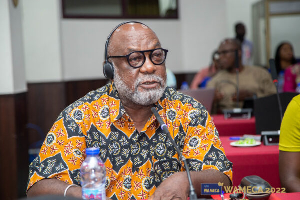
 Professor Kwame Karikari is founder of Media Foundation for West Africa (MFWA)
By the Grace of God, Professor Kwame Karikari, founder of the award-winning Media Foundation for West Africa (MFWA), turns 80 today, Wednesday, July 16, 2025.
A renowned professor of journalism and mass communication, he is also widely acknowledged as “an activist of freedom of expression, social justice and democracy in Africa”.
The pacesetting Foundation he established in 1997 is arguably the best-known and most respected institution of its kind in the sub-region. Similarly, his name has resonance in international media as an erudite, bold and vocal advocate of free expression but responsible, quality media practice.
Its latest international award was won by MFWA’s accountability journalism project, The Fourth Estate, in the ‘Media and Information Category’ in the 2024 World Justice Challenge.
Such has been the value of Prof Karikari’s contribution to media advancement in Ghana as well as in the sub-region, that one wonders why successive Ghana governments have not honoured him with a State Award.
There are planned events to celebrate Prof’s attainment of this landmark age – although seeing how spry he looks, one feels like asking to see his birth certificate for confirmation of his octogenarian status!
Still, I feel it would be totally remiss of me if I didn’t add my personal testimony, my salute to a senior colleague, friend and ‘brother’. He has been an inspiration and support to me in my journalism career, the myriads he has mentored not only in Ghana but also in the sub-region and, conceivably, even beyond.
I first met Kwame Karikari in 1981, when I was the Greater-Accra Chairperson of the Ghana Journalists Association (GJA). I was looking for a guest speaker to give a talk, as part of a monthly lecture series my executive had launched. I asked colleague Kwesi Cab-Addae, then with the Ghanaian Times if he could suggest a topic, as well as a speaker.
Mr Cab-Addae (now a lawyer in Cape Coast) promptly suggested the topic ‘Mass Media and Democracy’ and gave me the name of an academic, Kwame Karikari, who he felt would do a good job. Other colleagues confirmed that he was someone who was making waves with his stimulating views and noted for his frankness.
Mr Karikari and he readily agreed to be our speaker for September and gave an incisive, powerful lecture that was much applauded by our members. My diary entry for that day, September 5, 1981, sums it up simply as “Karikari lecture very successful”.
Despite coming from a humble background, he had managed to go to the USA, where he studied for his first degree at the City College of New York, then at the famous Columbia University for a Master’s degree in Journalism. On returning home in 1979, he was appointed lecturer at the University of Ghana, Legon; later earned Professor status, and served as Director of the School of Communication Studies.
Prof took an academic career break to serve as Director-General of the Ghana Broadcasting Corporation 1982-84.
We kept in touch, especially as from time to time we met at various media events. He was so approachable and supportive to all who needed his guidance that I took to consulting him on general professional issues, as well as on my career advancement.
In 2008, when I resigned from my position as Editor of the Ghanaian Times, he was helpful with advice and even with my job hunting. Thus, when the MFWA decided to launch a Ghana Media Standards Improvement Project (GMSIP), I was one of the applicants for the job of Coordinator and was appointed to the position after an interview by a panel.
The GMSIP initiative was a collaboration of the MFWA and the GJA, funded by the Royal Danish Embassy. The two-year project, launched on June 17, 2009, was an initiative to develop, particularly a culture of investigative and analytical journalism in the country. By the time it ended, we were gratified to hear that participating newsrooms were now referring to “doing it the GMSIP way”.
It involved 16 media houses nationwide – ten radio stations and six newspapers. A number of highly experienced media experts were recruited as resource persons for the training programmes that were central to the project’s aims.
Participants benefited from classroom programmes, complemented by on-site visits, during which the experts spent five days at each of the participating media houses to help underpin the theory with practical, on-the-spot guidance.
A special component of the project was the inclusion of campus radio stations, which even led to the formation of a Campus Radio Association of Ghana.
GMSIP training took us to Aburi, Sunyani, Tamale, Ho, Koforidua and Kumasi, with some unforgettable takeaways. I recall that in Kumasi, the participants reached consensus that the poor standards of some radio stations could also partly be linked to the fact that some rich people establish radio stations, purely as a commercial venture and thus dictate to their staff how the station should operate.
A memorable quote that Prof still likes to cite from that meeting was what one radio station owner reportedly constantly told his staff trying to work professionally: “I’m an investor, not an investigator” (meaning not a journalist).
That quote, a light-hearted view of a cynical attitude, also serves as a glimpse into Prof Karikari’s great sense of humour. Another unmistakable trait is his evident preference for a simple lifestyle, clearly attributed to his roots, his upbringing in his hometown, Akim Awisa, in the Eastern Region.
Prof once told an anecdote of how the last time he wore a suit to a function, because most of his friends had never seen him wearing one, even though he was sitting among them, they didn’t recognise him. He kept hearing people asking, “But where is Prof?” The suit had completely disguised him!
As indicated, Prof’s dedication to quality media and support for the profession extended well beyond the borders of Ghana. One outstanding evidence of this was the assistance he gave Liberian refugee journalists who had sought asylum in Ghana during the civil wars in their country.
He helped them to launch a newsletter for their community, Exile News, “to provide news and information on life in exile, and a means of rallying the refugees together for mutual support,” he explained. I, too, was involved with the newsletter as Prof charged me to assist them.
Demonstrating his principled, democratic credentials, some years ago, he handed over leadership as the Executive Director of the MFWA, content to be now just a board member. (Incidentally, Prof and I have previously served on the Board of the Graphic Communications Group Ltd, which he chaired.)
Formerly Dean of the School of Communication Studies at Wisconsin International University College, Accra, he now teaches there only about six hours a week. “Just to keep active and purposefully busy,” he told me in an interview earlier this week.
Currently, Prof is on a state duty, as one of the eight-member Constitution Review Committee (CRC) appointed by President John Mahama in January, soon after taking office.
On the CRC appointment, he views it as “such a great learning experience. It's quite an honour, and I am very grateful for the recognition that I still have something to offer our dear country. (Also), I am extremely honoured to work under the chairman of the Committee, Prof Kwasi Prempeh.
“He is among the scholars of the highest calibre I have come to know over the years. And I have grown to know many. The Government could not have chosen a better leader for this critical national assignment.”
Asked about any consultancy work at present, he responded poignantly, with typical humour: “No consultancies. I have learned very well the meaning of ‘retirement’. It means nobody needs you anymore. Discarded.”
Prof is married to Dr Rose Mensah-Kutin, Director of Abantu for Development and has “six children from two marriages; four girls and two boys and nine grandchildren.” (Abantu is a non-governmental international organisation focused on women's rights and social justice.)
One of the birthday activities is a public lecture on Thursday, July 17, at the Teachers Hall, Accra, on the apt topic Celebrating a life of commitment and service to free expression, democracy and social justice.
As indicated, despite the fact that Prof’s work and achievements have long put Ghana on the international media map, the State is yet to show its appreciation. Asked about that, he said with typical modesty: “I don't really know for what I would deserve something like that. The most memorable award I ever received was in 2000, given to me by the people and chiefs of Awisa, my hometown, for contributing to the education and development of the town.”
Surely, Prof Kwame Karikari deserves State recognition. Without doubt, his vision, innovative direction and selfless mentorship have impacted media progress in West Africa. I believe that his lifetime of “commitment and service to free expression, democracy and social justice” merits a national award, a complementary upgrade from the Awisa perceptive recognition so long ago.
Furthermore, a gem like Prof Karikari can’t be left feeling “discarded”.
But for now, I take the liberty of saying on behalf of the media fraternity in Ghana in particular, and in West Africa in general, HAPPY 80TH BIRTHDAY, PROF!



Copyright © 1994 - 2026 GhanaWeb. All rights reserved.










