



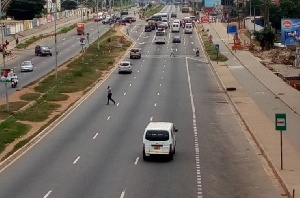
 Traffic on a highway in Ghana
Accra’s traffic is a national embarrassment. For years, successive governments have promised to fix the gridlock, yet the city remains suffocated by congestion so severe that traffic management has practically become the top priority of the Ghana Police Service—sometimes at the expense of crime prevention.
The problem isn’t that Accra lacks decent roads. The city has them. The problem is that those roads are clogged with bottlenecks: traffic lights at every turn, poorly designed intersections, and roundabouts that no longer serve their purpose in a city of over 2 million daily commuters.
The result is a transportation system that traps workers for hours, stifles business, and bleeds productivity out of the economy.
Consider the N1 Highway—arguably Ghana’s most important roadway. Instead of functioning as a true expressway, it is littered with traffic lights that interrupt flow every few kilometers. In most global capitals, such an artery would be signal-free, with interchanges or overpasses ensuring uninterrupted movement. Instead, the N1 has been reduced to a glorified urban street.
Or take the 37–Giffex Road, which links key government and business districts. Here too, traffic lights reign, where a modern interchange should stand. And yes, there is even a traffic stop in front of the Jubilee House, the seat of government. What does it say when even the presidency is not insulated from the dysfunction of Accra’s roads?
Meanwhile, citizens are left scrambling for space—SUV drivers muscle ambulances and fire trucks off the road, sirens blare from unauthorized vehicles, and the wealthy rely on police escorts to bulldoze through clogged intersections. For ordinary Ghanaians, the daily commute feels less like city driving and more like survival of the fittest.
What Needs to Change
The solutions aren’t rocket science. They’re the same fixes cities around the world have already implemented:
Interchanges Instead of Lights: Replace the worst choke points—37, Kwame Nkrumah Circle, Tetteh Quarshie, and Spintex—with modern interchanges, tunnels, or flyovers. These are the intersections that hold the city hostage during rush hour.
Signal-Free Expressways: Clear the N1 of traffic lights. Convert it into a true freeway with limited entry and exit points, like highways in the U.S. or Europe. The Accra–Tema Motorway, for instance, should never have been allowed to deteriorate into a patchwork of potholes and stop points—it must be rebuilt as a true, continuous expressway.
Dedicated Emergency Lanes: On major roads like Independence Avenue, Spintex, and the George Bush Highway, mark out emergency lanes for ambulances and fire tenders. This isn’t just a traffic issue—it’s a life-and-death matter.
Smarter Urban Planning: New developments, especially in East Legon, Adenta, and Pokuase, must integrate feeder roads that distribute traffic instead of dumping every car onto one or two main arteries. Cities like Nairobi and Lagos are already experimenting with bypasses and ring roads to take pressure off the center. Accra should do the same.
Enforcement and Citizen Responsibility: Citizens have a role too. Drivers must respect lanes, avoid blocking intersections, and stop treating sirens as toys. Enforcement should be swift, visible, and unforgiving for offenders who worsen congestion.
A New Way of Thinking
Accra doesn’t need more roads—it needs better roads. Roads that allow traffic to flow freely instead of stuttering at every red light. Roads that prioritize movement over chaos. Roads that make room for everyone, from buses to ambulances.
The chaos on our streets today is not inevitable. It is the result of poor design, weak enforcement, and a failure to prioritize efficiency. If authorities have the courage to launch a “war on bottlenecks”, Accra could finally become a city where traffic doesn’t strangle its future.
Until then, the capital remains a city in gridlock—an economy idling in neutral

Copyright © 1994 - 2026 GhanaWeb. All rights reserved.










