



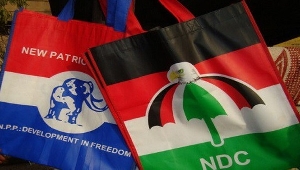
 Party flags of NPP and NDC
If you listen carefully to conversations across Ghana from social media discussions to market debates, university campuses, and diaspora forums one uncomfortable sentiment keeps surfacing: many Ghanaians increasingly feel that the country’s two dominant political parties, the NDC and the NPP, are not solving Ghana’s problems but may actually be part of them.
Whether this perception is fully justified or not, it reflects genuine frustration, especially among young people struggling with unemployment, rising living costs, and uncertain futures.
Political rivalry is overtaking national progress
Ghana’s democratic stability is rightly admired across Africa. However, political competition between the NDC and NPP has increasingly taken an adversarial tone that often looks more like a struggle for power than a collaboration for development.
Parliamentary debates frequently appear less about solving national challenges and more about defending party positions, discrediting opponents, and preparing for the next election cycle.
Policies started by one administration are sometimes abandoned or rebranded simply because they originated from the opposing party. This lack of continuity wastes resources and slows national progress.
The endless credit-and-blame game
Another worrying trend is the constant attempt by political actors to claim personal credit for national infrastructure while blaming opponents for every difficulty. We repeatedly hear statements like “Akufo-Addo did this” to undermine the NDC or “Mahama did that” to discredit
the NPP.
But the truth is simple: those projects were funded by Ghanaian taxpayers, national loans, and collective national resources. They do not belong to individuals or parties. Turning development projects into partisan trophies only deepens division.
Indeed, the obsession with scoring political points has increasingly become a disease in Ghanaian politics fundamentally a governance-mindset problem.
As I argue in Shifting Mindsets for Sustainable Development in Africa: A Political Economy Perspective, development slows when leadership prioritizes partisan victory over national purpose. This adversarial
mindset weakens institutional continuity, deepens polarization, and undermines the collaborative leadership Ghana urgently needs.
Economic hardship is fueling youth disillusionment
Ghana’s recent economic difficulties inflation, debt pressures, IMF interventions, and persistent youth unemployment — are not abstract statistics. They affect real lives. Many young Ghanaians are questioning whether alternating between the two major parties has truly improved
their prospects.
Migration aspirations are rising, informal employment is expanding, and trust in political leadership is declining. When hardship persists despite changes in government, people naturally start asking whether the political system itself needs rethinking.
Trust is eroding
Allegations of corruption, patronage politics, and economic mismanagement continue to surface from both sides of the political divide. Each election cycle often brings mutual accusations instead of clear, forward-looking national strategies.
This fuels a troubling perception among citizens that political elites sometimes protect each other while ordinary Ghanaians bear the consequences. Whether entirely fair or not, this perception
weakens democratic trust.
The real issue may be mindset, not just party
Ghana’s development challenge may not simply be about whether the NDC or NPP governs. It may be about the broader governance mindset shaping political leadership.
Short-term electoral thinking often overrides long-term planning. Patronage sometimes overshadows meritocracy. Policies change too frequently with new administrations. And many young people feel excluded from meaningful participation in national decision-making.
Sustainable development requires a shared national vision, policy continuity, and leadership maturity that rises above party lines.
What must change
Ghana needs a shift toward political maturity where national infrastructure and policies are seen as collective achievements, not partisan victories. Youth employment, entrepreneurship, innovation, and education reform must become central priorities rather than campaign slogans.
Stronger institutions are essential for accountability and continuity, but citizens also have a responsibility to demand performance, integrity, and unity from political leaders.
A question Ghana must confront
Many Ghanaians are now asking a difficult question: are political parties genuinely working for national development, or primarily for political advantage?
Democracy is not just about elections. It is about responsible governance, national cohesion, and improving citizens’ lives. Ghana has immense potential talented people, democratic stability, natural resources, and global goodwill.
But unlocking that potential requires political maturity,
policy consistency, and a shared national purpose that goes beyond partisan competition.
Until then, public frustration especially among the youth will likely persist.

Copyright © 1994 - 2026 GhanaWeb. All rights reserved.










