



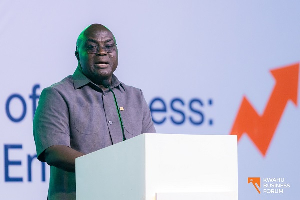
 Chief of Staff, Julius Debrah
In today’s political environment, leadership is too often judged by volume rather than value. Loud voices dominate headlines, aggressive rhetoric is mistaken for boldness, and public confrontations are frequently celebrated as signs of strength.
Yet, politics and governance have repeatedly shown that true leadership is not always loud. Sometimes, the strongest leaders are those who remain calm under pressure, measured in response, and strategic in execution.
This is why the growing tendency to mistake Julius Debrah’s calmness for weakness deserves deeper reflection.
Within the National Democratic Congress (NDC), conversations surrounding the future of leadership beyond President John Dramani Mahama’s political era continue to emerge in subtle but significant ways.
While the party has not officially opened discussions on succession, political watchers, grassroots members, and party loyalists continue to mention names believed to possess the experience, maturity, and temperament necessary to guide the party into the future. Among such names, Julius Debrah consistently appears in political conversations, even though he has made no public declaration of any future ambition.
Yet, one observation continues to surface in political discussions his calmness. Unfortunately, some interpret it as political softness or a lack of aggressiveness. But leadership is not always defined by who speaks the loudest or fights the hardest in public spaces. In many instances, leadership is about judgment, emotional discipline, relationship-building, patience, and the ability to unify competing interests.
Julius Debrah’s political style reflects a man who understands the importance of strategy over spectacle. Throughout his years in public service and governance, he has demonstrated an ability to engage across political lines, maintain composure during politically sensitive moments, and build relationships that extend beyond partisan divisions. These are not signs of weakness. They are often indicators of political maturity and quiet confidence.
The mistake many make in politics is assuming that calm leaders are passive leaders. History teaches otherwise. Some of the most impactful political figures have exercised influence not through noise, but through persuasion, discipline, and steady leadership. Calmness, when backed by experience and wisdom, often becomes an asset rather than a liability.
As the NDC gradually evolves and future leadership conversations inevitably emerge, party faithful must be careful not to confuse humility with weakness or composure with indecisiveness. Political organizations thrive not only on charisma and mobilization but also on stability, trust, and leaders capable of managing internal unity during difficult moments.
In times of uncertainty, political traditions often require leaders who can bridge divides rather than deepen them. Leaders who can inspire confidence without unnecessary hostility. Leaders who understand that strength is not always demonstrated through noise, but through consistency, restraint, and purposeful engagement.
Julius Debrah’s calmness should therefore not be misunderstood. Beyond the politics and beyond the noise lies a leadership style rooted in patience, maturity, and strategic thinking. What some perceive as silence may, in fact, be quiet strength preparing for the right moment.
In politics, calmness is not weakness. Sometimes, it is leadership in its most disciplined form.
Citizen Kofi Owusu
Citizenspeaks Columnist
#Citizenspeaks

Copyright © 1994 - 2026 GhanaWeb. All rights reserved.










