



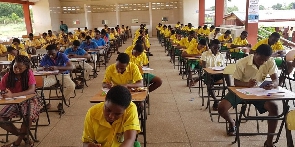
 Some students sitting for an examination | File Photo
Every year when the WASSCE results drop, as Ghanaians, we suddenly “rediscover” that we have a maths and science problem. Then the outrage cycle passes until the next results. This year is no different, except the numbers are particularly alarming.
Provisional 2025 WASSCE data show Core Mathematics passes (A1–C6) have dropped significantly to about 48%, down from roughly 67% just last year; about an 18 percentage-point decline in a single year.
Depending on which report you read, over half of test takers failed the maths exam (you need A1–C6 in maths to be accepted into university), so what this result means is that more than half of WASSCE holders in 2025 can’t enter university. Integrated Science is following a similar pattern of decline in student performance.
I am glad more people are finally paying attention to what is happening in our schools but we need to be honest here: WASSCE results are only a symptom, not the disease. If we use only WASSCE scores to diagnose the state of math and science education, we will keep treating the symptoms while ignoring the actual infection.
THIS CRISIS DIDN’T START WITH WASSCE 2025
Research has been ringing the alarm bell for decades. For instance, Ghana’s performance in international assessments like the Trends in International Mathematics and Science Study (TIMSS) which measures the maths and science knowledge of fourth- and eighth-grade students globally has been consistently below the international average (500 on the TIMSS scale). We participated in 2003, 2007, and 2011, and in all these years we scored below the international average.
In fact, in our last entry in 2011, out of the 42 participating countries in the Grade 8 test, Ghana recorded the lowest average score (331), placing us at the bottom of the performance distribution for that cycle. Ghana has not appeared again in TIMSS to date.
Scholars like Drs. Kofi Mereku, Anamuah-Mensah, Hamid Armah and many others (including my recent work in STEM) have been writing about the mathematics crisis in Ghana over the past two decades. At the same time, the World Bank and UNESCO introduced the concept of learning poverty; the percentage of 10-year-olds who cannot read and understand a simple text.
Globally, this stood around 57–70% in low- and middle-income countries pre-COVID. The current data shows a significant decline. Ghana regularly appears in analyses as a country struggling with foundational literacy and numeracy.
And we don’t need external bodies to tell us this issue. Our own National Standardised Test (NST) for Basic 2, 4 and 6 showed worrying patterns from 2021–2024. The 2022 P4 NST and the more recent 2024 P4/P6 NST found large proportions of learners below basic proficiency in English and Mathematics around a third or more of P6 learners are below average proficiency in maths (NaCCA, 2024).
These are the same children who will sit BECE and WASSCE in a few years. So the WASSCE story is not new. It is simply the most visible point of a long, predictable pipeline of under-learning. As a researcher, I acknowledge the limitations of these tests; however, when looked at collectively with other learning indicators, they are helpful in telling us where we are as a country.
OUR BIGGEST PROBLEM IS THAT WE ARE GOOD AT TRACKING EXAMS, NOT LEARNING
One of the most frustrating things coming from my experience as a researcher in this area is how little coherent learning data researchers and policy actors generate and use in Ghana. The Ministry of education and Ghana Education Service have failed to track learning trajectories in all the core subjects. Ghana currently have BECE and WASSCE and now early grade and basic school assessments like NST.
What the country lacks is a connected picture of what happens to a child’s numeracy skills from KG1 to JHS3. When exactly do they start to fall behind? Which schools are unable to move students from ‘below basic’ to ‘proficient’? And in which regions do the policymakers see the learning opportunities and challenges? By the time the system “discovers” the problem through BECE or WASSCE, the damage has already been done. You cannot fix 10–12 years of weak foundational numeracy with last-minute SHS teaching.
GHANA’S STEM FUTURE IS AT STAKE
Ghana is aggressively struggling with maths and science and we have a crisis. We are, by some measures, one of the SSA countries with the highest public spending on education. Student achievement in STEM subjects, however, is not keeping pace with investment, nor with the demands of a digital and AI-shaped future.
Where is our future in this technological era? AI, data science, epidemiology, engineering, green technologies; a rest on strong mathematics and science foundations. If we continue on this path, Ghana will still be importing the STEM capacity it needs for its own development. My argument is that the current WASSCE results are not just about grades; they are an early warning about our industrial, technological and innovation futures.
WHAT ACTUALLY NEEDS TO CHANGE?
Here I provide some policy directions to whoever is willing to listen.
1. BUILD A SERIOUS LEARNING DATA ECOSYSTEM
– Create opportunities for robust, routine assessment of learning, not just exam performance. The 2021, 2022 and 2024 NSTs gave us a baseline. We shouldn’t let these reports gather dust. Policymakers should use them to identify where learning is collapsing and which schools need intensive support.
– Track cohorts over time. A learner who is “below basic” in P4 maths does not magically become a WASSCE A1 candidate. We need longitudinal tracking from early primary through SHS. The Ministry of Education and GES should make data public and prioritise transparent sharing of learning outcomes.
– Parents, districts, and teacher unions should all be able to see patterns and push for targeted interventions. PTAs have collapsed over the years; we need stronger school-community engagement to drive this forward.
2. FIX THE CULTURE OF FEAR AROUND MATHS AND SCIENCE
– My research in Ghana has shown that there is rising math and science phobia among learners. It is common to find many students saying, “I’m not a math person,” “science is not for me.” Students self-exclude before the subject even has a chance. That belief doesn’t come from nowhere; it comes from how we teach students. We need to be serious about pedagogy.
– Across Ghana, many children encounter maths and science through humiliation for getting answers wrong, rote procedures without meaning, and chalk-and-talk pedagogy with no manipulatives or lab work.
– Changing how we train and retrain teachers to use current approaches that are culturally relevant and contextual to the Ghanaian learner is integral here.
– We need to resource schools. Take a sample of 1,000 public JHS: how many can run meaningful science experiments? Probably fewer than 10 JHS and primary schools would have a functional science lab.
– Our children shouldn’t have to wait until SHS before they know that acids and bases are not just topics in a textbook.
3. TAKE INDIGENOUS LANGUAGES AND KNOWLEDGES SERIOUSLY
My work and many others’ have shown that Ghanaian students often understand mathematical ideas better when introduced in Ghanaian languages and linked to cultural practices. We can’t talk about learner variability and then insist that everyone must encounter learning only in English with completely foreign examples.
If we are serious about foundational numeracy, we must allow and encourage concept development in local languages in the early and middle years; draw on Indigenous Ghanaian numeracy practices, spatial reasoning, trade, craft, and everyday problem-solving as legitimate STEM knowledge.
4. BUILD A STEM CULTURE
Dr. Yaw Osei Adutwum’s STEM schools initiative is a good start, but we need policy continuity from whichever government is in power. Nkrumah’s original vision considered STEM as a backbone for national development, in tandem with strong humanities and social sciences.
To cultivate a genuine STEM culture, our leaders and policymakers should:
– Provide scholarships and targeted incentives for students (especially from rural, low-income and marginalised communities) to pursue STEM and stay in the field.
– Start career exposure very early especially for girls. Let primary and JHS students see women scientists, engineers, coders and agricultural innovators who look like them.
– Intentionally create national and district-level STEM clubs, build on NSMQ, and create opportunities for students to continuously demonstrate their knowledge and skills.
5. INCLUDE TEACHERS IN ALL REFORMS
– Teachers are not the enemy of reform; they are the policy implementers. Any serious educational reform must include the voices of teachers.
– Provide ongoing, job-embedded professional learning and avoid one-off workshops.
– Improve working conditions and incentives for teachers. Class sizes of 60+ are not compatible with meaningful teaching and learning.
– Extend attention beyond SHS. Primary and JHS teachers lay the numeracy foundation that WASSCE later exposes.
– Support faculties of education and Ghanaian researchers with funding to study what works in our context — and then actually use that evidence in policy.
In conclusion, we should absolutely be concerned that nearly half of candidates are not achieving basic passes in Core Mathematics, and that large numbers are struggling in Integrated Science, but if we fixate only on this year’s WASSCE or use it as a political football, we will miss the point.
WASSCE results tell us a single story of performance at the end of secondary schooling, under high-stakes exam conditions, with all the distortions that it brings (cheating scandals, exam anxiety, rote teaching to the test). It cannot, on its own, explain:
– Where along the educational journey learners started falling behind
– How language of instruction shaped understanding
– How class size, teacher preparation, and school resourcing interacted
– What role gender, location, and socioeconomic status are playing in STEM outcomes
Educators and policymakers should seriously stop doing crisis management based solely on exam headlines and start getting their hands dirty in fixing these issues.
The writer, Dr Kenneth Gyamerah, is at the Frazer Faculty of Education, Ontario Tech University, Canada

Copyright © 1994 - 2026 GhanaWeb. All rights reserved.










