



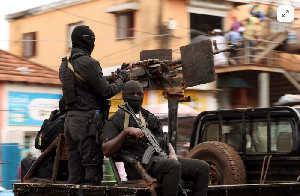
 There seems not to be a permanent solution to coup d'état and civil unrest
There has been extensive research and scholarship on what constitutes sustainable governance in the nations of the world. Depending on the circumstances, mostly determined by economic factors, leadership accountability, and personal interests, citizens call for change in political leadership.
Sometimes the conditions are such worse that the people are not able to exercise patience to make legitimate change or make peaceful transfer of power between successive governments; and they resort to using force, such as military takeover and civil unrest, to seize power from the political actors.
In this write-up, I seek to touch on why I think neither democratic rule nor military rule offers the solution to sustainable government. It also seeks to address the urgent need for nations of the world—especially African leaders—to begin to see political positions as an opportunity to serve their people rather than the leadership advantage it gives.
The Holy Bible, in the book of Genesis, tells that God created all things—evidence of the absoluteness of God’s authority, power, and control over all things, to make and unmake.
God formed man with soil from the earth He created, and breathed life into the mould to become a living being. It is like ‘He breathed Himself into being’ - and this is confirmed in Genesis 1:27 that God created man in His own image. God breathed into man — for man to become a soul. Yes, he breathed into us, poured his nature into us—and hence, there is God in every man.
All things set into motion or cease at the call of God. He does express the absoluteness of His power through the seasons he set —through the sun, moon, stars, rain, harmattan, winter, summer, rain, day, night, life, death, sowing, reaping, harvest, procreation, etc. No activity of any of his creations can oppose this absoluteness. The time and seasons are the daily evidence of God’s power.
Because of the nature of God in men, men are naturally drawn to power — and every man has that innate desire to control, seize power and exercise authority over his contemporaries. In my opinion, human ambition and the desire for control are directly linked to the "nature of God" within humanity. Man has natural desire for power. Historically, there has always been that struggle over who should exercise sovereignty over others.
This includes: the struggle over who should be the chief spending officer of financial resources; the struggle over who should be the chief recruiting officer; the struggle over who should be the head or leader in a group of people in a settlement to control their security, health delivery, education, finance, policy direction, law, justice system, etc.
These struggles are the order of the day. There is therefore this natural tendency for men to fight among themselves in order to seize this power to exercise control or authority over others. There is an innate desire in every man not to be subservient to the control of others—this is the energy that drives opposition, rebellion, and betrayal.
The maid wishes she were the one who were the master; the janitor wishes his status were exchanged with that of the boss. Ordinarily, one hardly sees a coordinate class of workers (workers at the same level) fighting over rights to do more work if that responsibility doesn’t come with an additional bonus, advantage, or recognition.
Once they are all entitled to the same remunerations, regardless of how hard or well one works, the practice is that they rather find excuses to reduce their workload. Naturally, men do not fight one another in their service to humanity , and the struggle comes into the picture when the service is only in name and form but its real value is leadership, control, authority, power, and influence over others.
When the goal is pure altruism or genuine help for others, people are generally willing to cooperate. Service, in its purest form, unites people around a common, external purpose. The spirit of service gets satisfaction and fulfillment by doing more for the welfare and interest of only those it serves.
It does not force for recognition or does not force to hold on to its service when the people it serves see it to be of no importance or relevant any longer. However the one with the leadership mindset is rather driven by his innate desire to be the star among the lot and to be the one to call the shots.
And because this is driven by his or her insatiable human desire, there is the natural tendency of wanting to hold on to the leadership role and the power that comes with it—even if he or she has outlived the usefulness of his responsibilities.
Holding on to power requires a lot of work: specifically, to have and keep the majority on your side. The majority comes in the form of men (either in votes or armed forces), arms, or money. The majority called ‘money’ has been the common denominator and currency used to trade this power—and without it, it is difficult for one to keep the majority, as it is needed for transportation, food, water, security, and general maintenance.
As it increasingly becomes difficult to meet all these needs, the likelihood is that one would use whatever means available to him or her —in order to have the value, ability, and capacity to trade for this power. This is the point where corruption and illegalities set in in order to keep the majority and hold on to power.
There seems not to be a permanent solution to coup d'état and civil unrest, because democracy has not offered that. Coup d'état might keep recurring—and in recent times, countries like Guinea, Benin, Guinea Bissau, Sierra Leone, and Burkina Faso are quintessential examples to draw wisdom from.
This is so because naturally, man does not want to be subservient to another man—and that is the reason for power struggle. When unarmed civilians become fed up with the rules of a tyrant, they are able to cause unrest, go on a rampage to change or overthrow a government.
A classic example is what happened in Sri Lanka in the year 2022, when protesters stormed the presidential palace in Colombo, driven by the country’s worst economic crisis in decades, to demand the resignation of the president. The civil unrest worked out for them - because the president fled to Singapore, and later resigned.
It is important for one to ponder on this, that if unarmed men can go this far in their quest to seek justice, imagine what armed men (military) can do when they begin to feel subservient to the management and corruption of a tyrant?
Man’s desire for power is innate—and this desire for power is insatiable. The focus on wanting to hold on to this power increases one's desire to obtain the majority of resources over others to keep this power - and this eventually leads to illegalities and corruption. When corruption becomes the order of the day, the people feel exploited and cheated, and advocacy begins.
However, as is always the case, power holders will use their majority to intimidate and suppress these voices, because the few who advocate cannot fight back. Eventually, the armed factions of the aggrieved populace (such as military, insurgent, and vigilante groups) begin to reason that if the justice system has failed and the voices of 'great minds' are ignored, they must resort to force to fight the political class's domination and restore the natural order of equality, mutual respect, and opportunity for all.
Man's innate desire for power would cause these armed leaders to perpetuate the cycle by holding on to power, a pattern that continues indefinitely. It becomes clear that neither a coup d'état nor a military takeover offers a lasting solution to tyranny; likewise, representative or majoritarian democracy offers no better option for good and sustainable governance.
Coup d'état is not the answer, and neither is majoritarian democracy, for the problems that they seek to remedy are still with us. What then constitutes the good and sustainable governance—that which makes a country great? Jesus Christ taught his disciples that “whoever would be great among you must be your servant … “ (Matthew 20:26-28). This teaching emphasises an idea of leadership, where greatness is tied to serving others, not dominating them - and the wisdom in this verse is useful to all generations including ours.
It touches on ‘service’ - that service is the key to greatness or building a great empire. People seldom become aggressive in their struggle to take power from a leader who exhibits a ‘spirit of service’ and demonstrates servant leadership. A leader who takes delight in exercising control, dominance and influence over the people is a leader who, however, faces intense opposition and resistance from his subjects.
A leader who has the spirit of service does not cheat nor does he adore corruption. The spirit of service in a person replenishes him or her to bear the fruit of patriotism, love, loyalty, transparency, empathy, accountability, care, justice, fairness, equality, inclusiveness and responsibility to all citizens—which must be the bedrock and foundation to build greatness, and make a nation prosperous.
Without the spirit of service in leadership, even the most perfect system of democracy cannot guarantee good governance and sustainable democracy. When the goal is pure altruism or genuine help for others, people are generally willing to cooperate. Service, in its purest form, unites people around a common, external purpose.
We therefore must put the interest of our dear nation, Ghana, at heart and build Ghana with an attitude and culture of genuine service—to make her great, strong and prosperous.
May God keep blessing our dear nation, Ghana.

Copyright © 1994 - 2026 GhanaWeb. All rights reserved.










