



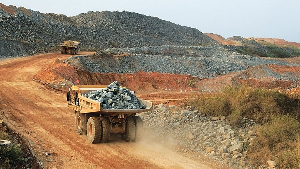
 File photo of a Damang Mine
I am not against any form of localisation or nationalisation drive in our mining sector by government.
As a matter of fact, in a 2022 thesis I submitted at the University of Mines and Technology (UMaT), where I studied the “Relationship Between Mineral Revenue and Economic Growth in Ghana: 1990–2020,” I made some revealing findings:
1. I found that US$68.8 billion worth of major minerals—such as gold, bauxite, manganese, and diamond—were exported over the study period.
2. Gold exports alone accounted for US$65.6 billion.
3. Government revenue (using royalties, corporate taxes, and PAYE as proxies) amounted to only US$6.6 billion, representing roughly a 10% net gain from the sector.
I am not particularly aligned with the Chamber’s use of overall effective tax rate metrics.
In concluding my study and making recommendations to government, I stated that:
“Government should develop a model that enables Ghanaians to hold significant shareholding structures in existing and future large-scale mining projects. This will help mitigate capital flight of mineral proceeds by multinational companies through repatriation privileges embedded in our own laws. It will also support the emergence of strong local players, ensuring that a greater portion of mining proceeds remains within the country.”
Verdict
I support all initiatives that will boost local participation in our mining sector. However, procedure must be clear to avoid any State Capture that may damage the intent.
Nationalisation/Boosting Localisation in Our Mining Sector: The Case of Damang Main Lease Extension Rejection
In an article dated April 13, 2025, I expressed concerns that government’s handling of the Damang lease lacked clarity and could potentially damage Ghana’s reputation as a mining investment destination, while also exposing the country to possible judgment debts. The matter actually made waves in the international media, which gave Ghana some bad image.
Subsequently, President John Dramani Mahama acted swiftly by initiating a one-year transition period between Abosso Goldfields Limited and the Government of Ghana. On April 18, 2026, that transition ends.
I am of the opinion that, Government’s localisation agenda, in the national interest, must be grounded in policy and law and not triggered only at the point of lease expiry of companies.
Below are my reflections as a citizen and natural resource governance enthusiast:
1. Government must act in a transparent and legally compliant manner to avoid unnecessary judgment debts. (Reference should be made to the International Centre for Settlement of Investments Disputes (ICSID) rulings in Tanzania, where similar actions resulted in penalties of approximately US$200 million against the government).
2. The push for nationalisation/localisation should not be perceived as an attempt to force Goldfields out of the lease. I still hold the view that, Government should instead renegotiate terms and explore joint venture arrangements, production-sharing models, or other prudent frameworks. At present, the State does not possess the full institutional and financial capacity to independently manage a large-scale mining operation.
3. Mining projects such as the Damang lease require significant time and capital to develop, with long payback periods. If investors perceive that lease renewals are driven more by discretion than by clear legal frameworks under the Minerals & Mining Regulations (Licensing) 2012, LI 2176, it could discourage reinvestment as mines approach expiry.
Without sufficient domestic capacity to fill the gap, this may threaten jobs, revenues, and community stability.
4. Government’s handling of the Damang lease must not be perceived as a subtle strategy to push Goldfields out. Such perceptions could weaken investor confidence and discourage continued capital deployment by other mining companies operating in Ghana.
5. If such perceptions take hold, the short- to medium-term consequences may include declining production, reduced foreign investment, job losses, and broader negative economic ripple effects.
6. Government must avoid being perceived as a state apparatus that can arbitrarily deny lease renewals. Even where legally permissible, unpredictability in regulatory and legal frameworks will deter serious investors.
7. Nationalisation/localisation should not be pursued only at the point of lease expiry. This sets a dangerous precedent and undermines long-term sector planning.
8. A country that struggles to mobilize even US$10–20 million for small-scale exploration cannot abruptly assume the financial and technical burden of full-scale nationalisation. I am not opposed to nationalisation but we must earn the capacity to implement it sustainably, not impose it prematurely.
How do we earn it?
9. Government must urgently complete the review of the National Mining Policy and clearly incorporate its localisation/nationalisation vision, with defined implementation timelines. This will allow stakeholders to plan accordingly. Parliament must play its oversight role.
10. Amendments to the Minerals and Mining Act, 2006 (Act 703) must be expedited and aligned with the revised National Mining Policy to give legal backing to this vision.
11. Government should consider entering into structured joint ventures with Goldfields and other operators as an interim pathway to localisation drawing lessons from successful global models.
11. Examples such as the Okavango Diamond Company (Botswana), ZCCM Investment Holdings Plc (Zambia), Codelco (Chile) and STAMICO (Tanzania) demonstrate how state participation can be enhanced without disrupting investor confidence.
12. Ghana may consider establishing a National Mining Company, similar to Uganda’s recent model, to coordinate state participation in partnership with private sector actors.
13. Ghana already has capable indigenous mining contractors—such as Engineers and Planners, Rocksure International, Rabotec etc. Government can form strategic consortia with such firms to partner multinational companies in resource development.
Conclusion
1.Ghana must first establish clear policies and laws to communicate its localisation agenda, with well-defined timelines for implementation.
2. Government should not attempt to independently manage the Damang Mine at this stage. If that becomes an option, the source of funding must be transparently presented and approved through Parliament.
3. I still think Government should table a compelling proposal to Goldfields that incorporates a structured localisation plan, including increased state participation.
4. All actions must be grounded in clear policy and law to avoid destabilising the mining sector.
5. Any re-award of the Damang lease must follow a transparent tender process, as stipulated under Regulation 258(c) of LI 2176, and must not be perceived as state capture.
What Ghanaians expect is not mere sloganeering around resource nationalism, but continuity, stability, and improved national benefit.
Auto dealers respond to 15% price cut announcement

Copyright © 1994 - 2026 GhanaWeb. All rights reserved.










