



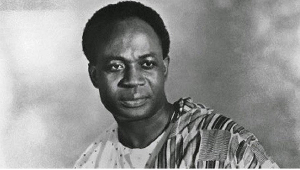
 File photo of Dr Kwame Nkrumah
More than six decades after independence, Ghana finds itself at an important crossroads. We have made remarkable progress in education, democracy, infrastructure, telecommunications, financial services, and regional influence. Yet beneath these achievements lies a difficult question that deserves honest national reflection.
Imagine explaining this to Kwame Nkrumah.
Imagine telling the man who led Ghana to independence that decades after lowering the colonial flag, Ghana still imports many of the products it has the resources, talent, and market to produce.
Not because Ghanaians lack intelligence.
Not because Ghana lacks raw materials.
Not because there is no demand.
But because somewhere along the way, we became more comfortable importing products than producing them.
This is not an argument against international trade. Every successful economy imports. Trade remains a critical component of economic growth and global competitiveness. The real issue is whether Ghana is doing enough to build productive capacity while continuing to consume what others produce.
Walk through any market, shopping centre, supermarket, or retail outlet in Ghana. The shelves are filled with products from China, Turkey, India, Europe, and the Middle East. Many of these products are affordable and accessible, and they serve an important role in meeting consumer demand.
However, a troubling question emerges: why are we spending so much capital importing finished products when we could be investing more aggressively in the machinery, technology, and expertise required to produce many of them locally?
The machine that manufactures a product is often more valuable than the product itself.
A shipment of imported goods may generate profits for a few months. A machine can create jobs, transfer skills, support local industries, and generate economic value for decades.
Every year, thousands of Ghanaian entrepreneurs travel abroad to purchase finished products for resale. They fill containers with goods and return home to distribute them through our markets. These entrepreneurs are not the problem. They are responding to opportunities within the economic system.
The question is whether our economic system is encouraging importation more than production.
Imagine if a fraction of the capital used to import finished goods was redirected toward acquiring manufacturing equipment. Imagine if entrepreneurs were supported not only to trade but also to produce. Imagine if groups of investors pooled resources to establish factories capable of manufacturing products that Ghana consumes daily.
The economic impact would be transformative.
New jobs would be created.
Local supply chains would emerge.
Foreign exchange pressures would be reduced.
Technical expertise would deepen.
Most importantly, wealth creation would become more sustainable.
One of Ghana's greatest achievements has been its investment in education. Across the country, universities, technical institutions, and training centres continue to produce talented graduates in engineering, science, technology, business, and related fields.
Yet an important question remains: what happens after graduation?
Too many talented young people leave school only to enter an economy that struggles to absorb their skills productively. Too many innovative ideas never move beyond the classroom. Too many capable engineers spend years searching for opportunities to apply their knowledge.
If Ghana can prioritise education, then Ghana must also prioritise industrialisation.
The true value of education is not measured solely by the number of certificates issued each year. It is measured by the industries created, the innovations commercialised, the technologies developed, and the jobs generated.
The next phase of Ghana's development should focus on connecting talent with capital.
We should identify brilliant minds in engineering, manufacturing, agriculture, technology, and applied sciences and provide structured support to help them establish enterprises capable of solving national problems.
We should create pathways that enable graduates to become industrialists, innovators, and manufacturers rather than merely job seekers.
This is where strategic international partnerships become important.
Countries such as China have demonstrated extraordinary success in manufacturing and industrial development. Rather than seeing such countries solely as sources of imported products, Ghana should increasingly engage them as partners in technology transfer, machinery acquisition, technical training, and industrial development.
The goal should not be to import more products.
The goal should be to import more productive capacity.
The goal should be to import more machinery.
The goal should be to import more industrial knowledge.
The goal should be to empower Ghanaian talent to build industries that create jobs and generate value locally.
Encouragingly, Ghana already possesses examples that demonstrate what is possible. The growth of local pharmaceutical manufacturing, agro-processing enterprises, and vehicle assembly operations shows that industrial development is not beyond our reach. These sectors prove that when policy, investment, and expertise align, local production can thrive.
The challenge is scaling these successes across more sectors of the economy.
Nkrumah understood that political independence was only the beginning. True freedom required economic transformation. It required a nation capable of producing, innovating, and creating value for itself.
That vision remains relevant today.
The challenge before Ghana is not a lack of talent. It is not a lack of resources. It is not a lack of ambition.
The challenge is whether we can transform our investment in education into industrial capacity, our entrepreneurial spirit into productive enterprises, and our consumption-driven economy into a production-driven one.
The future of Ghana will not be determined by the number of containers that arrive at our ports. It will be determined by the number of factories we build, the innovators we support, the technologies we adopt, and the industries we create.
Kwame Nkrumah's generation secured our political independence.
Our generation must complete the assignment by securing our economic independence.

Copyright © 1994 - 2026 GhanaWeb. All rights reserved.










