



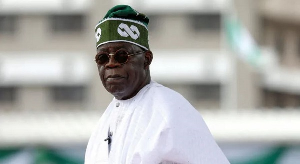
 President Bola Ahmed Tinubu
“We have corruption, insecurity, and many problems confronting us … but don’t pity me. I asked for the job. I campaigned for it. No excuses. I will live up to expectations, I promise you.”
— President Bola Ahmed Tinubu, Inauguration Dinner, May 28, 2023.
President Bola Ahmed Tinubu’s admonition that he should not be pitied for taking on the burden of trying to reboot a broken-down system of social and economic relationships is often cited. As general elections approach, it will be continuously repeated. The quote, like everything else, ought to be put in context; otherwise, it will lose its essence.
What Tinubu said in debunking any illusion of self-pity reminds one of the position of the Italian political philosopher Antonio Gramsci at a time when Italy was in dire straits, much like Nigeria is today. Gramsci, analysing a society in crisis, stated: “The crisis lies in the inability to move away from a failed system; because of this, a new society cannot be born. In the interregnum, all manner of morbid symptoms appear. We are in the age of monsters.”
Nigeria is indeed in the age of monsters. In this sordid interregnum, we see morbid symptoms: the country sleeps on a wheelchair even as criminal acts and their alarming consequences are taken for granted. To be fair to the President, he stepped into the lion’s den with a very risky bet that he could reboot the country—much like Lee Kuan Yew in 1965, Clement Attlee in 1945, and other courageous leaders before him.
Nigeria’s key problem, which Tinubu has the parliamentary majority to face, is a structural malfunction dating back to the reckless suspension of the 1963 Republican Constitution and, even more dangerously, the enactment of the utterly incomprehensible Decree 34 of 1966 by the Major General J. T. U. Aguiyi-Ironsi-led regime. That ill-advised decree, though later abolished, allowed the genie to escape the bottle, and all subsequent efforts to put it back have failed. Within this context, Tinubu displays a lionhearted bravery by attempting to put an end to the age of monsters.
It was always going to be difficult from Day One. For example, describing a country with 68 items on its Exclusive Legislative List as a federal state is a clear contradiction in terms. If a nation places more than a dozen items on its exclusive list, structural distortion is already underway. This is a key reason why Nigeria has constructed an uncompetitive state plagued by glaring institutional deficits. As the popular political maxim often puts it: “Federalism means that you eat what you kill.” This is perhaps the most succinct description of fiscal federalism available. It saves discerning minds from wading through volumes of scholarly works by well-known analysts such as Professor Ben Nwabueze.
In this vein, Tinubu, who clearly has a strategic roadmap, should be commended for the local government reforms and the recent submission of an Executive Bill for the devolution of internal security—colloquially referred to as state policing. These two measures are interwoven and indicate a vital realisation of the imperative to dismantle the roadblocks holding back the Nigerian state. Properly devolved and functional, local governments and policing systems will lead to the logical obliteration of the remaining barriers imposed by the Exclusive Legislative List. This will pave the way for a better-functioning society and a Nigeria that is truly competitive.
However, while these reforms—much like subsidy removal and forex modulation—are “game-changers”, they remain risky. Why is this so? Any social contract that remains elusive to the vast majority, or tilts towards the benefit of a few, is destined to fizzle away.
All things considered, a second Tinubu administration is highly recommended because Nigeria must gain a breath of fresh air by continuing to erase items from the debilitating Exclusive Legislative List. Sadly, none of his competitors possesses a similar history of taking a consistent, pro-federalist stance, nor have they clearly committed to dismantling post-1966 quasi-federalism or indicated which items they plan to remove. Therefore, with polling day approaching, it would be reckless not to stick with a candidate who has.
May the Lamb of God, who takes away the sin of the world, grant us peace in Nigeria!

Copyright © 1994 - 2026 GhanaWeb. All rights reserved.










