Ghana's fuel price debate has followed a familiar pattern for more than a decade. International crude prices rise, the cedi weakens, pump prices increase, and the government explains the adjustment through market conditions, taxes, levies and fiscal pressures. The opposition then challenges the explanation and argues that government policy is making the situation worse.
The striking feature of the current debate is that President John Dramani Mahama is now facing some of the same pressures his National Democratic Congress (NDC) once raised against the Akufo-Addo administration.
An examination of official petroleum price data, government statements, National Petroleum Authority (NPA) records and contemporaneous NDC statements shows that fuel prices increased substantially during Nana Akufo-Addo's eight-year presidency. They have also risen under Mahama since January 2025 — though unevenly, with significant reductions through parts of 2025 followed by sharp increases in 2026.
The Akufo-Addo years
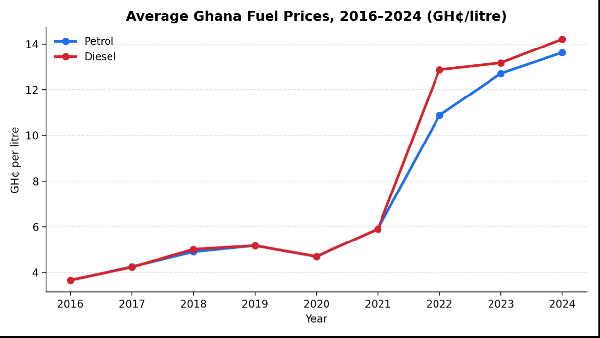
The clearest long-term comparison comes from the Energy Commission's petroleum price series, sourced from the NPA. Average petrol prices rose from GH¢3.66 per litre in 2016 — the last full year of Mahama's first term — to GH¢13.62 in 2024, Akufo-Addo's final year: an increase of roughly 272%. Diesel rose from GH¢3.67 to GH¢14.21 over the same period, about 287%.
The chart shows the pattern clearly: prices were broadly flat through 2016–2021, dipped in 2020 as the pandemic crushed global oil demand, then jumped sharply in 2022 as the Russia-Ukraine energy shock and cedi depreciation hit simultaneously—the single largest acceleration in the series. That 2022 jump does most of the work in the eight-year, 272–287% increase; it wasn't a steady year-on-year climb.
Ghana's downstream pricing was fully deregulated in 2015. Oil marketing companies set prices within an NPA-monitored formula keyed to international product prices and the cedi-dollar rate, so no government “sets” the pump price outright—it can only shape the outcome through taxes, levies, margins, and interventions.
The tax fight that defined the Akufo-Addo years
Fuel taxation was the sharpest point of political conflict. The Energy Sector Levies Act (ESLA), introduced under Mahama in 2015 to address energy-sector debt and fund power generation, was retained by Akufo-Addo's government and used to refinance more than GH¢8 billion in energy-sector debt by 2020. The NDC argued repeatedly — in 2019, 2021 and again in 2022 — that the government was blaming market forces while quietly raising the tax share of the pump price, and called for specific levies (the Special Petroleum Tax, the Energy Sector Levy, the sanitation levy) to be scrapped. The government's counter was historical: it said total petroleum taxes had risen far faster in the eight years before 2017 (28 pesewas to GH¢1.46 per litre) than in the Akufo-Addo years themselves (to about GH¢1.90), and that scrapping the Special Petroleum Tax alone would have cost about GH¢4 billion in revenue.
The 2022 shock made this argument moot for a while: Brent crude averaged about $99/barrel that year, the cedi depreciated over 15% in a single quarter, and diesel rose nearly 60% in under three months. Government's own response was to zero out the Price Stabilisation and Recovery Levy rather than touch the bigger revenue-generating levies.
Mahama's fuel story: a levy, then a shock
Mahama returned to office in January 2025 with the market in a very different position: the NPA floor stood at GH¢11.95 for petrol and GH¢12.82 for diesel. Falling international prices and a stronger cedi pushed those floors down through most of the year — to GH¢10.73 and GH¢11.11 by August 2025. That decline is the part of the story that complicates any simple “prices only go up” narrative.
Two things then changed it. First, in June 2025, Parliament approved a GH¢1 increase in the Energy Sector Shortfall and Debt Repayment Levy, taking it to GH¢1.95/litre on petrol and GH¢1.93/litre on diesel. Mahama's justification was structurally different from the market-pressure language of the Akufo-Addo years: he cited more than $3.1 billion in energy-sector legacy debt and a possible $1.8 billion further need to finance thermal fuel purchases, and the Finance Minister argued cedi appreciation would largely absorb the levy's cost to consumers.
Second, the 2026 geopolitical shock — the escalation of conflict involving the US, Israel and Iran, and fears over the Strait of Hormuz — hit international product prices hard. NPA CEO Godwin Edudzi Tamakloe said the price of a metric tonne of diesel on the international market rose from about $794 in February 2026 to roughly $1,519 by September — nearly doubling. Government's response this time was direct intervention rather than a tax cut: absorbing GH¢2/litre on diesel and, initially, GH¢0.36/litre on petrol, alongside removing some taxes and margins and deploying extra Metro Mass Transit buses. Tamakloe said the interventions had cost close to GH¢1 billion and that diesel would otherwise be selling near GH¢28/litre rather than the roughly GH¢16.77 floor set from September 16.
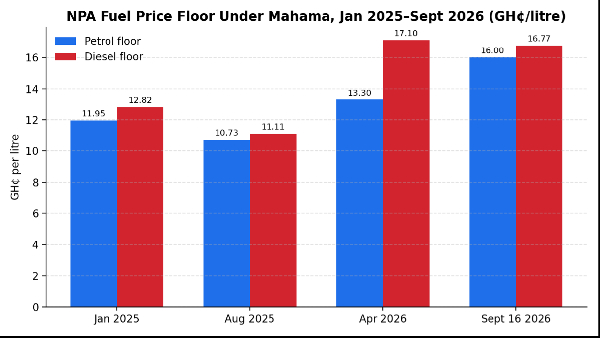
The dip-then-spike pattern is visible: both floors fell through mid-2025, then jumped sharply from April 2026 as the international shock arrived, with diesel actually easing slightly from its April 2026 peak once government intervention was applied, while petrol kept climbing to GH¢16 by mid-September.
Four similarities, and where the two administrations actually diverge
Both governments have operated in the same deregulated pricing system, cited international crude prices and the cedi-dollar rate as core drivers, and used tax or subsidy interventions to cushion consumers at different points. The difference is in sequencing and justification. Akufo-Addo's biggest shock (2022) combined an extreme international price spike with a sharp currency slide, and his government's response leaned on removing one levy while defending the rest on revenue grounds.
Mahama's term began with falling prices and a stronger cedi, which created room for a new domestic levy justified by energy-sector debt — before a separate 2026 external shock forced a shift toward direct price absorption rather than new taxation.
The political irony
The NDC spent years arguing that Akufo-Addo's government should strip out fuel levies rather than hide behind “market forces.” In government, Mahama's administration has both added a new levy (justified as energy-sector repair) and intervened to blunt a subsequent international shock — occupying both sides of the argument it once made from opposition.
The bottom line
Ghana's exposure hasn't changed: it imports the large majority of its refined products, prices them through a deregulated system tied to international costs, and remains sensitive to the cedi. What has changed is only which pressure — tax policy or external shock — dominates the explanation at a given moment. Until the underlying import dependence changes, the cycle described in the original draft will likely repeat under whichever party is in office: prices rise, government cites external and fiscal pressure, consumers demand relief, and the opposition disputes the explanation.
A methodology note: The cleanest way to state the overall change is two separate series, not one blended percentage. Akufo-Addo's fuel prices are best measured by the Energy Commission's annual averages (GH¢3.66→GH¢13.62 petrol, GH¢3.67→GH¢14.21 diesel, 2016–2024). Mahama's are best measured by NPA pricing-window floors, which move within any given year (GH¢11.95→GH¢16.00 petrol, GH¢12.82→GH¢16.77 diesel, January 2025–September 2026 — roughly 34% and 31% respectively). The two series use different units and time bases, so they shouldn't be quoted as a single like-for-like percentage.
Sources: Energy Commission of Ghana, National Petroleum Authority, Ministry of Finance, Ghana News Agency, Reuters, Graphic Online, Citi Newsroom, MyJoyOnline, 3News, Adomonline.




 A thumbnail of Ghana flag colors, a rising pump-price bar chart