



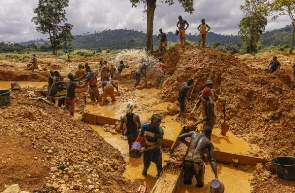
 Illegal miners at work
Ghana is currently facing a significant environmental, health, and social crisis due to the ineffectiveness of government measures to address illegal mining activities, commonly referred to as galamsey.
This situation has led many concerned citizens to urge the government to adopt more stringent enforcement measures, including the use of itching and chemical agents, in order to compel individuals engaged in this environmentally harmful practices to terminate their operations.
Certain individuals may assert that employing this strategy to mitigate illicit mining could be detrimental, as it poses significant health risks to both innocent individuals and those directly involved in the trade. These proponents emphasize that illicit mining constitutes a considerable source of environmental degradation within the country, resulting in extensive water and soil contamination from hazardous substances such as mercury and cyanide.
Therefore, the introduction of another harmful agent, even if classified as an irritant, may further exacerbate an already compromised environment.
It has been asserted that the use of irritating or chemical substances to address unlawful mining activities infringes upon human rights, as such measures do not adequately differentiate between offenders and innocent individuals.
I would like to raise the question of whether those who argue that the utilization of these substances violates human rights have fully considered the potential health risks posed to the broader Ghanaian populace, particularly to innocent residents within areas where illegal mining activities are taking place.
It is imperative for the citizens of Ghana to acknowledge that one of the most pressing environmental challenges associated with illicit gold mining is the utilization of mercury. This toxic element is employed by individuals engaged in environmentally destructive practices to extract gold from ore, often without consideration for the long-term detrimental effects on ecosystems.
Mercury poses significant health risks, and its release into rivers and aquatic systems results in bioaccumulation in fish and other marine organisms, subsequently endangering human populations that rely on these ecosystems for their livelihoods.
In light of this, it is essential for the government to adopt effective strategies, including the implementation of irritating and chemical agents, as robust measures in the fight against environmental crime.
Chemical or irritating agents are classified as crowd control weapons (CCWs) that comprise a variety of chemical compounds engineered to induce sensory discomfort and pain.
These agents are not intended to cause permanent harm or fatality; rather, they primarily elicit short-term effects such as temporary lacrimation (tear production), ocular irritation and discomfort, blepharospasm (spasms of the eyelids), cutaneous pain, respiratory challenges, as well as psychological effects, including disorientation and agitation.
Additionally, itching agents, which are derived from plant sources, provoke itching or allergic reactions when inhaled or applied to the skin. A notable example is a substance commonly referred to as "Apea" in Ghana.
Government authorities should consider the deployment of helicopters to disseminate herbicides or Apea in areas where illicit mining activities are suspected, particularly in the extraction of gold and other valuable minerals. To enhance the effectiveness of this initiative and safeguard the lives of innocent individuals, aerial personnel must collaborate closely with various law enforcement agencies. For instance, they must work in conjunction with local authorities who will provide intelligence regarding persons engaged in unlawful mining operations at specific sites. This coordinated approach will significantly improve the overall efficacy of this regulatory measure.
Prior to the deployment of helicopters for fighting illegal mining purposes, it is essential to conduct a thorough evaluation of the situation. This evaluation should consider various factors, including crowd size, the extent of violence, geographical location, and the presence of innocent residents in the vicinity. Based on this assessment, law enforcement may determine the most appropriate time and location for the application of irritating or chemical agents.
To underscore the importance of proper implementation of these agents, it is imperative to adhere to established protocols. Those responsible for executing this control strategy must perform a detailed analysis of crowd dynamics and assess the necessity for intervention. Furthermore, it is crucial to maintain a safe distance from illegal miners to mitigate the risk of escalation while ensuring the effectiveness of the operation.
I advocate for the strategic utilization of chemical and irritant agents in Ghana's efforts to combat illegal mining, commonly referred to as galamsey, employing helicopters and drones as operational tools.
While some may argue against this approach due to the high costs, noise levels, and accessibility issues associated with helicopters, it is imperative to emphasize that the protection of the nation's natural resources is of paramount importance, rendering financial considerations secondary in this context.
The effective deployment of chemical and irritant agents is contingent upon aerial support from helicopters, which are able to efficiently cover extensive areas while providing the ability to hover above illicit activity and conduct aerial surveillance. This capability is vital for enforcement operations in both urban and rural settings. Helicopters, whether operating at low or high altitudes, grant authorities a comprehensive aerial perspective, facilitating the tracking of criminal elements, oversight of public gatherings, and monitoring of unlawful activities from a secure distance.
In contrast, drones can operate at a safe distance to monitor suspicious activities, employing thermal imaging technology to identify locations of illicit mining activities without the awareness of illegal miners.
These aerial vehicles can conduct pre-entry reconnaissance to detect illegal mining operations and accurately locate individuals and vehicles involved. Drones can also facilitate the delivery of specialized equipment, such as thermal imaging cameras, which are vital for nocturnal search operations and tracking of suspects.
Their advantages include rapid deployment, effectiveness in aerial surveillance, and affordability, which allows for replacement should they be endangered. In light of the significant land degradation resulting from illegal mining practices, it is essential for the government to allocate resources towards the acquisition of helicopters and drones as a means to address this ecological crisis.
Legislators in Ghana must clearly communicate to the public that a significant majority - over 90% - supports the cessation of illegal mining activities, known locally as "galamsey."
Achieving this goal will require considerable financial resources and investment. It's essential to remember the proverb "You cannot have your cake and eat it too," which underscores the necessity of making difficult choices in resource allocation.

Copyright © 1994 - 2026 GhanaWeb. All rights reserved.










