



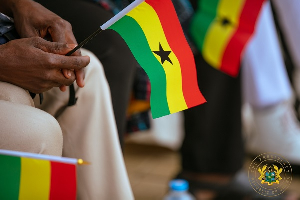
 File photo of the Ghana flag
A nation within a territory, basically, is bound by a common ancestry, language, and culture.
Along with this assertion, modern-day Ghana will not fit in.
We are a people of multiple groups with very distinctive cultural heritage and language.
Although there are claims of cultural linkages and certain common lingual foundations, respective practices and communal structures do differ.
However, we can be called a nation because of a shared history—our colonial past, the nationalism fight, and the pre-independence constitutional and political development that brought the colonies, the protectorate, and the mandate together with representation in the Gold Coast National Assembly.
With our national symbols, common values, and shared history, a nation had been born on March 6, 1957.
The period between 1966 and 1992 marked the dark years of military takeovers, abuse of human rights, and economic retrogression.
But like a phoenix out of the ashes, and the morning sun rising from behind the eastern ranges and the horizons of the seas, Ghana was ushered, once again, into democratic rule, with a renewed commitment towards nation building.
Although this dispensation has stood the test of time, the development dividend is yet to be realised. Regardless of the slow progress, there is much to celebrate in the last 3 decades—the ideals of relative stability, freedoms, and social progress.
Given these blessings of a society, there has never been a time that these ideals have been more at risk than in recent years.
Economic injustice, state capture, political polarisation, and chieftaincy and land disputes are permeating the crevices and weakening the ideals that were once thought to have been established in hearts and minds.
They are opening up sutured wounds and digging up buried hatchets.
Recent tensions on ethnicity and religion are tearing up the fabric of social cohesion.
A few months ago, protests erupted in circles and on social media on the recognition of the ethnic Ga word, Oobake, which translates to “Welcome,” in public spaces in the Greater Accra region in respect of the traditions of the indigenous people.
On the sidelines, this subtle request erupted into spiteful conversations on ethnic superiority across many social media platforms. Although no violent physical confrontations were recorded, the brutal exchanges emphasized deep divisions across ethnic lines and very uncompromising stances when it comes to tribal and ethnic conversations.
Ghana has been described as a relatively peaceful territory in West Africa.
This peace is a result of the supposed harmonious living among its inhabitants and their celebrated hospitality towards other people.
However, beneath the façade of smiles and welcomes lies the great concern of much deeper distrust and dislike among ethnic and religious groups.
In the Afrobarometer R10 Survey (2023/24), about 66.8% of Ghanaians expressed distrust of people from other ethnic groups, and some 10.7% expressed dislike for their neighbours of different ethnic groups.
Additionally, on the question of religion, 66.3% of Ghanaians did not trust people of other faiths, and 10.7% again did not like to be neighbours with people of faiths other than theirs.
The data further revealed that some 11.9% of Ghanaians loathed to be neighbours with others from a different political party.
These revelations from the recent data suggest how the country is divided not only along political lines, but also along religion and ethnicity.
The revelation makes one wonder then about the state of national identity in the country.
Another look inside the same data comes up with stark revelations.
Only 15% of Ghanaians feel only national identity.
This low figure raises serious concern, as those who even profess both national and ethnic identities are not up to two-thirds of the population.
It is therefore imperative that minds should worry and be concerned about the religious acrimonies brewing from the Shafic Osman v. Attorney General suit that seeks to plead the court to compel Wesley Girls High School, a Christian-Methodist faith-based government-assisted public school, to allow Muslim students to worship on campus according to their faith in respect to freedom of religion enshrined in the 1992 Constitution.
The social media exchanges, joinders by religious and faith representatives, uptakes by MPs and ministers, and panel views on TV and radio stations desire that efforts must be made to put the matter to rest in an alternative dispute resolution.
It is sufficient to maintain that religious, ethnic, and political identities contain intrinsic value to those that profess and hold them.
However, these values should not supersede the national identity in the body politic. Secularism should not translate to loss of national identity.
Yet, when citizens find higher purpose with their kinship in religion, ethnic, and political groupings, the occurrence of disregard and hostilities towards members of the outgroup naturally follows.
Without a doubt, it also means the state has failed to secure its citizens for itself through provision of their most basic needs and protection from harm.
In the Afrobarometer R10 survey, 78.4% of Ghanaians reported that the country was in a bad economic condition, with 66.9% also reporting that their personal living condition was bad.
Additionally, more than 60% of the population reported that they have, at some time, considered moving out of the country to North America and Europe as their major destinations because of economic hardship and to find better work.
A state does not cultivate national identity in a vacuum.
When citizens have made their input into the system, they, by extension, expect the output from the government.
Consistent output and input create a cycle of trust, which increases citizens' pride in their country.
But when religion, ethnicity, or partyism gives to its followers more than what the state is mandated to provide per the social contract, then it is not surprising we see a dwindled national identity.

Copyright © 1994 - 2026 GhanaWeb. All rights reserved.










