



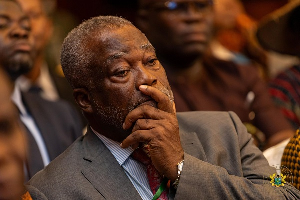
 U A R Colonel Festus Aboagye (Retired) is the author of this piece
Executive Summary
One-third of Ghana's local government projects are never completed (Williams, 2017). Fifteen national flagship projects examined in the underlying study carry more than US$6 billion in contract and programme values, and at least US$1.6 billion is still needed to finish them (Aboagye, 2026, forthcoming).
The state's own records now document the pattern: Agenda 111 hospitals stalled with only a fifth of contract value spent, the Saglemi housing estate left unusable after most of its budget was spent, a US$993 million multipurpose dam at Pwalugu that never went beyond site works, and a sugar factory at Komenda that has never run at full load.
This brief argues that the syndrome has crossed a threshold. It persists across decades, sectors and administrations; it ties up large resources; and the mechanisms that produced it are still at work.
That makes it a governance crisis in public investment, in a defined, chronic sense, not a crisis of the Ghanaian state. It is not a national-security crisis either, and the brief does not claim that abandoned projects cause insecurity. But the capabilities left unrealised, from district health care and jobs to flood control and connectivity, are ones the National Security Strategy (NSS) names as essential, so the crisis can amplify vulnerabilities the state already recognises.
The remedy must treat both the stock of unfinished projects and the flow of new commitments that keeps replenishing it.
Key messages
• This is now a governance crisis, not a list of failed projects. The same failures recur across sectors and governments because the system that selects, finances, contracts and operates public investment keeps producing them.
• Measure capability, not construction. A hospital counts when it treats patients, not when the ribbon is cut.
• Completion is conditional on value, not sunk cost. Money already spent is no reason to spend more; a transparent exit is a legitimate outcome.
• Security relevance is functional, and it never replaces appraisal. What matters is the consequence of prolonged non-operation; national security must not be used to rescue indefensible projects.
• Fix the flow, not just the stock. Clearing today's backlog without changing the rules that create it will only make room for new monuments.

Copyright © 1994 - 2026 GhanaWeb. All rights reserved.










