



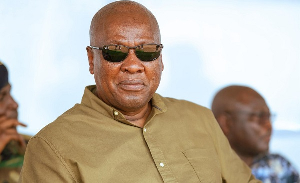
 President John Dramani Mahama posed for the camera at an event
TO: His Excellency, John Dramani Mahama, President of the Republic of Ghana
FROM: Common Purpose Alliance Ghana (CPAG)
DATE: May 15, 2026
SUBJECT: Executive Brief: Strategic Guardrails for the Post-IMF Transition to a Non-Financing Policy Coordination Instrument (PCI)
Executive Summary
Your Excellency, Ghana’s official graduation from the IMF’s Extended Credit Facility (ECF) and transition to a non-financing Policy Coordination Instrument (PCI) is a landmark victory for our national dignity and economic sovereignty. CPAG commends your administration’s efforts, which have yielded a significant $113 billion GDP, a 2.6% primary surplus, and a sharp debt reduction to 45.3% of GDP.
However, historically, Ghana’s greatest economic vulnerabilities have emerged not during IMF programs but in the immediate aftermath of exiting them. To ensure this exit is permanent and to protect your efforts framework, your administration must actively mitigate the loss of external enforcement by cementing airtight domestic guardrails.
The Strategic Trade-Off: Pros vs. Cons
The Opportunities (Pros)
● Policy Autonomy for National Agendas: Free from disbursement-linked conditionalities, the government can flexibly tailor fiscal policies to aggressively scale indigenous growth, such as the 24-Hour Economy initiative and the Big Push infrastructure program.
● Enhanced Market Credibility: Transitioning voluntarily to a PCI—backed by Fitch’s upgraded 'B' rating (Positive Outlook)—signals to international capital markets that Ghana’s recovery is structurally sound and "bankable."
● Reduced Borrowing Costs: Settling the $709 million Eurobond ahead of schedule proves debt sustainability, structurally lowering yield demands on future capital access.
The Vulnerabilities (Cons)
● Loss of Immediate Liquidity Buffers: Under the non-financing PCI, the Bank of Ghana can no longer rely on quarterly IMF cash tranches. In the event of catastrophic external shocks (e.g., commodity price volatility in cocoa or gold), there is no safety net.
● Depreciation of Political Will: Without the financial stick of the IMF, domestic political pressures—especially heading into local and regional cycles—risk diluting the rigorous fiscal discipline that achieved the 2025 surpluses
The Danger of Historical Antecedents
Ghana’s economic history warns against post-bailout complacency. We urge Cabinet to consider two critical historical parallels:
● The 2006 Exit Illusion: Following a successful IMF exit and a landmark 2007 Eurobond issuance, fiscal relaxation and lack of structural guardrails resulted in a massive 14.5% GDP budget deficit by 2009, forcing a return to Washington.
● The 2019 Monitoring Slippage: After graduating to a monitoring phase in 2019, structural rigidities left the country completely exposed to the macro-shocks of 2020–2022, culminating in an avoidable debt crisis.
The 2026 Reality Check: While public debt has dropped significantly, nearly 70% of domestic revenue remains structurally tied to rigid expenditures (public sector wages and debt servicing), leaving very narrow margins for error.
Pragmatic Recommendations for the Mahama Administration
To ensure that the PCI serves as a rigid blueprint rather than a soft suggestion, CPAG recommends the following three-pronged strategy:
1▪︎ Operationalize the New Legislative Guardrails
Your Excellency’s recent assent to the Value for Money Office Act and the Governance Advisory Council Act was an excellent first step. Next, the Independent Fiscal Council must be given autonomous legal teeth to publicly "red flag" the Ministry of Finance if expenditures deviate from the targeted primary surplus, establishing a culture of domestic policing.
2▪︎ Implement Radical Domestic Revenue Mobilization (DRM)
Relying on market borrowing to fund the "Big Push" must be discouraged. Instead, focus must aggressively shift toward expanding the tax net through full-scale digital formalization of the informal sector. Furthermore, plugging revenue leakages in critical State-Owned Enterprises (SOEs), specifically the Electricity Company of Ghana (ECG), must be prioritized to prevent hidden liabilities from bleeding the national treasury.
3▪︎ Institutionalize a Sovereignty Buffer Fund
With gross reserves currently standing at a healthy $12.3 billion, your administration should legally earmark a percentage of mineral and petroleum windfall revenues into a consolidated National Stabilization Buffer. This fund will serve as Ghana's internal IMF, providing immediate liquidity during global shocks without compromising our hard-won economic sovereignty.
Conclusion
The transition to a non-financing framework is an extraordinary opportunity to prove that Ghana can self-govern prosperously. By replacing external IMF conditionalities with rigid, self-imposed domestic legislation, the Mahama administration will permanently break the boom-and-bust cycle to solidify any legacy.
With debt projected to fall to 46% of GDP by 2027, the government must resist the urge to go on a fresh Eurobond borrowing spree. Focus should shift toward concessional financing and Public-Private Partnerships (PPPs) for infrastructure.

Copyright © 1994 - 2026 GhanaWeb. All rights reserved.










