



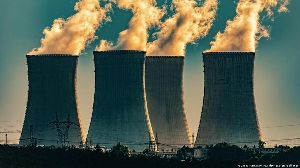
 File photo of a Nuclear Power Plant
Ghana has entered a turning point in its energy journey. With President John Dramani Mahama’s recent announcement that the country will begin the process of building its first nuclear power plant, our national conversation has shifted from possibility to reality.
Nuclear Power Ghana (NPG), the Ghana Atomic Energy Commission (GAEC), and the International Atomic Energy Agency (IAEA) have all been laying the groundwork for years—but this announcement marks the beginning of a much bigger responsibility.
The promise is real, but so are the risks and I say this with the sensitivity of someone who lived in Japan during the Fukushima nuclear disaster.
That experience shaped how I see nuclear energy—not as a political slogan or a technological achievement, but as a commitment that demands absolute seriousness.
What Fukushima taught me - And what Ghana must understand
Many people remember Fukushima as a technological failure. But the truth is that the disaster began with a massive earthquake and tsunami, forces that overwhelmed even Japan’s advanced protective systems.
Ghana does not face earthquakes of that scale, but we face our own natural threats:
1. Severe and frequent flooding,
2. Coastal erosion,
3. Extreme rainfall events,
4. Unpredictable climate patterns.
Any of these, if not factored into the design of a nuclear plant, could trigger dangerous consequences. We must build a facility strong enough to withstand Ghana’s specific risks, not Japan’s.
But what struck me most in Japan was not only the displacement of people, but it was also the collapse of agriculture. Farmers watched crops rot in their fields because no one trusted the food grown in Fukushima.
Local buyers refused to purchase it and international markets stopped
importing produce from the region altogether. Even products that were perfectly safe could not
escape the stigma.
Entire livelihoods vanished overnight and a whole agricultural economy suffered a massive setback.
For Ghana, a country where agriculture contributes significantly to GDP and supports millions, this is a warning we cannot ignore.
A nuclear accident does not only threaten people; it threatens land, food systems, exports, tourism and national reputation.
The Promise: Why Ghana is looking at Nuclear
1. Stable, Reliable Power for the First Time in Generations
Our national development has struggled under unstable energy supply. Nuclear power offers long-term, round-the-clock electricity, the backbone of any serious industrialised economy.
2. Reducing Dependence on Hydro and Fuel Imports
Hydro suffers when rain fails. Fuel imports drain foreign exchange.
Nuclear energy provides a stable alternative that is less vulnerable to external shocks.
3. Building Scientific Capacity and Regional Leadership
Ghana has quietly built strong foundations:
1. A research reactor at Kwabenya,
2. The School of Nuclear and Allied Sciences (SNAS),
3. An independent regulatory authority,
4. A new nuclear simulator for training.
With proper investment, Ghana can become a regional hub for nuclear science and training, not merely a consumer of imported technology.
The risks and hard questions
Nuclear power is powerful, but it demands long-term commitment and humility.
1. The Financial Burden is Huge
Nuclear plants require billions in investment. Poorly negotiated financing can harm future generations through national debt and higher electricity prices.
2. Safety Must Come Before Politics
Fukushima taught me that one incident can undo decades of progress.
Ghana must consider:
1. How well can our emergency services respond?
2. Are host communities fully informed and prepared?
3. Is the regulator free from political interference?
4. Are we planning for floods and extreme weather with the seriousness they deserve?
3. Agricultural Vulnerability
If a contamination event occurs, Ghana could lose access to export markets for cocoa, cashew, fruits, fish, vegetables, and more. Local consumers may reject produce from affected regions and a national economic crisis could follow.
4. Radioactive Waste Must Be Managed Carefully
Waste remains dangerous for centuries. A clear, scientific, well-funded waste and decommissioning plan is non-negotiable.
5. Global Powers Will Compete for Influence
The US, China, Russia and others all want Ghana to adopt their technology. We must choose based on Ghana’s long-term interest, not geopolitical pressure.
6. Corruption is a Direct Safety Threat
Every procurement decision must be transparent. Nuclear energy does not forgive shortcuts or
compromised oversight.
Non-negotiable preparations Ghana must make
1. Radical Transparency
Publish all major details:
1. vendor proposals,
2. safety studies,
3. financing arrangements,
4. long-term obligations.
2. Strengthen the Nuclear Regulatory Authority (NRA)
The regulator must be independent, well-funded, and able to say “no” when safety is at risk.
3. Engage Host Communities Honestly
Farmers, fisherfolk, chiefs, youth groups, market women, and local leaders must all be part of the
planning and decision-making process.
4. A National Waste and Decommissioning Strategy
A clear plan must exist before any construction begins.
5. Train the Workforce That Will Run the Plant
Ghana must invest heavily in training:
1. Engineers
2. Operators
3. Emergency responders
4. Medical teams
5. Environmental scientists
6.Cybersecurity specialists
A nuclear programme succeeds only when its people are competent and prepared.
A personal reflection from Japan
Fukushima left deep emotional and economic scars. I still remember the empty shelves where food from Fukushima used to be. I remember farmers in tears, knowing they could not sell what they had grown.
I remember roads leading to evacuated towns—silent, lifeless, frozen in time.
Those memories remind me that nuclear energy demands respect. Not fear but respect. Ghana must enter this field with wisdom, preparation, and humility.
Conclusion: A Responsible Path Forward
President Mahama’s announcement is historic. Ghana now has a chance to strengthen its energy future, build scientific capacity, and lead in West Africa’s nuclear landscape.
But we must move forward with open eyes, strong institutions, scientific discipline, and a deep commitment to safety.
Nuclear power can become one of Ghana’s greatest achievements, if we prepare properly.
If we do not, the cost could be immeasurable.
Let us move forward, not blindly, but wisely, with the lessons of Japan etched into our planning and our responsibility to future generations.

Copyright © 1994 - 2026 GhanaWeb. All rights reserved.










