



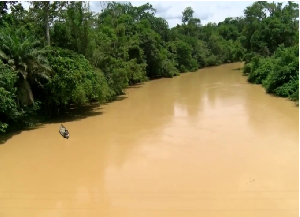
 A river in Ghana polluted by galamsey operations
Across Ghana, taps are running but confidence is drying up. As illegal mining (galamsey) continues to ravage the country’s major river basins, the Ghana Water Company Limited (GWCL) is battling a level of pollution its ageing treatment systems were never designed to handle.
The consequences are increasingly stark: treatment-plant shutdowns, soaring operational costs, and growing fears that the water flowing into households may not always be as safe as citizens assume.
While the government has intensified its fight against illegal mining, experts warn that an equally urgent issue is being overlooked — the quality of water reaching our homes. Heavy mineral particles, extreme turbidity, and mining-derived contaminants now threaten to turn Ghana’s water crisis into a public-health emergency.
A water treatment system overwhelmed by pollution
In recent years, raw water from rivers such as the Pra, Birim, Ankobra, Tano and Offin has become heavily contaminated with silt, clay, undissolved minerals, and traces of chemicals associated with illicit mining.
At some intake points, turbidity levels have been recorded tens of thousands of times higher than what treatment plants were designed to process. Most of Ghana’s water treatment infrastructure was designed decades ago – long before galamsey transformed the country’s river system into murky, metallic streams.
According to operational assessments, the company is now forced to battle unprecedented turbidity levels, high chemical usage, frequent back washing cycles and clogging filters that struggles to keep up the load.
GWCL’s own annual operational reports, and regulatory filings have repeatedly highlighted:
Excessively high turbidity requiring emergency chemical dosing.
Rapid clogging of filters and shortened filtration cycles.
Increased sludge-generation and disposal difficulties.
Unplanned shutdowns of plants when raw-water pollution exceeds treatable limits.
Escalating treatment costs and energy usage due to pollution load.
Several plants — notably in the Central, Western, Eastern and Ashanti Regions — have temporarily reduced output or shut down entirely because the incoming water was simply “untreatable” under current conditions.
These disruptions are not just operational issues – they are red flags showing that Ghana’s water treatment system is no longer resilient enough to guarantee consistent safety.
Is the water safe to drink? A growing concern
Most GWCL plants strive to meet microbial and chemical standards, but this achievement is becoming increasingly difficult and inconsistent.
Extreme turbidity forces the system to operate well beyond its intended capacity, raising the risk that:
Fine mineral particles may pass through treatment barriers
Heavy-metal residues from mining activities may not be fully removed
High turbidity may reduce the effectiveness of chlorine, compromising disinfection
Intermittent supply increases contamination risk within pipelines.
Households have increasingly reported discoloured water, sediment deposits, or unusual tastes — signs that pollutants may be slipping past treatment barriers.
International standards, including those of the World Health Organization, emphasise that safe drinking water must not only be free from pathogens but must also show consistently low turbidity and minimal presence of metals or industrial contaminants.
When treatment plants strain to meet these thresholds, public health is at risk.
Government efforts are not enough without water-safety intervention
The government’s ongoing anti-galamsey operations are critical, but the polluted water in Ghanaian rivers must still be treated today, long before the rivers heal. A parallel emergency response is needed—because what flows from the tap is as important as what happens at the riverbank.
Without aggressive infrastructural investment, the country risks an invisible health epidemic caused not by bacteria or cholera, but by heavy metals and fine particulates accumulating in the body over decades.
Global Precedents: When polluted water destroyed lives
Around the world, governments learned too late that contaminated source water, combined with insufficient treatment, can trigger national health disasters. Ghana must pay attention to these precedents.
1. Minamata Disease — Japan
Mercury discharged into Minamata Bay in the mid-20th century led to one of the world’s worst industrial health crises. Communities suffered severe neurological disease, while babies were born permanently disabled due to prenatal exposure.
Lesson for Ghana: Heavy metals in water — even at low levels — can silently accumulate in people over years, causing irreversible health damage.
2. Ok Tedi Environmental Disaster — Papua New Guinea
Decades of mine waste dumped directly into the Ok Tedi River devastated entire river ecosystems, destroyed fisheries, and displaced communities dependent on the river for drinking water and agriculture.
Lesson for Ghana: Mining pollution can permanently destroy rivers — a warning for the Pra, Birim and Ankobra, where galamsey pollution continues to worsen.
3. Baia Mare Cyanide Spill — Romania (2000)
A collapsed tailings dam released cyanide-laced wastewater into major European rivers, affecting millions, killing aquatic life across borders, and threatening drinking- water systems.
Lesson for Ghana: A single tailings spill in a mining zone could contaminate vast stretches of Ghana’s rivers, overwhelming treatment systems.
4. Heavy-Metal Contamination in Amazonian Mining Regions Research across
Ecuador, Peru, and Bolivia revealed dangerous levels of arsenic, mercury, lead, cadmium, and manganese in rivers contaminated by small-scale gold mining. Children and adults faced hazard levels far above safe thresholds.
Lesson for Ghana: Small-scale mining — such as galamsey — can cause chronic heavy- metal exposure, even when no dramatic disaster occurs.
Ghana is approaching a health emergency
These global disasters share one truth:
When water sources become polluted faster than treatment systems can cope, public health collapses.
Ghana’s situation mirrors the early stages of these crises.
The combination of:
Uncontrolled river pollution.
Treatment machinery operating beyond its limits.
Untreated mineral particles in tap water.
Inconsistent compliance with turbidity standards.
Increasing shutdowns of GWCL plants indicates that the nation is standing on the edge of a preventable tragedy.
Why the government must act now
1. Upgrade GWCL’s Water-Treatment Machinery
Plants urgently require:
High-capacity pre-sedimentation systems, Lamella clarifiers and modern flocculation units, Dual-media or membrane filtration, Automated turbidity and heavy-metal monitoring, Upgraded sludge-handling systems.
Without these, Ghana’s treatment plants cannot cope with the new reality of polluted rivers.
2. Treat Water Safety as a Public-Health Priority
Just as Ghana mobilises rapidly during cholera outbreaks or pandemics, it must respond with equal urgency to mining-related water contamination. The health risks are long-term, irreversible, and affect millions.
3. Strengthen Water-Quality Monitoring and Transparency
GWCL and regulators should publish:
Turbidity readings at intakes and treatment outputs.
Heavy-metal test results.
Maps showing pollution hotspots.
Regular reports on plant shutdowns and causes.
Public trust depends on full transparency.
4. Intensify and Sustain the Fight Against Galamsey
No treatment upgrade can compensate for rivers destroyed at their source. Enforcement, riverbank restoration, and stricter mining governance are essential.
Conclusion: Water is life — and time is running out
Ghana’s battle against illegal mining is necessary — but insufficient. Without urgent upgrades to GWCL’s treatment plants and aggressive protection of water sources, Ghana risks repeating some of the world’s worst water pollution disasters.
The water flowing from Ghana’s taps must not only be available; it must be safe. If government fails to treat this as the public-health crisis it is, the cost will be measured not only in money — but in lives.



Copyright © 1994 - 2026 GhanaWeb. All rights reserved.










