



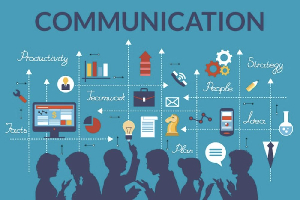
 File photo of communication channels `
I remember the brief. It was sometime around 2013, and I was sitting in a creative meeting at Publicis West Africa in Accra, working on a campaign for one of our major clients.
The room was full of talented people debating the best radio jingle, the most eye-catching billboard placement, and how many flyers we needed to print for an activation. Social media was something we bolted on at the end, a nice-to-have, not a strategy. That was how it worked. That was how everyone worked.
Fast forward to today. I am running BloomBit LLC, a digital media and technology consulting firm based in Atlanta, where artificial intelligence is not a buzzword we toss around but the actual engine behind everything we build for our clients. The world of communication has not just evolved since those Publicis days; it has been completely rebuilt. And yet, when I look back home at the small business landscape in Ghana, I see too many entrepreneurs still operating as if the calendar reads 2014.
This is not to criticise. I am writing this because I have been on both sides of this story, and I genuinely believe that Ghana’s small business community has everything it needs to lead, if it is willing to adapt. So let me take you through what I have seen, what I know, and what I believe every Ghanaian entrepreneur must do right now.
What Communication Looked Like Ten Years Ago
Let me paint you a picture. A decade ago, if you owned a small business in Accra—a boutique, a pharmacy, a catering company, a print shop—your communication strategy probably looked something like this: you had a Facebook page that you updated whenever you remembered to. You printed flyers and distributed them around your neighbourhood.
If you could afford it, you ran a radio spot. You had a basic website that a cousin built for you in 2011 and had not been touched since. And most importantly, you relied on word of mouth, which, to be fair, has always been, and remains, the most powerful marketing tool in Ghanaian culture.
I lived that reality. When I moved from Publicis to CDH Investment Holdings as Corporate Communication and Brand Development Officer, I was working with businesses that had significant resources and still struggled to build coherent, consistent communication strategies.
We were rebranding Novotel Hotels into Accra City Hotel. We were elevating Gilead Medical and Dental Center’s brand voice. Even at that level, the tools and thinking were still largely traditional. Digital was creeping in, but slowly. The instinct was always to reach for what was familiar.
The communication was largely one-directional. Businesses talked to their customers. Engagement was measured in how many people saw your billboard, not in how many people clicked, commented, shared, or converted. The data was minimal. Targeting was broad. You cast a wide net and hoped.
“The communication was largely one-directional. Businesses talked to their customers. You cast a wide net and hoped.”
What Has Changed — And Why It Changes Everything
The transformation over the past decade has been nothing short of revolutionary. I have watched it unfold in real time, first from Accra and now from Atlanta, and the pace of change still surprises me.
Social media platforms are no longer simple broadcasting tools; they are complex, algorithm-driven ecosystems that reward consistency, authenticity, and precision. TikTok and Instagram Reels have made short-form video content not just popular but essential.
If your business is not producing video content in 2026, you are functionally invisible to an enormous segment of the market. WhatsApp Business has quietly become one of the most powerful customer service and sales channels across West Africa. And search engine optimisation, something most small businesses in Ghana still treat as a luxury, now determines whether a potential customer finds you or finds your competitor.
But here is the shift that matters most, and the one I want you to truly absorb: the conversation is no longer one-directional. Customers now expect to engage with brands, be heard, receive personalised responses, and experience communication that feels tailored to them. The businesses winning today are the ones that have figured out how to have genuine, data-informed conversations with their audiences at scale.
I study this professionally. My graduate research at Georgia State University has taken me deep into visual culture, media representation, and the power of communication to shape behaviour and identity. And what I have come to understand, both academically and in practice, is that the businesses that thrive are those that treat communication not as an afterthought but as a core business function, as strategic and essential as finance or operations.
Why I Built BloomBit — And What It Taught Me
When I founded BloomBit LLC, I was driven by a very specific conviction: that the gap between large corporations and small businesses in the digital communication space was not about talent or ideas, it was about access to the right tools and strategies. The name says it all: “Bloom” for growth, “Bit” for technology. My vision was to merge these two forces to create transformative digital strategies for the businesses that need them most.
What working with clients across industries and geographies has confirmed is this: the single biggest opportunity in digital communication right now is artificial intelligence. And most small businesses—in Ghana, in the United States, everywhere—are not even close to harnessing it.
At BloomBit, we have integrated AI-powered content engines, CRM automation workflows, and data analytics systems into our clients’ operations. The results have been remarkable. We helped Black Star Marathon, an organisation I also serve on the board of, reimagine their brand story and digital presence. Within three months, their online engagement increased by 40% and their brand value grew by 350%. That is not magic. That is what happens when you combine strategy, storytelling, and technology intentionally.
“AI is not replacing people — it is replacing inefficiency. And inefficiency is the one thing small businesses cannot afford.”
The AI Era: What Is Already Happening — Whether You Are Ready or Not
Let me be direct with you. Artificial intelligence is not the future of communication. It is the present. Right now, as you read this, AI tools are being used by your competitors to generate content, respond to customer inquiries, analyse audience behaviour, and optimise advertising spend—all faster, cheaper, and more accurately than any human team could do alone.
Platforms like ChatGPT, Google Gemini, and Microsoft Copilot have democratised content creation in ways that were genuinely unimaginable ten years ago. A small business owner with no dedicated marketing team can now produce professional-grade email campaigns, social media content calendars, customer service scripts, and advertising copy in minutes.
The cost barrier that once separated large corporations from small businesses is collapsing. This should be an incredible equaliser, but only for the businesses that choose to take advantage of it.
There is also something deeper happening in search that I want Ghanaian business owners to understand. The way people find businesses online is changing fundamentally. We are moving from traditional SEO—optimising for Google’s blue links—towards what we call AEO (Answer Engine Optimisation), GEO (Generative Engine Optimisation), and AIO (AI Integration Optimisation). In practical terms, this means that Google is no longer just a search engine; it is an answer engine. And increasingly, the “answers” it delivers are generated by AI, not pulled from a list of websites.
If your business is not optimised for this new reality, you will not appear in those AI-generated answers. You will not exist in the search landscape of the next decade. This is not alarmism; it is the trajectory I see every day in my work, in my research, and in the rapidly evolving digital environment we all inhabit.
To Ghanaian Small Business Owners: Five Things You Must Do Now
I want to be practical. Theory is useful, but what Ghanaian entrepreneurs need right now is a clear action plan. Based on my experience building brands in Ghana, running a digital consulting firm in the United States, and studying communication at the graduate level, here is what I believe every small business must do:
Start Using AI Content Tools — Today, Not Tomorrow
Stop waiting for permission or for someone to show you how. Open a free ChatGPT account. Ask it to write your next social media caption, your next promotional email, your next product description. You will be surprised by what is possible. AI does not replace your voice or your creativity—it amplifies it. Your job is to give it direction. Think of it as the most efficient junior team member you have ever hired, available around the clock, at almost no cost.
Treat Your Website as a Living Business Asset
If your website has not been updated in the last six months, it is hurting your business. A static website is the digital equivalent of a locked shopfront. Your website must be fast, mobile-optimised, and built with current SEO best practices. More importantly, it must be designed with the AI search era in mind—answering the specific questions your customers are asking, in clear, accessible language. This is no longer optional. It is the price of entry.
Invest in Short-Form Video — It Is Non-Negotiable
I spent years studying visual communication and working as a videographer and producer—including producing my own television show, “The Other Side,” which was nominated for Promising TV Show of the Year in Ghana. I understand video intimately. And I can tell you with absolute certainty: if you are not producing short-form video content for TikTok, Instagram Reels, or YouTube Shorts, you are leaving an enormous amount of audience attention on the table. You do not need a big budget. You need a smartphone, good lighting, and something genuine to say.
Use WhatsApp Business as a Serious CRM Tool
Most Ghanaian small businesses are already using WhatsApp to communicate with customers. But very few are using it strategically. WhatsApp Business allows you to set automated responses, create product catalogues, segment your customer list, and broadcast targeted messages. Combined with AI automation tools, it becomes one of the most powerful customer relationship management channels available—and it is already in your pocket. This is not a new tool you need to learn. It is a tool you already use, applied with more intention.
Make Data-Informed Decisions — Not Just Instinct-Based Ones
Ghanaian entrepreneurship is built on instinct, relationships, and resilience. I deeply respect that. But instinct alone is no longer sufficient in a data-rich world. Google Analytics is free. Meta Business Suite insights are free. The data that tells you who your customers are, what content they engage with, when they are online, and what drives them to purchase—all of that is available to you at no cost. The businesses that learn to read and act on that data will consistently outperform those that do not. Start small. Track one metric this week. Build from there.
Ghana Has Always Been Capable of More
I want to close with something personal. I grew up in Ghana. I studied at KNUST. I built my career in Accra. I understand the constraints that small business owners face—the infrastructure challenges, the capital limitations, the competing demands on time and energy. I am not writing from a position of distance or judgement.
I am writing from a position of absolute belief in what Ghana’s entrepreneurs are capable of. I have seen it. I have worked alongside it. I am invested in Ghana’s future beyond the boardroom. I serve on the board of Black Star Marathon because sport and community are threads woven through everything I do.
The vision I built BloomBit around—merging growth and technology to create transformative outcomes for small businesses—is a vision I hold as much for Accra as I do for Atlanta. The tools are now accessible. The knowledge is available. What the next chapter requires is the courage to adapt, the discipline to execute, and the boldness to think bigger.
The algorithms are already running. The question is whether you will run with them.

Copyright © 1994 - 2026 GhanaWeb. All rights reserved.










