



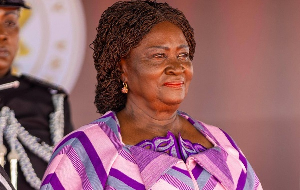
 Prof Jane Naana Opoku-Agyemang is the Vice President
A few months ago, the Vice President of the Republic of Ghana, Her Excellency Prof Jane Naana Opoku-Agyemang, visited a public sector institution with which I am affiliated. The visit was part of her working tours of various Ministries, Departments, and Agencies (MDAs), an initiative aimed at promoting public sector efficiency, transparency, and collaboration.
As she walked into the conference room, took her seat, and listened attentively to the briefings about the institution and the reforms undertaken by its transformative head, I observed something remarkable. When she finally took the microphone, she spoke in her usual soft tone. The only time her voice, as many who know her will confirm, rose to the ceiling was when she reiterated her long-standing conviction: whatever good Accra enjoys, every other part of Ghana, whether near or far, must equally enjoy or enjoy even better. This, she said, is how we build a peaceful and sustainable society. Even though her voice was not the loudest in the room, every word carried authority, respect, clarity, and power.
She spoke about the importance of working together as a society, converging on a single vision to serve all Ghanaians. She emphasized equity across every part of the country.
As she concluded, my mind drifted to an article titled “Leadership Is Not About Being the Loudest.” In it, Costas K.G. explains that leadership is about listening to what others miss. He offers a compelling metaphor: “Think of leadership like a storm. Loud leaders are the thunder, grabbing attention and shaking the room. Quiet leaders are the rain, steady, nourishing growth beneath the surface. Both have power. But rain transforms the ground it touches.”
In Ghana’s political climate, where loudness and spectacle are often mistaken for strength, this distinction matters deeply. We have come to confuse noise with vision. Yet the most enduring leaders in history were rarely the loudest; they were the most purposeful. Vice President Opoku-Agyemang embodies this kind of quiet gravity.
To be clear, this is not to suggest that charisma or forceful oratory have no place in leadership. There are moments, rallying a nation during a crisis, for instance, where a commanding voice is indispensable. But these moments, I believe, are the exception. What truly transforms a society is not the thunder that shakes it, but the rain that nurtures it day after day.
Writing on this very subject, brand strategist Jenie McGinn observed that leadership is not about volume but about gravity and that gravity can be soft, quiet, and still hold the entire room.
Vice President Opoku-Agyemang embodies exactly that kind of gravity. Since making history in December 2024 as Ghana’s first female Vice President, her work has focused on policy coordination, advocacy, youth empowerment, women’s and PWDs’ rights, equity, education, and diplomacy. She brings an impressive pedigree: Ghana’s first female Vice Chancellor, former Minister for Education, former Chancellor of the Women’s University in Africa, two-time Fulbright scholar, and recipient of the University of Cape Coast’s Distinguished Fellow Award.
Her philosophy of deliberate, understated action is evident in tangible initiatives such as advocating for inclusive education that leaves no child behind, equitable resource distribution to underserved regions, the free sanitary pad initiative, and the push for a women’s development bank. She consistently tackles social barriers, including child marriage, sexual abuse, domestic violence, and witchcraft accusations, while championing opportunities for women in the informal economy and persons with disabilities.
As someone who has researched the participation of PWDs in community development, I find her commitment to genuine inclusion particularly significant. In an era that rewards the loudest voices, she is a powerful reminder that real leadership does not need to announce itself. It shows up, listens, acts, and—over time its impact speaks louder than any noise ever could.
She serves with humility, wisdom, and purpose, making the most difference quietly, consistently, and meaningfully.
About the Author
The author of this article is not affiliated with the National Democratic Congress (NDC), any political party, or any political campaign. This piece is written purely for analytical and commentary purposes, exploring themes of leadership and governance. It does not constitute an endorsement of any political figure or party.
Lawson Kwame Lugu holds a master's degree in development communication from the University of Media, Arts and Communication, formerly known as the Ghana Institute of Journalism (GIJ), and is currently a final-year law student.
Lugu’s interests include advocating for persons with disabilities, community development, media, constitutional and human rights, policy and local governance, and development communication.
He is the author of a 2024 research journal article published in the Noyam E-Journal of Humanities, Arts and Social Sciences (EHASS), titled “Do Persons with Disabilities Really Participate in Community Development Services in Ghana? Evidence from the Adenta Municipality.” He has also written numerous opinion articles published in newspapers and online media outlets, including “Reigniting Citizens’ Passion for Local-Level Elections” and “Transforming Ghana: Strengthening the Rights of Persons with Disabilities.”
Email: lawsonkwamelugu@yahoo.com

Copyright © 1994 - 2026 GhanaWeb. All rights reserved.










