



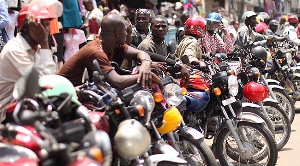
 The proposal to legalise and regulate okadas intends to standardise their operations
In Ghana, informal economic activities have long been the backbone of daily livelihoods for millions. Among these, the okada (commercial motorcycle) sector has played a critical role in providing fast, low-cost transportation and generating income in urban and rural areas alike.
Yet, despite its importance, this sector—and others such as traffic hawking, pottering (kayayei), and carting (truck/barrow pushers)—has often been relegated to the margins of formal economic policy.
Recent developments in legislation signal that integrating such ventures into the formal economy can become a transformative strategy for reducing unemployment and tackling multidimensional poverty.
Okadas have been perceived as a “harmless and crime-less” economic activity, providing a vital source of income for many without relying on large capital investments.
The proposal to legalise and regulate okadas intends to standardise their operations through measures such as mandatory licensing, compulsory training, periodic vehicle inspections, and the imposition of safety regulations (e.g., helmet use and minimum age requirements).
These measures are designed not only to enhance public safety but also to transition the sector from an informal survival mechanism into a regulated, professionally run industry. Moreover, this initiative is expected to yield significant multiplier effects.
By formally recognising okada operators, the government can extend benefits such as access to social security and microfinance opportunities. This pathway from informality to formal economic participation is crucial to alleviating multidimensional poverty, as it directly impacts areas beyond income—improving overall quality of life, access to finance, and lifelong learning and personal development.
Legalisation is more than an administrative realignment. It represents a proactive strategy to empower vulnerable populations. With formal status, registered operators may receive credit, insurance, and pension benefits, reducing the financial vulnerability that comes with informal work; the introduction of mandatory training and proficiency assessments will help ensure that operators are not only safer on the roads but also more competitive in a rapidly modernising economy; and the process will help stimulate additional economic activities that benefit local communities.
The formalisation of okadas is thus a model of how a seemingly modest venture can propel broader socioeconomic development.
Ghana’s informal economy is not limited to okadas. Sectors such as traffic hawking, pottering (kayayei), and carting have long provided livelihoods despite minimal support from successive governments. In the major cities, hawkers and vendors are forced to sell their wares on pavements because a lack of dedicated markets keeps them out of the mainstream economy.
With targeted policy reform, these ventures can also be modernised using strategies similar to those proposed for okadas. Instead of remaining a survival strategy marked by vulnerability and exploitation, they could evolve into an organized, dignified, and sustainable urban service.
For example, in parts of Asia, traditional rickshaw services have undergone major transformations. Transitioning from manual or non-motorised rickshaws to motorised, digitally integrated systems, these services now offer safe, reliable, and efficient last-mile mobility solutions with a market size of $5.5 billion in 2024 and 2034 projection of $11.2 billion.
The evolution of these systems shows that with proper regulatory support and technological integration, even the most informal of ventures can be revitalised to drive urban mobility and economic inclusion. Ghana could mirror this approach—adopting digital platforms to coordinate services, improving customer trust through certification, and linking operators to microfinance networks.
For okada legalisation and similar initiatives to succeed, several key policy measures are essential. Policymakers must design regulatory frameworks that are inclusive rather than exclusionary. For example, while a minimum age requirement (such as 25 years) may enhance safety, complementary programs should support younger operators through training and apprenticeship schemes.
Additionally, creating designated zones for street hawking and modernised marketplaces can integrate informal vendors into the urban fabric, thereby improving both livelihoods and urban aesthetics. Furthermore, digital platforms can facilitate the management of these informal sectors, enabling real-time coordination, secure payment systems, and enhanced accountability.
Lastly, collaborative efforts between the government, finance and insurance institutions, and tech innovators could amplify the impact of formalisation measures, ensuring that innovations are both scalable and sustainable.
In conclusion, addressing the multifaceted challenges of informality—such as inadequate regulation, lack of social protection, and limited access to finance—these policy measures have the potential to create a more resilient and inclusive economic landscape in Ghana.

Copyright © 1994 - 2026 GhanaWeb. All rights reserved.










