



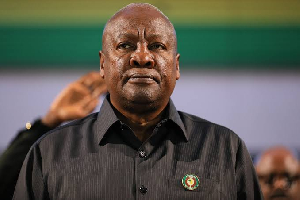
 President John Dramani Mahama
Introduction
Ghana’s infrastructure deficit is estimated at over $60 billion by the Ghana Infrastructure Plan 2018-2047. The NDC government's $10 billion Big Push is the solution. The article submits that the Big Push currently designed and implemented is concrete; however, physical structures are disconnected from fiscal reality, value chains, local accountability, and people’s livelihoods.
Using recent evidence from Wa and Kumasi demolitions, IMF fiscal data, and the Africa Policy Lens poll of May 2026, the article shows why a concrete-led strategy is not garnering political capital or productive jobs. In a productivity-led alternative, the article proposes a Big Push that would change the value proposition of the Ghanaian infrastructure budget.
Every government of the Fourth Republic has had its infrastructure moment. Rawlings had roads. Kufuor had schools and highways. Mills/Mahama had E-blocks and interchange projects. H.E. Akufo-Addo had 1D1F and Agenda 111. The NDC’s version is the Big Push, $10 billion over 5 years for roads, rail, hospitals, schools, markets and agro-industrial parks. The ambition is commendable.
Ghana needs roads to reduce travel time from 6 to 3 hours between key food baskets, needs a cold chain to reduce 40% post-harvest losses, and needs reliable power for night-shift work. But ambition without connection is waste.
We defined connection as the fiscal, value-chain, livelihood, and governance that must exist for concrete to become development. Connection means infrastructure that connects to income, not just to a ribbon-cutting. Concrete is kilometres built and sheds commissioned. For example, connection is: How much did my transport cost per crate reduce? How much of my harvest did I save? Did I keep my stall? Can my district maintain it after you leave?. That's why the article is titled Concrete Without Connection, meaning the NDC is delivering the first without the second.
Fiscal disconnection
The Maths Does Not Add Up
Ghana’s 2024 Budget provides for GHS 28.7 billion in total capital expenditure, roughly $1.9 billion at the time. Actual releases historically average 55-60% of allocation. This means real CAPEX is under $1.2 billion per annum.
The Big Push requires $2 billion per annum _additional. Where does it come from? Three options exist: tax more, borrow more, or reallocate.
Tax-to-GDP is 13.2% (World Bank, 2023), one of the lowest among lower-middle-income peers. Borrowing more breaches the IMF ECF conditionality, which caps non-concessional borrowing and demands a primary surplus of 1.5% of GDP by 2026. Reallocation means cutting free SHS, NHIS, or interest payments – all politically impossible.
The result is that projects start with fanfare, then stall for lack of funds. The Auditor-General reported over 400 stalled projects in 2023 alone. The cost to complete them is estimated at $2.3 billion – more than one year of the Big Push.
The Ghosts of Saglemi and E-Blocks
Saglemi Housing: $200 million spent, 1,500 units uncompleted, deteriorating. E-blocks: 124 started under Mahama, fewer than 60 completed by 2024, each requiring re-evaluation at 40% higher cost. Eastern Corridor Road: under construction since 2011, still incomplete. When a new government announces new markets without completing old ones, the voter learns that Big Push means Big Abandonment.
Value-chain disconnection
Infrastructure creates growth only when it lowers the cost of doing business. A road is not development. Instead, a road that reduces the cost of moving tomatoes from Techiman to Accra by 15% and connects to a cold store is development.
Case 1: Roads Without Storage
Ghana produces 1.2 million metric tons of tomatoes annually but loses 30-40% post-harvest. Building a 20km feeder road to Akomadan without a 500-ton cold storage facility means that the farmer still sells at harvest glut for GHS 50 per crate instead of GHS 300 in lean season. The road benefits the trader, not the farmer.
Case 2: Markets Without Affordability
The Kejetia Phase II and Kotokuraba markets increased trading spaces but increased monthly rents from GHS 300 to GHS 900-1200. Many original traders, mostly women, could not afford them and now trade on streets. The building is modern but the value chain is broken. A World Bank study (2023) found that Ghana’s logistics cost is 32% of product value compared to 12% in South Africa, not because of lack of roads but of fragmented storage, lack of standards and no aggregation. The Big Push as currently framed, measures kilometres, not cost reduction.
LIVELIHOOD DISCONNECTION
The most painful disconnection is human. In June 2026, two events defined the Big Push in public perception. In Wa, the Municipal Assembly demolished the 70-year-old Tendamba Primary School serving over 200 pupils to make way for a modern market. Pupils were sent home without a relocation plan. In Aboabo, Kumasi, the Sekyedumase Rural Bank branch serving small traders and farmers for 30 years was demolished for the same reason. This is not development; it is displacement. A government that promised a 24-hour economy and jobs cannot start by destroying a school and a community bank that provided both education and credit. True modernisation upgrades livelihoods within development, not erase them. The Africa Policy Lens poll (May 1-15, 2026) captured this mood. Voters who said their personal wellbeing had worsened were 23 points more likely to lean NPP (49% NPP vs 38% NDC nationally). More women lean NDC (44%) than men (34%), but women are also the most affected by market demolitions and rent hikes. Concrete without connection loses women traders, pupils and rural banks – the base of NDC support.
GOVERNANCE DISCONNECTION
IDEG’s Executive Director Dr. Emmanuel Akwetey called on August 12 for NDC/NPP consensus on election of MMDCEs. The Constitution Review Committee has proposed non-partisan election of DCEs. The two major parties disagree on whether it should be partisan or non-partisan.
The relevance to Big Push is direct: who owns the project? Currently, projects are designed in Accra, awarded in Accra, and commissioned in Accra. MMDCEs are appointed, not elected, and therefore accountable upward, not downward. When a market is demolished and rebuilt, there is no town hall, no ESIA published, and no maintenance plan. The Auditor-General found that 78% of MMDAs had no asset register for completed projects in 2023. Without elected local leadership that can approve projects, the Big Push will remain an Accra push.
What a connected big push would look like
A Connected Push would flip the model to the following:
a) Completion Before Commencement Act: Legislate that 60% of annual CAPEX goes to completing stalled projects. Publish a National Stalled Projects Register with cost-to-complete and expected jobs. No new sod-cutting in a district with two or more abandoned projects over GHS 10 million.
b) Value-Chain Conditionality: Every project above $10 million must publish:
(i) Cost-Benefit Analysis, (ii) Expected reduction in logistics cost, (iii) Direct and indirect jobs, (iv) Maintenance funding source for 10 years. A road must be justified by its impact on shea, not just its length.
c)Leverage, Don’t Just Spend: Use Ghana Infrastructure Investment Fund (GIIF) to crowd-in pension funds, diaspora bonds, and PPPs. Toll roads with e-tolling, market concessions with 30% reserved for old traders, and energy transmission lines on a BOOT basis. Government’s role is to de-risk, not to build everything.
d)Livelihood Safeguard: No demolition of school, health facility or financial institution without published resettlement and continuity plan approved by District Assembly and CHRAJ. Traders displaced by market projects must get first right of refusal at old rent for 2 years.
CONCLUSION
Ghana does not need less infrastructure. It needs infrastructure that connects. The 49% versus 38% poll is not about NPP being more loved; it is about NDC being perceived as building monuments while pockets shrink. NPP’s quiet rebuild from polling stations to regional chairs like Okoe-Boye in Greater Accra and COKA in Ashanti shows that organization and presence matter.
NDC’s Big Push must show that it understands productivity and people matter more. The choice is not between building and not building. It is between a Big Push that leaves concrete without connection, and a Smart Push that leaves jobs with dignity.
If NDC wants its Push to be remembered like Kufuor’s roads or even parts of Kwame Nkrumah’s Akosombo projects that still create value 50 years later, it must connect concrete to cold stores, to credit, to classrooms and to elected local accountability.
Otherwise, we will in 2030 audit another list of abandoned projects, and ask again: where did the $10 billion go?

Copyright © 1994 - 2026 GhanaWeb. All rights reserved.










