



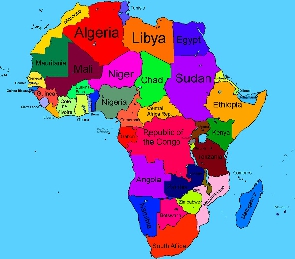
 File photo of African map
Across parts of West and Central Africa, democracy is retreating, not only because of internal political struggles, but because foreign-backed authoritarianism is reshaping the lives of millions.
The rise of coups, disinformation networks, mercenary interventions, and constitutional manipulations has created a region where ordinary Africans, not political elites, bear the greatest burden.
While analysts often frame these events in geopolitical terms, the human cost is far more urgent. Families displaced from their homes, journalists living in fear, and communities struggling with instability illustrate a truth that Africa cannot ignore: foreign interference in domestic politics is not an abstract threat, it is a daily reality with dire consequences.
Burkina Faso’s twin coups of 2022 created a wave of instability that continues to ripple across the region. The first coup in January toppled President Roch Marc Kaboré, and another in September removed Lieutenant Colonel Paul-Henri Damiba. Both coups deepened insecurity, especially in the northern regions already burdened by insurgent attacks.
As violence intensified, civilians fled. A 2024 joint report by IOM, UNHCR and UNICEF estimates that more than 15,000 Burkinabe asylum seekers crossed into Ghana’s Upper East and Upper West regions.
These Ghanaian border communities, already among the poorest in the country, now struggle to support the influx.
Local clinics run short of medicine. Schools absorb more pupils than they can handle. Families who had little to begin with now share food and water with displaced neighbours.
For the refugees, the trauma of uprooting is compounded by uncertainty. Their suffering is not simply the result of domestic political infighting but of a larger pattern where foreign support fuels instability for strategic gain.
The human story here is one of resilience under pressure, but also of fragility. And it demonstrates how quickly political shocks spill across borders, turning ordinary people into unintended victims of geopolitical games.
Central African Republic
The situation in the Central African Republic (CAR) reveals a different, but equally painful, dimension of foreign-backed authoritarianism.
President Faustin-Archange Touadéra, elected democratically in 2016, has since consolidated power with heavy support from the Russian-linked Wagner Group.
The 2023 constitutional referendum that abolished term limits was less a democratic choice and more an operation secured through intimidation. Wagner operatives were deployed nationwide, not only to “maintain order” but to enforce loyalty.
Reports from journalists, aid workers, and civilians describe a climate of fear, where dissent carries violent consequences.
UN investigations have documented human rights abuses linked to Wagner forces, including intimidation of political opponents, harassment of minority communities, and attacks on civilians. Civic space has shrunk so drastically that speaking openly feels dangerous.
For many Central Africans, democracy has stopped being something they can shape, and has become something imposed upon them by force.
The suffering here is not symbolic; it is physical, immediate, and personal.
Weapon against citizens
Not all foreign interference arrives with soldiers. In Angola, it came through disinformation networks that blurred truth and manipulated public sentiment.
In 2025, two Russian nationals were arrested for orchestrating a propaganda campaign that fuelled unrest during protests over rising fuel prices.
Posing as journalists, they infiltrated political circles, conducted opinion polls, and produced content designed to inflame tensions.
Their activities created confusion and mistrust. Citizens could no longer distinguish genuine civic expression from foreign manipulation. Protests escalated, political figures were misrepresented, and public trust in democratic processes eroded.
Once again, ordinary people, struggling with economic pressures, became pawns in a foreign strategy they neither initiated nor benefited from.
Why the poorest countries suffer the most
Across Burkina Faso, CAR and Angola, a clear pattern emerges. Countries classified as Least Developed Countries (LDCs) face the highest vulnerability to coups and external interference.
Weak state institutions, struggling economies, and histories of military involvement create an opening for foreign influence.
And when foreign actors step in, citizens pay the price through:
1.Displacement and forced migration
2. Shrinking media freedom
3.Loss of livelihood
4.Heightened insecurity
5.Deepened mistrust in public institutions
Democracy weakens, but the human wounds cut deeper.
Foreign-backed authoritarianism is not merely a political problem; it is a human emergency.
The people fleeing Burkina Faso, the civilians intimidated in CAR, and the misled citizens in Angola all reveal a continent at a crossroads.
Safeguarding democracy must begin with safeguarding people. Because until Africa confronts the forces that exploit its fragility, ordinary Africans will continue to pay the highest price.
'He wanted sex' – Woman assaulted by husband in viral video recounts ordeal

Copyright © 1994 - 2026 GhanaWeb. All rights reserved.










