



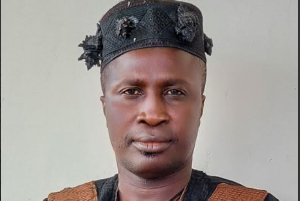
 Nana Yaw Wi Asamoah Boadi is a traditionalist
Our Students-from Raw Material for the West to Raw Material for China:
Ghana’s Perpetual Subordination Education System
On a humid Tuesday morning in Accra, I watched a group of university graduates file out of a job interview for an office assistant position that required typing speed and a smile. Twenty of them. One job. Later that day, I saw a video of a Chinese first-grade classroom where children were soldering small circuit boards. Let that sink in.
We have a crisis, but not the one politicians mention during rallies. The real crisis is that Ghanaian education has quietly given up on the idea of Ghana. We have become a nation that educates for export—raw minds for the West, and soon, if rumours are true, raw labour for China.
The Great Misalignment
Let me say what many whisper: our education system is not producing problem-solvers; it is producing prayer warriors who can sing, dance, and memorise. From early grade to tertiary, the dominant culture is one of performance—not production. We spend hours in religious observances in public schools (yes, in state-funded classrooms), hours perfecting choreography for speech and prize-giving days, but ask a final-year senior high student to fix a broken borehole pump or calculate the profit margin on a tomato farm, and you will meet a blank stare.
The numbers are unforgiving. According to the Ghana Statistical Service, over 1.3 million young people are neither in employment, education, nor training (GSS, 2023). Meanwhile, the same report shows that employers constantly complain of a mismatch between academic certificates and practical competence. We are graduating young people who can recite every lyric of a gospel song but cannot sew a button or write a business proposal.
We call them unemployed. The truth is crueller: many are unemployable not because they are lazy, but because they were never taught to think.
The Raw Material Economy of the Mind
For decades, the unspoken pact was simple: Ghanaian schools filter the brightest, Western universities take the cream, and the rest wait for NGO jobs or diaspora remittances. Our curriculum has been a mirror of British templates, then American influences, and now—if educational leadership gets its way—a pivot toward Chinese language and vocational alignment with China’s Belt and Road projects.
Do not misunderstand me. Learning Mandarin is not foolish. China is an economic reality. But the rumoured plan to introduce Chinese as a formal part of the curriculum, while no Ghanaian language is mandatory beyond a basic level, tells you everything about our psychology. We are once again preparing ourselves to serve—this time as a fluent workforce for Chinese firms, as translators, as low-tier technicians in someone else’s industrial strategy.
A senior official at the Ministry of Education recently floated the idea that Chinese could become “the second language of Ghanaian industry.” I nearly choked on my kenkey. Second language? After English, we will take Chinese, while our own Twi, Ga, Ewe, and Dagbani are left to die slowly on the tongues of grandmothers? What exactly are we preserving?
he Chinese Example We Refuse to See
China was not always a superpower. In fact, in the 1970s, China was poorer and more agrarian than Ghana is today. Per capita income was lower. Infrastructure was crumbling. Illiteracy was widespread. But then they made a choice that we have never dared to make: they closed certain doors and opened their own.
From the 1980s, Beijing restructured its basic education to prioritise indigenous problem-solving. They did not abandon Western science, but they stopped teaching it as worship. They fused Marxism with Confucian pragmatism and began a quiet revolution: early grade schools introduced “labour education”—children as young as six learning to grow vegetables, repair furniture, and assemble simple machines (Zhao, 2019). By middle school, students were building drones and writing code—not in English, but in Mandarin, using local metaphors and local problems.
Today, China produces more STEM graduates than the US, India, and Germany combined (World Economic Forum, 2022). And their unemployment rate for youth with technical skills is below five percent.
Here is the kicker: they did this not by copying the West, but by indigenising modernity. Their language, their cosmology, their approach to time, hierarchy, even spirituality—all rooted in thousands of years of their own understanding of how the universe works. They did not wait for UNESCO or the World Bank to give them a curriculum.
We, on the other hand, have outsourced our imagination.
The Prayer–Performance Trap
The overdependence on divine intervention in our schools has become a crutch. In many Ghanaian tertiary institutions, you will find more vigils than laboratories. More singing competitions than engineering workshops. In early grade classrooms, children spend more time memorising scriptures and choreographing cultural dances for visiting dignitaries than they do measuring rainfall or designing simple toys from scrap materials.
This is not culture. This is escapism. We have turned singing and dancing into a substitute for production. Meanwhile, a six-year-old in Shenzhen is learning that a broken toy can be fixed with a screwdriver and a curious mind. Our six-year-old is learning that if you sing loud enough, God will send someone from Canada to sponsor you, or you will go viral on social media.
Researchers, Oppong & Adjepong (2022), noted that Ghana’s basic education system emphasises “rote learning and deference to authority” rather than inquiry, experimentation, or failure-tolerance. In other words, we are training subordinates, not owners.
Internalising Subordination
This is the deepest wound. After years of this education, the young Ghanaian mind no longer dreams of building a factory. It dreams of a visa. We have normalised the idea that success means leaving—leaving your land, your language, your family, your birthright. We sell plots of inherited land to pay for IELTS exams. We mortgage futures to pay agents who promise a road to Europe or a scholarship to a Chinese university, where we will still be second-class. And we call this ambition.
I have sat with final-year university students who cannot name five indigenous plants with medicinal value, but they can tell you the visa process for Canada by heart. They have never read a single Ghanaian philosopher- not even Kwame Nkrumah-, but they can quote American entrepreneurs. Their inner map of the world starts at Kotoka International and ends at Heathrow or Beijing Capital.
We have educated ourselves into self-hatred. Not the loud kind. The quiet kind that renames streets after foreign leaders, that insists English-only in classrooms, that looks down on local apprenticeships as “dirty” while glorifying white-collar paper pushing.
A Liberation Curriculum
What would it mean to truly decolonise Ghanaian education? Not the superficial “Africanisation” that slaps a kente pattern on a colonial syllabus and secretly sends it to the West for approval. I mean a complete rethinking of why we learn- Self-knowledge and existential essence.
First, officialise a Ghanaian language as the medium of instruction for at least the first six years. Neuroscience is clear: children learn best in their mother tongue (UNESCO, 2016). China understood this. Germany understood this. Japan understood this. Only we think our children need English before they can count to twenty in Ga or Twi.
Second, introduce “local problem” modules. Every term, every student from primary to JHS must solve one real problem in their community: how to stop a stream from drying up, how to preserve tomatoes without refrigeration, how to design a simple maize sheller using local scrap. No theory. No exams. Just build. Just fail. Just try again.
Third, scrap the obsession with endless religious observances during school hours. Faith belongs in the home and the place of worship, not as a substitute for physics lab. Let us replace one hour of singing with one hour of carpentry, coding, or soil testing.
Fourth, and most controversially, we must stop treating every foreign language as a ladder and our own as a relic. If we introduce Chinese, it must be after we have achieved fluency in a Ghanaian language. And it must be taught alongside a critical question: What can we learn from China’s method, not just its money?
The Alternative Is Not East or West
The greatest lie we have swallowed is that our choice is between following the West or following China. The real path is neither. It is turning inward—not to be isolated, but to be rooted. China did not close itself off forever. They closed strategically, built their base, and then opened on their terms. We have never closed anything. We have been open for business—open to being a market, a source of raw labour, a beautiful song-and-dance nation for tourists.
I dream of an education that produces a young Ghanaian who does not need a visa to feel valuable. Who looks at a piece of land and sees a factory, not a ticket to sell? Who can repair a generator, write a contract in Twi, Ewe, Dagbani, or Ga, start a cooperative, and teach a child to do the same?.
Until then, we will keep manufacturing prayer and exporting people. And the cycle will continue. Unfortunately, many received a similar education, but fortunately, many are waking up now. Very soon, posterity will judge those in charge, and who knows how the judgment day will be.
Our Ancestors are with heavy hearts !!!
References:
Oppong, Charles & Adjepong, Adjei. (2022). Introduction of history in the Ghana basic school curriculum: The missing link. Ghana Journal of Education: Issues and Practice (GJE). 8. 44-57. 10.47963/gje81328.
Ghana Statistical Service. (2023). Annual Household Income and Expenditure Survey: NSS Accra
UNESCO. (2003). Education in a Multilingual World. Paris: UNESCO Publishing.
World Economic Forum. (2022). The Future of Jobs Report 2022. Geneva: WEF.
Zhao, Y. (2019). The Takeaway: What China Can Teach the World About Education. London: Routledge.

Copyright © 1994 - 2026 GhanaWeb. All rights reserved.










