



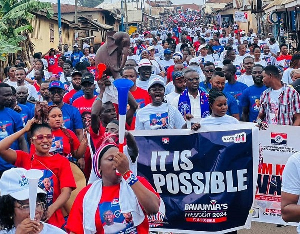
 Some members of the New Patriotic Party (NPP) on the street
With the 31 January 2026 NPP presidential primaries fast approaching, the party is in dire need of calm, cohesion, and discipline.
This is not merely about optics; it is about survival.
A party that enters a national election divided often exits defeated.
The recent escalation of internal insults is a dangerous sign that discipline is slipping.
Primaries are meant to be contests of ideas, policies, and leadership visions.
When they instead devolve into name-calling, public ridicule, and factional bitterness, the damage extends far beyond the internal arena.
And make no mistake: the opposition is watching.
The National Democratic Congress (NDC) will not hesitate to archive every jab, every insult, and every self-inflicted wound.
Come 2028, these words could be repackaged as evidence of disunity, poor judgment, or lack of leadership maturity within the NPP.
Parties rarely lose elections solely because of their opponents; they often lose because of their own internal fractures.
A Party at a Crossroads — Why the NPP must tame its internal fire
The New Patriotic Party (NPP) has weathered storms before, but the recent spike in internal verbal warfare suggests a party drifting dangerously close to self-sabotage. Reports of Atta Akyea allegedly describing Kennedy Agyapong as suffering from “mouth diarrhoea” and “not fit to be president” mark a new low in a competition where ideas should be clashing, not personalities.
Such remarks, if accurately reported, do not merely injure the reputation of a colleague; they wound the moral standing of the entire party.
A party cannot afford this kind of public spectacle, especially not on the eve of a crucial presidential primary scheduled for 31 January 2026.
The NPP is a party built on the ideals of tolerance, intellectual debate, and democratic maturity.
Allowing its leading figures to trade insults in the open court of public opinion risks eroding its credibility.
At a time when Ghanaians are scrutinising leadership quality more than ever, internal chaos only deepens doubts about the party’s capacity to govern itself, let alone the nation.
If the NPP fails to rein in this internal fire now, the blaze will not only scorch individuals but potentially consume the party’s chances in
the future.
Kennedy Agyapong’s Fiery Speech Style — Asset or Liability for a Presidential Ambition?
Kennedy Agyapong’s political persona has long been defined by bluntness, unfiltered commentary, and a reputation for “telling it as it is.”
While this approach has earned him loyal supporters who see him as bold, authentic, and incorruptible, it has also left behind a trail of controversial outbursts that opponents frequently capitalise on.
His record of fiery speeches, widely documented in Ghanaian political discourse, could cast a long shadow over his bid for higher office.
Presidential candidates are judged not only by the strength of their ideas but by their temperament under pressure, their diplomatic instincts, and their ability to unify.
A history of verbal confrontations, harsh accusations, or emotionally charged remarks risks being interpreted as signs of unpredictability or impulsiveness, traits that can unsettle undecided voters.
Should he secure the NPP’s nomination, every past statement will likely be revisited, replayed, and reframed by political opponents, especially the NDC, who are skilled at weaponising old rhetoric in election season.
The 2028 electoral battlefield will be unforgiving.
In modern politics, words never die; they merely go into storage, waiting for strategic resurrection.
Agyapong may need not only a political strategy but deliberate image recalibration if he hopes to reassure the broader Ghanaian electorate that he can transition from former outspoken legislator to steady national leader.
If the NPP wishes to remain competitive in 2028, it must prioritise peace now.
Not next month.
Not after the primaries.
Now.

Copyright © 1994 - 2026 GhanaWeb. All rights reserved.










