



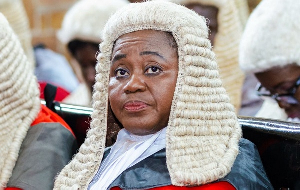
 Suspended Chief Justice Gertrude Araba Torkornoo
The recent joint statement issued by the Bar Council of England and Wales (BCEW) and the Commonwealth Lawyers Association (CLA) concerning the suspension of Ghana’s Chief Justice, Her Ladyship Justice Gertrude Torkornoo, is regrettable both in tone and in substance.
The joint statement reflects a troubling detachment from Ghana’s constitutional framework and a premature alignment with partisan narratives that risk undermining the very judicial independence the statement purports to defend.
Most disconcerting, however, is the profound ignorance displayed by the BCEW and CLA, their posture of institutional condescension and manifest imperial resonance that permeates the statement - an approach that not only disrespects Ghana’s sovereignty and advanced judiciary.
Rather, its colonial inflection is jarring and illsuited to the norms of progressive international diplomacy and transnational legal fraternity.
Mischaracterization of constitutional process
The statement fails to acknowledge that the suspension of the Chief Justice is not an arbitrary executive act but the activation of Article 146 of the Constitution of Ghana, a provision designed to uphold judicial accountability through a structured, multi-phase process.
This mechanism is neither novel nor capricious.
It is a constitutional safeguard that admits of two possible outcomes: exoneration and reinstatement, or culpability and removal.
To suggest that the mere invocation of this process amounts to a fait accompli, and thereby a breach of judicial independence, is either an act of political mischief, a grotesque mischaracterization to caricature the law, or a fundamental misapprehension of the architecture of constitutional checks and balances.
Procedural integrity and constitutional fidelity
Assertions that the process lacks fairness, such as the substitution of witnesses for petitioners or the alleged discourtesy shown to legal representatives, remain speculative and unsupported by any authoritative findings, having been canvassed and disposed of across multiple judicial fora.
Needless to say, such concerns, if genuinely held, are properly ventilated through the courts, a position the suspended Chief Justice herself acknowledges.
The statements issued by the BCEW and CLA overlook both the procedural latitude afforded to investigative committees under Ghanaian law and the principle that due process must be assessed contextually, not through the prism of political expectation.
While the invocation of the Latimer House Principles is commendable, it cannot displace domestic constitutional provisions or constrain the discretion of duly constituted investigative bodies. Moreover, nothing in the ongoing proceedings suggests, even remotely, that the process is on a collision course with the Latimer House Principles or any applicable international norms.
Political witch-hunting: A presumed un-sustained executive misconduct
The uncouth and ill-considered call for the immediate reinstatement of the Chief Justice by a meddlesome interloper such as the BCEW is nothing short of incredible.
It presumes misconduct by the Executive without the benefit of adjudication, a posture that is not only premature and procedurally out of order but also grossly prejudicial.
Such presumptions undermine the integrity of the ongoing process and risk politicizing what is, at its core, a constitutional inquiry into judicial conduct, specifically, alleged stated misconduct and incompetence, which automatically triggers a constitutional imperative under Article 146. This imperative cannot be circumvented by the Executive, nor by any other party.
Once triggered, the process is not discretionary and does not conform to the sentiments expressed in the joint statement of the BCEW and CLA. In any case, the rule of law demands restraint, not reflexive political condemnation and intermeddling.
A Double-standard motion cloaked in unethical advocacy
It is noteworthy that the joint statement mirrors the position previously adopted by the Ghana Bar Association, a stance that has itself attracted criticism for its apparent partisanship in this matter.
The uncritical replication of this posture by the BCEW and CLA, without independent verification or engagement with the full factual matrix, raises legitimate concerns about institutional bias and the erosion of objectivity in transnational legal advocacy.
It must also be stated forcefully that, the politicization of the ongoing article 146 proceedings both by the Ghana Bar Association and the Bar Council of England and Wales and the Commonwealth Lawyers Association, under the guise of defending judicial independence, risks undermining the very principle they purport to uphold.
Judicial accountability – The Locus Classicus
Those unfamiliar with the contours of Article 146 and its jurisprudential lineage would do well to examine comparative precedents, most notably the Privy Council’s ruling in the matter of the Chief Justice of Gibraltar (November 2009).
The case illustrates key elements of a prima facie threshold and the procedural and evidentiary rigour required in such inquiries (without prejudice to the ongoing proceeding involving suspended Chief Justice of Ghana).
The Gibraltar case stands as the gold standard the locus classicus for judicial accountability in modern constitutional democracies, and it ought to serve as the benchmark against which the Article 146 proceedings are measured.
Conclusion
The suspension of a Chief Justice is undoubtedly a grave matter. But gravity must not give way to sentimentality or political expediency.
The rule of law is not served by premature calls for reinstatement, nor by statements that disregard the constitutional mechanisms designed to uphold judicial integrity.
The Bar Council of England and Wales and the Commonwealth Lawyers Association would better serve the cause of justice by engaging with the facts, respecting Ghana’s sovereignty and its constitutional order, and allowing the process to reach its lawful conclusion.
By Julius K Manu, a policy and institutional development consultant.
He also has postgraduate academic background in law.

Copyright © 1994 - 2026 GhanaWeb. All rights reserved.










