



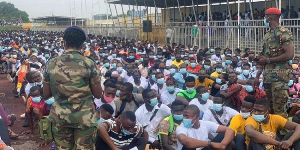
 Over thousands of Ghanaians thronged the stadium for the exercise
May the souls of the twelve vibrant and patriotic young men and women who lost their lives rest in perfect peace. For the living, may we never forget the tragic events of November 12, a day that began with a hope to serve Ghana but ended in heartbreak for the families of the departed twelve.
What was supposed to be a routine recruitment exercise by the Ghana Armed Forces at the El-Wak Sports Stadium in Accra, turned into a national tragedy when an uncontrolled crowd surge led to the death of twelve potential recruits and injuries to several others.
At dawn, thousands of young men and women converged on the El-Wak Stadium in Accra, eager to take part in the Armed Forces recruitment process. Many had travelled long distances, clutching their documents and dreams of serving their country.
According to the GAF, the day’s exercise was meant to involve document verification and body selection. However, what began as an orderly process quickly spiralled into chaos. Eyewitnesses recounted that the stampede occurred moments after the gates of the stadium were opened.
Preliminary investigations by the Ghana Armed Forces indicate that the stampede was triggered by an unexpected surge of applicants who breached security protocols and rushed into the gates ahead of scheduled screening at about 0620 hours.
This incident has once again raised critical questions about public safety, crowd management, and institutional preparedness. What security measures were in place to control the massive turnout? Why was the venue not prepared for such an overwhelming number of people?
The El-Wak Stadium, though spacious, has limited entry and exit points, a dangerous setup when managing large crowds.
Beyond structural issues, there is also the matter of human behaviour and command. Videos circulating online showed some military personnel reacting aggressively to the situation, with a few threatening to show the recruits where power lies. Such responses, though possibly out of frustration, may have further escalated the tension.
Twelve young lives were lost, lives filled with promise, ambition, and hope.
At the heart of this tragedy lies a painful reality, which is Ghana’s growing youth unemployment crisis. With limited job opportunities and high economic uncertainty, recruitment exercises by security agencies often attract overwhelming numbers.
The Armed Forces, Police Service, Immigration, and Fire Service are seen not just as stable employers but as gateways to dignity and national service.
When tens of thousands of youth scramble for a few thousand positions, the risk of chaos becomes almost inevitable. This tragedy, therefore, is not just a failure of logistics; it also mirrors the socioeconomic pressures facing young Ghanaians today.
Recommendations
To ensure that such a painful incident never occurs again, several critical reforms must be implemented
1. Digitised recruitment process
The Ghana Armed Forces and other security services should move all pre-screening and document verification online.
Applicants should only report physically after initial digital shortlisting has been completed. This would drastically reduce crowd sizes and improve efficiency.
2. Timed and zonal scheduling
Instead of calling thousands of applicants to a single venue, the process should be decentralised by region and conducted in timed batches. Clear communication on reporting times would prevent overcrowding.
3. Enhanced security and crowd control training
Personnel managing such exercises must be trained in crowd psychology, emergency response, and non-violent control techniques. Coordination with the Police, Fire Service, and National Ambulance Service should be mandatory.
4. Improved infrastructure at screening centres
Screening centres must have multiple entry and exit points, barriers to manage queues, visible signage, and emergency medical stations. These are standard crowd management tools that save lives.
5. Public education on safety conduct
Applicants themselves must be educated on orderly conduct during national recruitment exercises. Sensitisation through the media and community outreach can reduce panic behaviours and mass surges.
6. Accountability and transparent review
The Ghana Armed Forces, together with the Ministry of Defence, should commission an independent review of the incident. Families of the deceased deserve not only condolences but justice and assurance that lessons have been learned.
Conclusion
The El-Wak tragedy must serve as a turning point and a call to rethink how public recruitment exercises are managed. It is not enough to mourn; the systems that failed must be corrected.
Twelve promising lives have been lost in pursuit of service to our dear nation. Their sacrifice should not fade into another statistic. Ghana must honour them by building safer systems, ensuring that no dream of serving the nation ever ends in death.

Copyright © 1994 - 2026 GhanaWeb. All rights reserved.










