



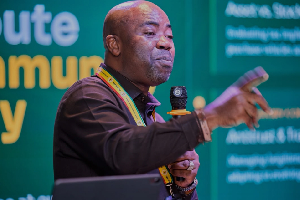
 Samson Deen presents Ghana’s emerging sports-development agenda
The Committee has created momentum. The national task now is to convert that momentum into an accountable, investable and inclusive sports-development system.
Samson Deen, Chairman of the Resource Mobilisation and Partnership Committee, presenting the emerging national sports-development agenda. Ghana has never lacked sporting talent. What it has lacked is a durable national system capable of finding that talent early, developing it fairly, financing it transparently and connecting it to opportunity. Across football parks, school fields, community courts and para-sport training grounds, ability is abundant.
The pathway from raw promise to sustained excellence, however, remains uncertain. That is why the early work of the Resource Mobilisation and Partnership Committee of the National Sports Authority deserves serious attention. Led by Samson Deen, the RMPC has begun to frame sport not merely as a sequence of competitions or a recurring demand on the public purse, but as a national development platform with commercial, social and diplomatic value. The Committee’s first formal weekly assessment shows an institution moving quickly from inauguration to mobilisation.
It has advanced consultations with sports federations and the media, clarified a proposed pathway from constituency competition through regional qualification to national opportunity, developed banking and transport partnership proposals, prepared parliamentary and inter-ministerial engagement packages, and attracted an initial in-kind contribution from the Ghana–Anhui Chamber of Commerce.
The donation of 600 pairs of footwear and 1,520 T-shirts—2,120 items in total—may not in itself transform Ghana Sports. Its deeper significance is that it arrived within days of the Committee’s inauguration and demonstrated what can happen when a public institution presents partners with a clear national proposition. It was an early proof of concept: business and international networks can be mobilised around grassroots sport when the offer is organised, visible and connected to measurable public value.
The RMPC deserves credit for urgency. Too many public committees begin with speeches, disappear into meetings and return months later with documents that never leave the shelf. This Committee has created visibility, opened stakeholder channels and placed the Constituency Games, the proposed National Talent Bank and sports commercialisation into the public conversation.
Yet the same weekly assessment that records the progress also offers an important warning. Momentum is currently moving faster than institutional readiness. Major sponsorship proposals remain proposals rather than signed revenue. The Games still require an approved phased calendar, final sport selection, eligibility rules, a minimum delivery budget and a clear responsibility matrix.
The Talent Bank still requires an approved owner, data-control rules, consent procedures, safeguarding standards, access rights and a credible appeals mechanism.
There is also no consolidated financial statement showing the approved budget, cash secured, verified value of in-kind support, conditions attached to contributions or the remaining funding gap. Ghana must not confuse visibility with viability. A successful launch is useful; a controlled delivery system is indispensable.
This is not an argument against the RMPC. It is precisely why the Committee should now be strengthened. The difficult work begins after the headlines: converting interest into contracts, donations into audited assets, plans into budgets, and public enthusiasm into a programme that survives changes in personalities and political seasons.
Ghanaians should see the RMPC not as another sports committee competing for attention, but as a potentially valuable instrument of the national reset agenda. Properly directed, it can connect sport to youth employment, education, health, tourism, national cohesion, gender inclusion, disability inclusion, local economic activity and Ghana’s international image.
Sports development is inherently inter-ministerial. The Ministry responsible for Sports cannot alone provide security, school access, district coordination, medical support, digital identity, transport, employment pathways, gender safeguards and community infrastructure. Presidential interest can break institutional silos and require ministries, agencies, regional administrations and local authorities to cooperate around one accountable national framework.
The Constituency Games also offer the Presidency a practical way to make national policy visible at community level. Unlike a centralised programme experienced mainly in Accra, constituency-based competition can touch all parts of the country. It can give young people a reason to participate, communities a platform for pride, businesses a credible activation opportunity and technical officials a structured route for talent identification.
This interest, however, should not mean political capture. Presidential support must protect the programme from partisan selection, ceremonial excess and unfunded promises. The strongest contribution the Presidency can make is to insist on national ownership, transparent rules, measurable outcomes and continuity beyond one administration.
The next phase should begin with a formal presidential and NSA-backed delivery compact. That compact should define the outcomes expected over the next twelve months, identify accountable owners, establish deadlines and require a public-facing performance dashboard. The RMPC should recommend and mobilise; the NSA Board and authorised management structures should approve contracts, receive funds and protect public assets. Those boundaries must remain clear.
A verified financial-readiness statement is now urgent. It should distinguish approved budget, secured cash, independently valued in-kind contributions, conditional offers, receivables and the genuine funding gap. No proposal should be described as sponsorship income until it is approved, signed and supported by payment or a verifiable in-kind instrument.
The active partnership pipeline also needs an official deal ledger. Every prospect should carry a proposed value, probability, approval status, contract status, activation obligations, payment status and responsible owner. The immediate commercial test is not how many letters are sent, but whether at least one credible proposal can be converted into an approved term sheet without compromising public value.
Facility commercialisation must become part of the reset. The NSA should complete a rights inventory, establish ownership, commission independent valuation, develop rate cards and identify three priority facilities for commercially responsible planning. Naming rights, concessions, hospitality, ticketing, broadcast, digital media and facility-use opportunities can generate revenue, but only where procurement, legal review and fair valuation prevent exclusivity from becoming undervaluation.
The Constituency Games should resist the temptation to launch everything everywhere at once. A phased minimum-viable rollout would allow Ghana to test competition formats, logistics, safeguarding, media operations and financial controls before national expansion. Core sports should be selected according to participation potential, facility availability, cost, public appeal, gender balance and para-sport inclusion—not lobbying strength.
Technical selection must remain in technical hands. Federations, coaches and qualified officials should agree eligibility rules, qualification pathways and competition standards. Political office should enable the programme, not choose its winners. A transparent complaints and appeals process will be essential to public trust.
The proposed National Talent Bank could become the programme’s most enduring legacy if it is built correctly. It should record verified sporting data, not political affiliations. Athletes and parents must understand consent, access and data use. Child protection, disability inclusion, medical confidentiality and cyber security must be designed before mass registration, not added after a breach or controversy.
The media consultation was an important step because national programmes require independent scrutiny as much as publicity. Community-first reporting can bring unknown athletes into view and help the public understand sports beyond elite football. Journalist training developed with federations can improve technical accuracy across athletics, para-sport and other disciplines that rarely receive sustained coverage.
But media partnership must never become a demand for unquestioning endorsement. The best contribution journalists can make is to report achievements accurately, expose gaps responsibly and keep promises measurable. An evidence-based weekly brief distinguishing completed actions from active proposals would strengthen confidence and reduce the risk of inflated expectations.
The President has an opportunity to turn the RMPC into the mobilisation engine of a broader Ghana Sports reset. A short presidential directive could convene the relevant ministries, require a unified implementation framework, protect a transparent financial architecture and demand quarterly reporting on participation, partnerships, facilities, talent progression and inclusion.
Presidential attention would also signal to corporate Ghana that sport is not a charitable afterthought. It is an investable sector capable of creating audiences, jobs, events, data, tourism, brands and national pride. Government should not crowd out private investment; it should create the rules, confidence and infrastructure that allow responsible investment to grow.
For Samson Deen and the RMPC, the next measure of leadership will be restraint as much as ambition: saying only what can be evidenced, assigning ownership to every commitment, closing deals within authority and building controls before scale. If that discipline is maintained, the Committee can become more than a mobilisation body. It can become the bridge between public policy and the resources Ghana Sports has long needed.
The country has tried episodic interventions before. It has celebrated champions without building enough pathways behind them and launched programmes without protecting continuity. The RMPC now offers a chance to do something different: to connect every constituency to a national system, every partnership to verified value and every promise to accountable delivery.
That is a tool the President should use—not to politicise Ghana Sports, but to reset it.

Copyright © 1994 - 2026 GhanaWeb. All rights reserved.










