



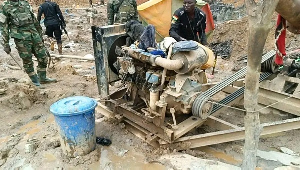
 File photo of a galamsey site
Introduction
The term galamsey — widely used in Ghana — refers to small-scale, often informal or illegal gold mining. According to the Oxford English Dictionary, galamsey originates from the phrase “gather them and sell,” describing individuals who collect small amounts of gold and sell them to licensed dealers.
Historically, galamsey was a local livelihood activity deeply embedded in Ghana’s mining culture, particularly in gold-rich communities such as Obuasi, Tarkwa, Prestea, and Bogoso.
Over time, however, galamsey has come to represent unregulated, environmentally destructive mining, often associated with river pollution, deforestation, and unsafe labour practices. What began as a survival-driven economic activity has evolved into one of Ghana’s most pressing environmental and governance challenges — a complex blend of poverty, opportunity, and state neglect.
Understanding the Root Causes
The galamsey problem cannot be solved through theories and police raids alone. We have tried that approach for years, and it has not worked. What Ghana needs is a practical economic model that formalises and integrates small-scale mining into the broader national development agenda. Other countries, such as Tanzania and Bolivia, have shown that when small-scale miners are properly trained, licensed, and connected to local value chains, they become part of the solution rather than the problem.
Let’s be honest: galamsey did not begin yesterday. Those in Obuasi, Tarkwa, and their surrounding communities, such as Prestea and Bogoso, know it has been part of our mining story from the very start. It became a crisis only after Ghana signed onto the Structural Adjustment Programme in the 1980s and 1990s. We sold off our state-owned mines without considering the livelihoods of the thousands who depended on them. That economic shift forced many into illegal mining simply to survive.
A New Way Forward
If we truly want to address this issue, we must stop pretending that enforcement alone will save us. We need to engage professionals who understand the complex realities of galamsey, collaborate meaningfully with the affected communities, and build a transparent framework that transforms this so-called menace into a sustainable and profitable industry for the nation.
The following forward-looking proposals could help Ghana achieve that transformation:
1. National Dialogue and Recognition: Government and its agencies must first acknowledge small-scale mining as a legitimate trade and convene an open national dialogue involving all known galamsey operators, experts, and community leaders to design an inclusive reform strategy.
2. Special Purpose Corporation: Establish a dedicated entity to facilitate the registration and formalisation of small-scale miners. This corporation would assist operators to form legitimate firms with shareholding rights, access to financing, and appropriate technical and environmental supervision.
3. Registration and Compliance Period: Provide a reasonable time frame for operators to register under the new framework, and introduce enforceable penalties for non-compliance or continued illegal activity.
4. Moratorium on New Licences: Suspend all new small-scale mining licences during the registration phase, permitting only those who commit to the reformed structure to operate.
5. Government Participation: Allow the government, through relevant agencies, to hold equity in the new small- to medium-scale firms, ensuring oversight and shared accountability. These firms would operate only within recognised mining zones.
6. Professional Management and Governance: Appoint competent and experienced management teams to oversee all registered firms under open governance structures to promote transparency, efficiency, and trust.
7. Integration with Goldbod: Require all registered firms to sell their products exclusively through Goldbod, ensuring traceability, standardisation, and the prevention of smuggling and illicit trade.
Conclusion
The knowledge, the people, and the opportunity already exist — what is missing is the collective will to act decisively and strategically. Galamsey, if properly managed, can evolve from a national crisis into a pillar of local development, job creation, and responsible resource management.
The proposed reforms would not only regularise operations but also create vast employment opportunities for young people, skilled workers, and mining-dependent communities. Moreover, formalising these activities would expand Ghana’s tax base, replacing the current unreliable and narrow tax net with a robust and inclusive fiscal system that captures value from a once-unregulated economy.
Ghana has the expertise to lead this transformation; what remains is the courage to approach the issue with honesty, inclusion, and innovation.

Copyright © 1994 - 2026 GhanaWeb. All rights reserved.










