



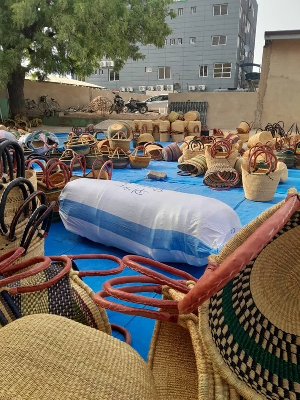
 Some woven baskets on display
The Upper East Region of Ghana, with its vibrant traditions and diverse handicrafts, has long been associated with the production of high-quality woven baskets. Known globally as "Bolga baskets”, these intricately woven products have put the Upper East Region on the world map.
Despite the global acclaim, the people of this region, particularly women continue to face significant challenges in accessing the full economic potential of their craft.
However, local efforts, particularly through partnerships between Paku Enterprise and a US NGO, Weaving Hope Together, are beginning to revitalize the basket industry, presenting a sustainable gateway to employment and poverty reduction.
Speaking to this Writer in an interview, the Chief Executive Officer (CEO) of Paku Enterprise, Paul Akurugu,, explained that the basket weaving has been a source of income for thousands in the region, especially women who use their craft to supplement their income from subsistence farming and petty trading.
“In fact, the region is home to thousands of people who rely on basket weaving for their livelihoods, a testament to the industry’s immense employment potential. The basket industry represents one of the largest job creation sectors in Ghana yet ignored from getting adequate support or even not all from the present and previous governments” , the CEO stressed.
He explained that the basket industry when supported, has the capacity to combat poverty, curb rural-urban migration, and mitigate the adverse effects of climate change.
Through a partnership with African Market Baskets, a US-based basket wholesaler, Paku Enterprise is able to export these baskets to the United States. This collaboration has increased the global footprint of Bolgatanga’s baskets, providing consistent income for local artisans.
The export market for Ghanaian baskets is substantial. In 2024 alone, the Ghana Export Promotion Authority (GEPA) reported that the country exported about $10,000,000 worth of baskets to markets in the United Kingdom, the United States, Australia, and New Zealand.
This demand from international markets has been a crucial pillar in supporting the livelihoods of weavers in the Upper East Region, many of whom are part of organized groups supported by Paku Enterprise and African Market Baskets.
One of the notable successes initiated by the Paku Enterprise is the establishment of over 5, 000 women’s weaver groups across many communities in the Region including Zorbisi, Bolga-Sherigu, Pulmolgo Sherigu,Zaare,Sumbrungu. Bongo , Bongo-Seo, Gambibgo, Dulugu, Yininee, Nyariga, Yorogo, and Vea. These groups benefit from raw material supplies and are able to produce large quantities of baskets for export.
Aside from the above, the efforts of Paku Enterprise and its partners, especially African Market Baskets, have resulted in the creation of new weaving centers and storage facilities in communities that help maintain high production standards.
Adukoma Nyama, leader of the Sokabisi Female Basket Weavers Association, shared how the partnership has allowed women in her community to earn stable incomes.
“Through this commercial basket weaving, we are able to support our children’s education and care for our families,” she explained. Empowered with skills and resources, women in these communities are now making significant contributions to the local economy while transforming their own lives.
Challenges of Basket Weavers
Despite the promising success stories, the industry faces challenges. The increasing global tariffs on Ghanaian products, particularly in the US market, have impacted the demand for the region’s baskets. Women weavers, who rely on international buyers such as African Market Baskets, are struggling to meet basic needs as orders have dwindled.
Moved by the women’s plight, Steven Karowe, founder of African Market Baskets, pledged that his organization, in collaboration with Paku Enterprise, would mobilize resources to temporarily buy baskets to help relieve their burden. He also highlighted that the newly constructed male and female toilet facility, a community-driven project, is part of the mission of his NGO, Weaving Hope Together, aimed at improving public health and hygiene.
To overcome these hurdles, Paku Enterprise has advocated for support from Ghana’s government, particularly in reducing the interest rates on loans and providing export financing.
The CEO of Paku Enterprise, Akurugu, stressed the need for Government to create an enabling environment for artisans to ensure that the basket industry can continue to thrive and provide sustainable employment opportunities.
According to him, the basket industry holds significant promise for the people of Upper East Region especially women
“The basket industry does not only provide a source of income; to the indigenes of the Region, but it is also the gateway to improving the quality of life for thousands. With the right support, both from the government and the private sector, this industry can become a cornerstone of the region’s economy, offering a model for sustainable development in rural areas”.
Akurugu, added that prior to the tariff increase, the company, in partnership with African Market Baskets, spent approximately $2 million annually on basket purchases from the region.
Leveraging the 24-Hour Economy
Both of these stories illustrate how strategic partnerships can unlock the potential of a local industry to create widespread employment. As Ghana looks to expand its 24-hour economy, the basket industry represents a viable sector for government support. By facilitating easier access to international markets, offering financial incentives to businesses such as the Paku Enterprise, and reducing tariffs, government can help make the 24-hour economy a reality for regions such as the Upper East.
The basket industry’s potential extends beyond just economic benefit. It is a community-driven enterprise that aligns with several SDGs, and with the right support, it can act as a gateway to sustainable employment for Ghana’s youth, especially women, and provide a model for rural development.
Through targeted government policy and support, the basket industry could become an economic engine driving sustainable growth in the Upper East Region and beyond.
The 24-hour economy concept is one that seeks to capitalize on continuous production, commerce, and service delivery across various sectors, from agriculture to manufacturing and retail.
The basket industry in the Upper East Region, if supported appropriately, could become a key driver of this economy, especially through the integration of international exports and local demand.
As demonstrated by Paku Enterprise and African Market Baskets, there is a clear demand for Bolgatanga baskets in international markets. However, global tariffs and high shipping costs create barriers to this demand.



Copyright © 1994 - 2026 GhanaWeb. All rights reserved.










