



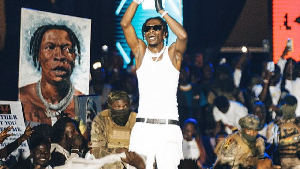
 Shatta Wale is a Ghanaian Dancehall artiste
October 18, 2025, will forever be remembered as the night Accra stood still. Not because of social unrest, a political march, or a national announcement, but because of music, passion, and one man whose name has become synonymous with both controversy and connection.
That man is Shatta Wale, born Charles Nii Armah Mensah, a figure who continues to blur the lines between rebellion and reverence.
On October 17, he turned 41, and the entire nation seemed to pause and celebrate with him.
His birthday dominated social media, with tributes pouring in from celebrities, politicians, churches, and ordinary fans alike.
Among the most unexpected acknowledgements was a message from the Church of Pentecost’s Ministry to Celebrities, a gesture that spoke volumes about his influence beyond entertainment.
The following day, Independence Square transformed into a sea of lights, sound, and devotion. Shatta Fest 2025 was not just a concert. It was a gathering of believers, a mass communion of people who have found in Shatta Wale a reflection of themselves.
The air vibrated with chants of SM4Lyf, and the crowd, numbering in tens of thousands, stretched as far as the eye could see.
From street vendors and taxi drivers to media moguls and ministers, all stood shoulder to shoulder, united by a voice that refuses to be tamed.
Accra had not seen such a spectacle in years.
The People's Champion
In a music industry where many stars are polished, scripted, and managed to the point of sterility, Shatta Wale stands apart. He is unfiltered, unpredictable, and unrepentantly real.
His rawness, which critics often interpret as arrogance, is precisely what makes him magnetic. He is not a perfect man, but he is an honest one, and that honesty has earned him something far greater than industry awards; it has earned him loyalty.
In an age where image often matters more than truth, Wale’s imperfections have become his strength. His fans know that behind every outburst, every rant, and every controversy lies a man who speaks the language of the ordinary Ghanaian.
His music captures their frustrations, their ambitions, and their humour. His life embodies their struggles.
Songs like “Ghana Be Village” speak directly to national realities that many prefer to ignore, while “Too Much Chemical” takes aim at the moral and environmental decay in Ghanaian society. Shatta’s music may not always be polished, but it is alive with meaning. Each track feels like a street sermon wrapped in rhythm and rebellion.
When he cannot express himself through melody, he takes to social media. His posts, often emotional and impulsive, have landed him in more than a few difficult situations.
Yet, they have also made him more relatable. To his fans, these moments of vulnerability and chaos do not diminish him. They humanise him.
“You can’t fake connection,” Shatta Wale said to his fans that night. “The people know who’s real, and that’s why the streets will always be my home.”
That line, simple yet profound, explains why Shatta Wale continues to command such power even in the face of institutional rejection.
From Outcast to Icon
Few artists in Ghana’s entertainment history have endured the level of rejection that Shatta Wale has faced.
In the early 2000s, he emerged as Bandana, the young artist behind the hit “Moko Hoo”. But soon after, he disappeared from the spotlight, dismissed as a one-hit wonder. Many counted him out.
Years later, he returned with a new name, a new energy, and an unbreakable conviction. Bandana had evolved into Shatta Wale, and with him came a new definition of Ghanaian dancehall.
He spoke the language of the ghetto and made it mainstream. He reclaimed visibility not through corporate deals or foreign co-signs, but through consistency and connection.
His re-emergence was not simply a musical comeback but a cultural resurrection. He built the Shatta Movement, a loyal army of fans who saw in him not a superstar, but a mirror.
For the youth navigating unemployment, frustration, and limited opportunity, Shatta represented resistance and hope. His slogan, SM4Lyf, became more than a fandom name. It became a philosophy of resilience.
Industry critics and corporate elites tried to silence him, but the streets amplified him louder. For every door that closed, ten new paths opened through the power of the people. Shatta Wale’s career became a masterclass in self-reinvention and self-reliance.
“They said I was finished,” he once remarked. “But how can you finish someone the streets have crowned?”
That statement is no exaggeration. His influence now extends far beyond Ghana. Across Africa, his name resonates as a symbol of independence in an industry dominated by commercial conformity.
Shatta Fest 2025, A Celebration of Survival
Independence Square on that October night was more than a concert venue. It was a shrine. The stage shimmered under layers of light and sound as pyrotechnics exploded into the sky.
Every moment felt like both a performance and a prophecy. When Shatta Wale appeared, the crowd erupted in unison. Thousands of phones lit up, capturing a man whose very presence seemed to electrify the air.
The setlist moved effortlessly between old anthems and new favourites. When he performed “Ayoo” and “Taking Over”, the chants were deafening. When he slowed down with “Bulletproof”, couples swayed in the crowd, some in tears, others simply overwhelmed by the emotion of the night.
There were guest appearances from emerging talents and industry peers, proving that despite his combative image, Shatta Wale remains a mentor at heart. He knows that legacy is not built in isolation. It is built by lifting others while staying grounded.
The performance lasted for hours, yet no one seemed eager to leave. When he finally closed with “On God”, fireworks illuminated the Accra sky in a dazzling burst of color. The symbolism was unmistakable.
For a man once treated as an outcast, standing tall before a city that once doubted him, this was not just a concert. It was redemption in full volume.
Why Shatta Still Matters
In Ghana’s contemporary entertainment landscape, Shatta Wale’s significance cannot be reduced to music charts or awards.
He represents something deeper, something cultural. He embodies the duality of the Ghanaian spirit, defiant yet spiritual, loud yet loyal, flawed yet faithful.
He reminds the youth that success is not about perfection but persistence. He represents the power of authenticity in a world obsessed with filters and facades.
His journey also challenges the establishment to rethink what it means to be a “respectable” artist. Through his triumphs and mistakes, Shatta Wale has made the case that true artistry must reflect real life in all its chaos and complexity.
While his critics accuse him of being brash and unrefined, his supporters see him as the last honest man in showbiz.
They see someone who speaks his mind, fights his battles in public, and refuses to bow to the expectations of an industry that often rewards compliance over creativity.
For that reason, Shatta Wale’s influence goes beyond the stage. He has become a cultural force, a reminder that the Ghanaian dream can be loud, colourful, and unapologetically imperfect.
Legacy Beyond Music
As the final echoes of Shatta Fest 2025 faded into the Accra night, one truth stood clear. Shatta Wale is not merely a musician. He is a movement, a mirror reflecting Ghana’s evolving identity. He is the son of the soil who turned defiance into devotion, who transformed rejection into revival.
In his imperfections, the people see their own. In his victories, they find hope. His story continues to unfold, unpredictable and fearless, just like the streets that made him.
For those who could not witness the magic of that night, highlights and exclusive footage are available on Shatta Wale’s official YouTube channel and social media platforms, where his energy lives on through every frame.
Because when Shatta Wale speaks, the streets do not just listen; they roar.

Copyright © 1994 - 2026 GhanaWeb. All rights reserved.










