



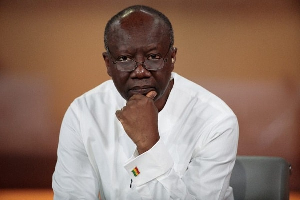
 Ken Ofori-Atta is Ghana's former Minister of Finance
You may recall that in February 2025, Office of the Special Prosecutor (OSP) in a press conference announced that an investigation is being conducted into Ghana’s former Minister for Finance, Ken Ofori-Atta in relations to contractual arrangements between Strategic Mobilisation Ghana Limited and the Ghana Revenue Authority for revenue assurance in the petroleum and mineral sectors, the termination of a contract between the Electricity Company of Ghana and Beijing Xiao Cheng Technology (BXC), procurement processes and financial transactions related to the National Cathedral, a Ministry of Health contract with Service Ghana Auto Group Limited for the acquisition and maintenance of 307 ambulances and the management and disbursement of funds from the Tax Refund Account of the Ghana Revenue Authority.
At the time of the announcement, the Special Prosecutor, Kissi Agyebeng indicated that the legal team of Ken Ofori-Atta had informed his office that the former minister was outside of the jurisdiction indefinitely for medical reasons. The indefinite indication of the former minister’s return to the country, led to his declaration as a fugitive from justice.
Along the line, it was reported that the former minister had indicated his intention to voluntarily return, therefore his name should be taken off the OSPs wanted list.
As the drama continued, and upon his failure to report to the OSP as indicated, the OSP in June redeclared Ofori Atta’s fugitive status and requested INTERPOL to issue a Red Notice, which was formally published under the charge of “Using Public Office for Profit.” The OSP further submitted an extradition request through the Attorney-General seeking his provisional arrest and return to Ghana to face prosecution.
Three months ago, Professor Angela Ofori-Atta, wife of former Finance Minister, told Joy News that her husband had undergone surgery abroad and was expected to make a full recovery.
It is October 2025; the former minister has still not returned to Ghana. Instead of honoring his promise to report to the OSP, he has been busy weaponizing the courts, filing case after case to frustrate the process.
The first was an application at the Accra High Court seeking to strike out a warrant issued for his arrest. His lawyers claimed the OSP obtained it unlawfully and demanded that even the Interpol Red Notice be set aside.
The court dismissed the application. But true to form, Ken Ofori-Atta’s legal team did not stop there. They went on to flood the courts with multiple actions, all aimed at one thing: buying time and avoiding accountability.
To date, he has filed no less than four civil cases against the OSP. The message is loud and clear: I will not return to Ghana, and I will use every legal loophole to make sure of it.
This is not legal defence; it is abuse of court processes to serve his interest with frivolous claims, repeated suits, and tactics designed to harass or stall justice. Ken Ofori-Atta’s conduct fits this description perfectly.
And why not? For decades, Ghanaian public officials have treated accountability as optional. They steal time, evade scrutiny, and hide behind ill health or legal gymnastics when called to answer. Ofori-Atta is simply following a well-worn script, one written in the ink of impunity.
But I am hopeful that this time, Ghanaians are watching, and the OSP has not relented in its efforts. The real test is whether the state will finally draw a line in the sand and prove that no one, however powerful, can escape the arms length of accountability.
The recent circulation of a photograph showing Ken Ofori-Atta and his wife, Professor Angela Ofori-Atta, strolling leisurely on the streets of Washington DC, has reawakened debates in Ghana’s accountability, justice, and the culture of impunity among political elites.
It clearly vindicates the Special Prosecutor’s long-held conviction that Ken Ofori-Atta was not sincere about his ill health excuses.
For many Ghanaians, the picture making rounds on social media is more than just an ordinary snapshot; it is a symbol of how the powerful, once shielded by the corridors of government, often slip away to the comfort of foreign cities while ordinary citizens continue to reel under the weight of their decisions.
It is precisely why the return of Ofori-Atta to face investigation, and possible prosecution has become a defining litmus test for the reset agenda. The question on the lips of many Ghanaians remains; what is the way forward?
Ghana’s democratic journey has been littered with instances where powerful figures accused of financial mismanagement or corruption managed to escape justice, either through political cover, delayed processes, or quiet resettlement abroad.
This cycle breeds a culture of impunity, signaling to the public that justice is a tool for the powerless, not the privileged.
Ofori-Atta, who presided over some of the most turbulent economic periods in Ghana’s recent history, is seen by many as emblematic of this challenge.
Allegations of mismanagement, questionable borrowing practices, and opaque financial dealings tied to his tenure have left scars on the national conscience.
For citizens who bore the brunt of austerity, high inflation, and collapsed businesses, watching him stroll in Washington sends the painful message that justice can be delayed.
This is where the role of the United States becomes crucial. Ghana’s renewed anti-corruption agenda and the OSP’s relentless approach to the fight cannot succeed if those implicated in wrongdoing are allowed to find refuge abroad.
Just as Ghana has cooperated with international partners in cases involving money laundering, terrorism, and transnational crime, so too must the US be a willing partner in ensuring that figures like Ken Ofori-Atta are returned to face the law.
The principle is simple; justice must be blind to geography and status. America, which positions itself as a global beacon of democracy and accountability, cannot be a safe haven for individuals wanted for financial accountability in their home countries.
Supporting Ghana’s request for Ofori-Atta’s return would send a strong signal across Africa that impunity will no longer be rewarded with foreign comfort.
If the government succeeds in bringing him home to face investigation, it will mark a bold break from the past and set a precedent that no Ghanaian, however powerful, is above the law.
Failure, however, would only reinforce cynicism and deepen the distrust that has long plagued the nation’s governance structures. For a country desperate to restore confidence in its democracy, this case could either become a watershed victory or another chapter in the painful story of impunity.
The way forward is clear. Ghana must pursue Ken Ofori-Atta’s return with the same seriousness it has applied in demanding accountability from ordinary citizens.
America must cooperate, not obstruct. And Ghanaians themselves must remain vigilant, insisting that this process is not derailed by political expediency.
Because at the end of the day, this is bigger than one man or one family. It is about whether Ghana can finally break the chains of impunity and affirm, once and for all, that in the land of freedom and justice, no one is untouchable.
KNUST SHS student in viral fondling video with assistant headmaster breaks silence

Copyright © 1994 - 2026 GhanaWeb. All rights reserved.










