



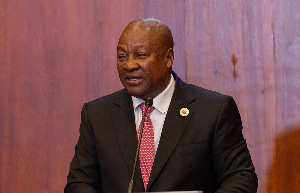
 President of Ghana, John Dramani Mahama
The latest revelation by the Director of Research and Communication at the Office of the Special Prosecutor (OSP) on NewsFile has shaken the foundations of Ghana’s democratic discourse.
According to his disclosure, the government of John Dramani Mahama has allegedly created a WhatsApp group that includes heads of state institutions, a representative from the Supreme Court, civil society actors, media influencers, senior lawyers, and other high-level personalities.
The task assigned to this unusual assembly is obvious: champion government business.
Eagle Eye International will plainly describe the WhatsApp group task to coordinate and champion the government's political agenda.
These so-called neutrals are now coded government-employed Presidential Staffers.
But what the whistleblower failed to add is how much President Mahama pays them as stipends at the end of every month.
For many observers, this is not just disturbing; it is the textbook definition of state capture.
The Executive, Legislature, Judiciary, Fourth Estate (Media), and now the NEUTRALS. Sadly, Ghana is now in the armpit of H E John Dramani Mahama.
The very idea that individuals entrusted with independent mandates, heads of state institutions, judicial affiliates, CSO leaders, media gatekeepers, and legal elites would be placed in a coordinated, government-run operational group is a direct assault on the pillars of democratic governance.
It suggests a deliberate attempt by the Mahama administration to consolidate power not through constitutional structures but through covert influence networks.
In any constitutional democracy, state institutions must operate with clear autonomy, insulated from partisan manipulation.
When the executive arm seeks to form a hidden coalition that spans the judiciary, oversight agencies, civil society, and the media, it signals a strategic effort to control the flow of information, suppress dissent, and manage public perception from within.
Eagle Eye International, known for its advocacy around transparency, civic freedoms, and anti-corruption, has every reason to join well-meaning citizens to kick against this revelation that confirms our long-standing concerns about a creeping architecture of state capture being engineered by the Mahama government.
This is not ordinary political coordination. This is not policy consultation. This is quite a political colonisation of the state and its watchdogs.
It is important for the Ghanaian citizens to know that State capture thrives on: compromising independent institutions, stifling checks and balances, manipulating justice outcomes, neutralising whistleblowers and dissenters, and rewriting national narratives through captured media voices.
And here, in one revelation, all these elements appear disturbingly present.
The implications are severe:
1. Accountability becomes impossible when the same institutions meant to investigate corruption are co-opted into supporting the ruling party’s agenda.
2. Oversight collapses when media and CSOs are absorbed into partisan communication machinery.
3. Justice becomes compromised if any member of the judiciary or its representatives participates in partisan coordination behind closed doors.
4. Citizens’ voices become irrelevant because the narrative that reaches the public is already sanitised, curated, and controlled.
5. Ghana’s democratic credentials take a historic hit, falling below the standards expected of a constitutional republic.
Should we allow this shocking revelation to go unchallenged?
This form of covert coordination sets a terrifying precedent.
A government can unofficially reorganize the state into a partisan coalition while publicly pretending to uphold institutional independence. This is not governance; it is soft authoritarianism. No democracy survives when the institutions that must check the executive are instead enlisted to echo its agenda.
This revelation does not exist in a vacuum. It fits a growing pattern: appointment termination, contract cancellations, targeted appointments removals, partisan institutional shake-ups, politicised prosecutions, and now a covert influence network at the highest levels.
Ghanaians must remain vigilant. Democracy survives on transparency, and the Republic cannot be allowed to slip quietly into the grip of a coordinated partisan machine.
Ghanaians are dead while alive. God have mercy



Copyright © 1994 - 2026 GhanaWeb. All rights reserved.










