



 There are moments when language illuminates reality
There are moments when language illuminates reality, and moments when it is used to escape it. The Minority's claim that Ghana harbours cocaine laboratories belongs, regrettably, to the second kind.
It arrived without the caution of a security briefing or the specificity of an investigative report. It arrived as a thunderclap: narcotics were no longer merely passing through Ghana but were allegedly being processed here. That is not a small allegation. It raises the spectre of organised crime, porous borders and official complicity. An accusation of that weight demands evidence.
Then came the obvious questions. Where are these laboratories? Who is being investigated? Which agency holds the file? And the claim, reportedly, changed genre: it was a metaphor. Reports said Minority Leader Alexander Afenyo-Markin described the language as metaphorical rather than a claim requiring evidence.
The trouble was never that the Minority reached for a figure of speech. The trouble was that it reached for one with handcuffs, fingerprints, a street address and an implied crime scene, then discovered, under questioning, that it had been writing poetry all along.
A moment, please, for the benefit of language, which has suffered enough in our politics. A simile says Ghana is like a cocaine laboratory. A metaphor says Ghana is one. A malapropism is the accidental substitution of a wrong word for a similar-sounding right one. What we witnessed was grander than all three: the substitution of evidence with a figure of speech.
For one unfortunate moment, Afenyo-Markin became Afenyo-Malaprop-Markin: a man who charged the nation in the language of criminal fact and, when asked to produce the docket, retreated into the vocabulary of verse.
We were handed, in short, a laboratory without a laboratory; narcotics without narcotics; handcuffs without suspects; and, most impressively, a defence without evidence. The only substance manufactured here was alarm, packaged for the evening news and dissolved into metaphor at the first sight of a document. This is not oversight. It is semantic escape artistry.
Perhaps we should await the next instalment. Ghana may not be a cocaine hub after all; perhaps it is a sonnet. Customs officers may be literary critics. Every request for proof may be dismissed as a hostile reading of the text.
It would be funny if it were cheap. It is not.
A country's reputation is not a campaign leaflet. It is national capital, accumulated over decades through credible institutions, reliable laws, secure commerce and the confidence of those who choose to trade, invest, study and cooperate with us. A careless allegation does not remain in the parliamentary chamber or the television studio. It travels. And it returns through foreign eyes: as a risk flag at a bank, a delay at a port, a question at an embassy, or an added burden on every Ghanaian who carries our passport abroad.
To smear one's own country for fleeting political currency is to cut off one's nose to spite one's face, except that one must now be careful: somebody may later explain that the nose was only a metaphor.
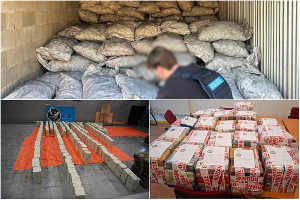
None of this is an argument for complacency. Narcotics seizures and trafficking risks linked to Ghana are real public concerns, and the response must be serious. The Minority has not merely a right but a democratic duty to interrogate border controls, demand port audits and press for lawful, independent investigations. It reportedly sought a parliamentary inquiry into recent narcotics seizures, which the Speaker declined in light of related pending criminal proceedings. The more serious constitutional question is how Parliament can provide meaningful oversight without prejudicing active cases, not how to fill an evidentiary vacuum with rumour.
Nor should the government take comfort. It owes Ghanaians verifiable seizure data, transparent prosecutions, credible preventive measures and straight answers, without treating every critic as a saboteur. Secrecy is fertile soil for suspicion, and a government that hides the file invites the poets.
So the Minority must choose what kind of opposition it will be. It can be a vigilant constitutional watchdog, armed with documents and willing to compel action through facts. Or it can be a factory of political smoke, mistaking the thrill of an allegation for the durable work of accountability. The first earns public trust. The second spends it recklessly.
This is not a plea for a timid opposition. Ghana needs a fearless one. But courage does not lie in saying the most damaging thing one can say about one's own country. It lies in saying what one can prove, pursuing what one suspects through lawful institutions, and correcting oneself plainly when one has overstated the case.
A republic facing real security risks needs investigation, not insinuation; evidence, not performance; and a politics of substance, not narcotic metaphors.

Copyright © 1994 - 2026 GhanaWeb. All rights reserved.










